

Ethereum is the largest staked asset in crypto. More than 36 million ETH or roughly 30% of the total circulating supply is currently staked, secured by nearly 1 million active validators. As the ETH staking ecosystem has matured, so has the sophistication of the institutions participating. What was once a niche activity for crypto-native operators is now a core component of how institutional capital engages with the Ethereum ecosystem. This spans from neobanks and trading platforms to asset managers and treasury teams.
At Fireblocks, we’ve seen this firsthand in our own customer base. ETH staking volume on our platform has more than doubled in the last six months. The institutions driving that growth are building staking into their core product offering and treasury strategies. They’re asking for more: more provider choice, more flexible validator structures, and better tooling to manage what they’ve deployed.
This post covers the most significant updates to Fireblocks’ ETH staking capabilities, including new providers, a new provider connectivity standard, post-Pectra validator types, liquid staking, and consolidation tooling.
What’s New at Fireblocks: More ETH Providers, Standardized via ETH Staking Link
Fireblocks has offered native staking since 2023, and currently offers support for ETH, SOL, POL, the Cosmos ecosystem, Lido liquid staking, and more, all accessible via the Fireblocks console or the native staking API, with policy enforcement applied to every staking action.
The most significant recent update is to our ETH staking capabilities, with a new standardized interface, ETH Staking Link, that significantly expands staking optionality for institutions and their users.
This update stems from the fact that ETH staking is architecturally different from other chains. On Solana, one validator serves many staking addresses. On Ethereum, ETH validators are limited in how much staking balance they can serve. That means every new stake requires dynamic validator provisioning, which in practice means a tight, real-time integration between Fireblocks and a staking provider. Until now, that complexity limited ETH staking on Fireblocks to two providers: Figment and Kiln.
ETH Staking Link streamlines provider integrations
ETH Staking Link is a new Fireblocks standard interface that defines exactly how a staking provider integrates their validator infrastructure with the Fireblocks platform. It’s minimal by design, with providers implementing only the endpoints necessary to create validators, report health, and receive lifecycle events. Fireblocks handles orchestration, transaction serialization, broadcasting, lifecycle tracking, and state management. The result is a well-defined integration standard that any vetted provider can implement, dramatically reducing the time and complexity of bringing a new ETH staking provider live.
The result: five providers, with more coming
ETH staking on Fireblocks now supports:
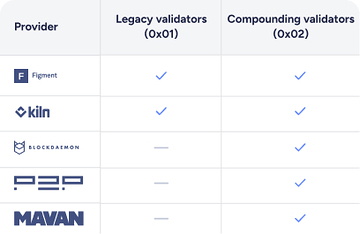
Blockdaemon, P2P.org, and MAVAN are now available via ETH Link. Legacy validators remain available with Figment and Kiln. If you have existing legacy positions, those continue to work exactly as before. More provider integrations are in active development.
Meet the New Providers
Blockdaemon
Blockdaemon is a global institutional blockchain infrastructure provider securing over $110 billion in digital assets for more than 400 institutions. Known for consistently optimized Ethereum validator performance, Blockdaemon has a strong track record globally with large-scale institutional clients and partners including Bitso, Hashdex, Citi, Revolut, and Bithumb. Their staking infrastructure supports over 50 protocols, and they have a long-standing presence in the Fireblocks ecosystem.
P2P.org
P2P.org is a non-custodial validator infrastructure provider with over $10B in delegated assets across 40+ proof-of-stake networks. Operating since 2018, P2P.org is SOC 2 Type II attested and serves 190+ institutional clients including regulated banks, exchanges, asset managers, and protocols.
MAVAN
MAVAN (Made in America Validator Network) is the largest single staking operation in the world, providing institutional-grade non-custodial staking and node services. Delivering secure, multi-zonal, 24/7, high-performance blockchain infrastructure at scale. MAVAN holds ISO 27001:2022, SOC 2 Type I, SOC 2 Type II, and NORS certifications. MAVAN operates validators for the most utilized Proof-of-Stake (PoS) and delegated Proof-of-Stake (dPoS) networks, supporting native ETH and SOL staking within the Fireblocks Staking console. MAVAN is a Bitmine Immersion Technologies, Inc company.
Understanding the Two Validator Types: Legacy and Compounding
The Ethereum Pectra upgrade, a major protocol upgrade that activated on mainnet in May 2025, introduced a new validator type that changes the economics and operational profile of ETH staking. It’s worth understanding the difference, because it affects which providers you can use and how your stake behaves over time.
Legacy validators (0x01)
Legacy validators (0x01) are the original Ethereum validator type. They hold exactly 32 ETH, and consensus layer rewards are automatically distributed to your withdrawal address rather than remaining on the validator. If you want to add more ETH to a staking position, you need to create a new validator. Legacy validators remain fully supported on Fireblocks through Figment and Kiln.
Compounding validators (0x02)
Compounding validators (0x02) are the new post-Pectra type. They offer several improvements:
- Auto-compounding rewards. Rather than being swept to your vault, consensus layer rewards remain on the validator and compound automatically, increasing your staking balance and, over time, your returns.
- Up to 2,048 ETH per validator. Legacy validators cap at 32 ETH. Compounding validators support up to 2,048 ETH, which dramatically simplifies validator management for institutions with large ETH positions.
- Top-ups. You can add ETH to an existing compounding validator position without creating a new one.
- Partial withdrawals. You can withdraw a portion of your staked balance rather than exiting the entire validator.
All three new providers, Blockdaemon, P2P.org, and MAVAN, support compounding validators only. Figment and Kiln support both types, giving customers with existing legacy positions continuity while they evaluate migration.
Liquid Staking Is Also Part of the Picture
Not every institution wants to manage validator positions directly. For those who prefer liquidity alongside yield, Fireblocks also supports Lido liquid staking for ETH natively, accessible via the same Fireblocks console and staking API.
With Lido, users deposit ETH and receive stETH in return: a liquid token that accrues staking rewards while remaining transferable and usable in other contexts. This is a different product from native staking, with no validator to manage, no activation queue, and no exit period, making it well-suited for treasury teams that need flexibility or platforms that want to offer staking yield without locking up user assets.
The Clear Path to Institutional ETH Staking
Ethereum is the largest staked asset in crypto, and the infrastructure around it is maturing quickly. Post-Pectra compounding validators, liquid staking, a growing validator marketplace, and consolidation tooling make staking ETH through Fireblocks better than ever, providing institutions with an infrastructure that is simpler to operate, more flexible to manage, and more open to provider choice. All without sacrificing the policy controls and security architecture that institutional participation requires.
If you’re a platform looking to offer ETH staking to your users, or an institution evaluating your staking strategy for your treasury, our team is available to walk through what this looks like for your specific setup. In the meantime, check out our Liquid Staking 101 report for a deeper dive.