Home / Glossary / Embedded Wallets
Embedded Wallets: Definition, How They Work & Key Use Cases
What Are Embedded Wallets?
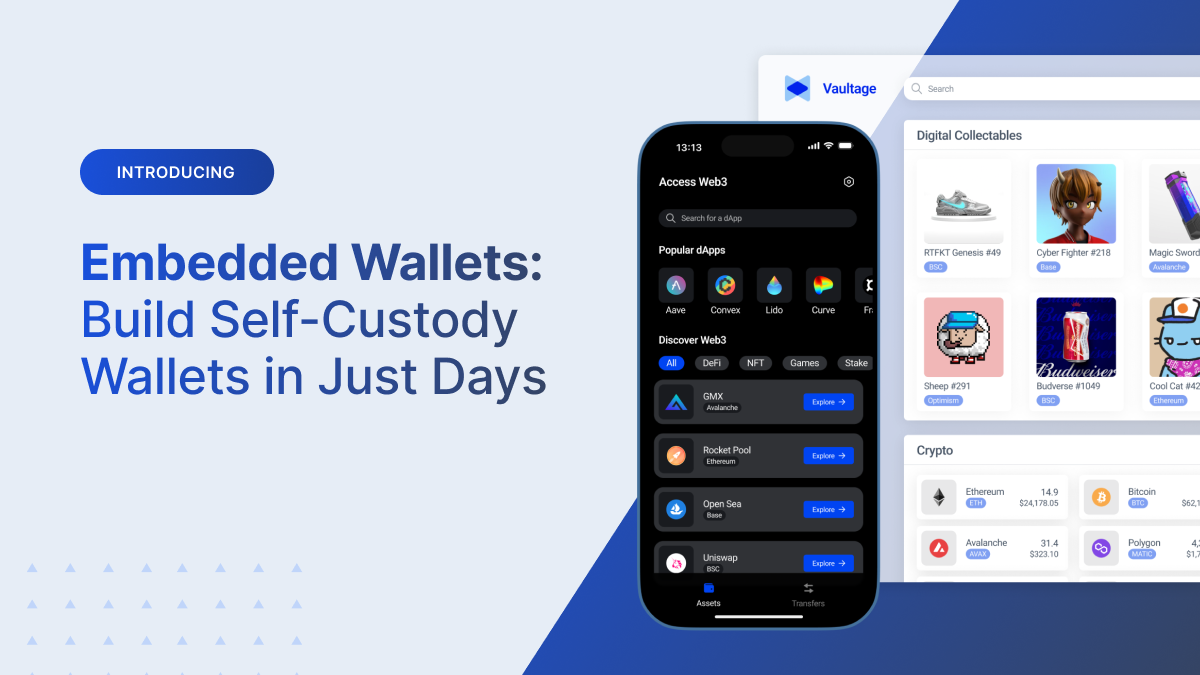
An embedded wallet is a blockchain wallet built directly into a web or mobile application, making crypto and digital asset functionality invisible to the end user. Rather than redirecting users to an external wallet app or asking them to store a seed phrase, an embedded wallet surfaces transaction signing, asset management, and onchain interactions natively inside the host application experience.
From the user’s perspective, there is no separate wallet to install or configure. They simply log in with an email address, a social account, or a passkey. Then the wallet is created automatically in the background. This frictionless onboarding is one of the primary reasons embedded wallets have become the infrastructure of choice for fintechs, neobanks, gaming platforms, and Web3 consumer apps building at scale.
Embedded wallets are sometimes called user-controlled wallets or end-user wallets. They are distinct from business-controlled wallets used for treasury management or from the infrastructure businesses use to manage customer funds at scale (Wallets-as-a-Service). With an embedded wallet, the end user of the application holds their own assets. In turn, neither Fireblocks nor the issuing business holds those assets on the user’s behalf.
How Assets Are Held with Embedded Wallets
While some wallet infrastructure enables custodial models (where the business controls their user or customer’s assets), embedded wallets are typically non-custodial. Non-custodial means the end user retains control of their keys. This is typically via multi-party computation (MPC), which distributes key material across the user’s device and a secure server. No single party ever holds a complete private key. This model is generally considered non-custodial from a regulatory standpoint and eliminates single points of failure.
For most enterprises building embedded wallet infrastructure today, the non-custodial MPC model:
- Reduces the regulatory burden associated with holding customer assets
- Improves security posture
- Better aligns with the trust expectations of end users in crypto-native and fintech contexts
How MPC Powers Embedded Wallet Security
Multi-party computation (MPC) is the cryptographic foundation of modern non-custodial embedded wallets. MPC distributes private key management across two or more parties. It is typically the user’s device and a secure server. This way no single party ever has access to the complete key material.
In practice, this means that even if an attacker compromises the server, they only obtain a key share that is cryptographically useless without the corresponding share on the user’s device. Conversely, if a user’s device is lost or stolen, the server-side share alone cannot authorize transactions. The result is a multi-party computation embedded wallet architecture that eliminates the single points of failure that make seed phrases and traditional custodial models risky.
The MPC security advantages over custodial wallets are significant for enterprise deployments:
- No seed phrase exposure for end users, reducing phishing risk
- Threshold signature schemes that require multiple parties to sign transactions
- Key rotation capabilities that allow share refresh without changing the on-chain address
- Granular policy controls that restrict transaction types, amounts, and destinations
To learn more about Fireblocks’ MPC implementation of embedded wallets, see Dynamic’s MPC-TSS information.
Embedded Wallet Use Cases Across Industries
Embedded wallets unlock onchain capabilities for businesses that need to deliver those features without burdening their users with the complexity of blockchain infrastructure.
Common business applications include:
- Cryptocurrency payment processing: Enabling users to send and receive crypto within a payments or commerce app without external wallet dependencies.
- In-app trading and stablecoin transactions: Allowing retail investors or neobank users to hold, swap, and transfer digital assets natively in an existing financial app.
- NFT minting and marketplaces: Giving users a wallet automatically at signup so they can mint, receive, and transfer NFTs without any Web3 onboarding steps.
- DeFi access: Embedding DeFi protocol interactions such as liquidity provision, staking, yield strategies within enterprise or consumer applications.
- Loyalty and rewards programs: Issuing tokenized rewards or loyalty points into user wallets as part of engagement programs.
- Enterprise blockchain applications: Powering identity, permissioned networks, supply chain verification, and other enterprise use cases where users need a wallet but not blockchain expertise.
- Virtual and physical card issuance: Provisioning debit cards linked to wallet balances so users can spend digital assets at traditional point-of-sale and online merchants.
For a detailed breakdown of embedded wallet infrastructure options across these use cases, see Fireblocks’ Embedded Wallet Infrastructure Comparison.
Why Embedded Wallets Matter for Business
Beyond the technical architecture, embedded wallets deliver measurable business value. For product and engineering teams building embedded wallets for enterprise blockchain applications or consumer fintech, the case rests on four pillars:
- Faster time to market: SDK-based integration means teams can ship on-chain features in weeks rather than months, without building key management infrastructure from scratch.
- Reduced regulatory burden: Non-custodial models generally avoid triggering the licensing and compliance obligations that come with holding customer funds, giving legal and compliance teams a cleaner path to launch.
- Improved user retention: Frictionless UX removes the dropoff that occurs when users are redirected to external wallets, directly improving activation and retention metrics.
- New revenue streams: Applications that embed wallets can unlock transaction fee revenue, staking yield sharing, and new product categories tied to on-chain activity.
Embedded Wallets vs. Traditional Crypto Wallets
Traditional crypto wallets are standalone products designed for crypto-native users who actively manage their own keys and interact directly with blockchains. Some examples include browser extensions like MetaMask, hardware wallets like Ledger, or mobile apps like Trust Wallet.
Embedded wallets serve a different audience and a different use case. The comparison across key dimensions:
- UX and onboarding friction: Traditional wallets require users to create accounts, store seed phrases, and switch contexts to transact. Embedded wallets are created automatically at app signup with no additional steps.
- Custody model: Hardware and self-custody wallets put full key responsibility on the user. Embedded MPC wallets distribute key management in a way that is non-custodial but recoverable.
- Developer control: Embedded wallets give developers full control over transaction policies, supported chains, and wallet UX. Traditional wallets are products the user installs independently.
- Target audience: Traditional wallets suit crypto-native power users. Embedded wallets are designed for mainstream consumer and enterprise users who want blockchain functionality without blockchain complexity.
The right fit depends on your user base. If you are building for crypto-native users who expect full control and cross-app portability, traditional wallets remain relevant. If you are building for mainstream users or want to embed on-chain features into an existing product, embedded wallets are the correct architecture.
Embedded Wallets vs. Wallet-as-a-Service: What’s the Difference?
Fireblocks offers two distinct wallet infrastructure products that are often discussed together but serve fundamentally different purposes.
Wallets-as-a-Service (WaaS) is infrastructure for organizations that manage wallets and assets on behalf of their customers. This could include exchanges, payment processors, OTC desks, and neobanks that need to operate high-volume, business-controlled wallet infrastructure at scale. The business controls the keys and assets; Fireblocks provides the infrastructure.
Embedded wallets are typically used to provide products to end users. They are non-custodial wallets where end users hold their own assets inside a business’s application. Neither Fireblocks nor the issuing business holds assets on behalf of users.
The organizing question is: who controls the assets? For WaaS, the business does. For embedded wallets, the end user does.
Best Practices for Integrating an Embedded Wallet SDK
When evaluating best practices for embedding a wallet SDK in an app, engineering teams should address these considerations before and during integration:
- Key backup and recovery flows: Define how users recover wallet access if they lose their device. MPC-based recovery mechanisms, social recovery, or encrypted backup to cloud storage should be implemented before launch.
- Authentication methods: Support SSO, biometric login, passkeys, and social login to minimize onboarding friction. Authentication should be decoupled from key generation so users can add or change auth methods without affecting wallet access.
- Multi-device support: Users expect to access their wallet from multiple devices. Ensure your SDK and provider support multi-device key share distribution.
- Performance optimization: MPC transaction signing involves network round-trips. Profile your signing latency and ensure it meets UX requirements.
- Policy engine integration: Leverage transaction policy controls to enforce spending limits, allowlist destinations, and flag suspicious activity before transactions are signed.
For further information on the topic, review developer documentation from Fireblocks on Non-Custodial Wallets implementation and Dynamic on MPC configuration.
What to Look for in an Embedded Wallet Provider
For enterprise and fintech buyers evaluating the pros and cons of embedded wallet providers versus other wallet alternatives, the following criteria should structure your evaluation:
- Security architecture: Understand whether the provider uses MPC, HSM, or traditional key management. Ask how key shares are distributed, stored, and rotated, and whether the provider has undergone third-party security audits.
- SDK quality and developer experience: Evaluate SDK documentation, supported frameworks (web, iOS, Android), integration complexity, and the quality of developer support.
- Compliance support: Assess whether the provider offers KYC/AML tooling, transaction monitoring integrations, and regulatory reporting capabilities relevant to your jurisdiction.
- Scalability: Embedded wallet infrastructure built for fintechs and gaming apps often needs to support millions of wallets. Confirm throughput benchmarks and SLAs.
- Ecosystem connectivity: Evaluate support for wallet connectors, DeFi protocol integrations, and the breadth of supported blockchains and token standards.
Fireblocks published an embedded wallet infrastructure comparison guide that maps these criteria across provider options.
How Fireblocks Delivers Embedded Wallet Infrastructure
Fireblocks’ embedded wallet offering is built for businesses that need to deliver non-custodial wallet experiences at scale without building MPC cryptography or key management infrastructure from scratch.
The platform is built on battle-tested TSS-MPCtechnology, the same security foundation that secures trillions of dollars in institutional digital asset transactions. For embedded wallets, this means end users get non-custodial, MPC-secured wallets with no seed phrases, with key shares distributed between the user’s device and Fireblocks’ secure infrastructure.
Following Fireblocks’ acquisition of Dynamic, the platform now offers seamless UX layer capabilities including social login, passkey authentication, email-based onboarding, and multi-chain wallet creation. This combines enterprise-grade key security with the consumer-grade UX that drives activation and retention.
Key capabilities of the Fireblocks embedded wallet product include:
- MPC-based non-custodial architecture with no single point of failure
- SDK availability across web, iOS, and Android
- Low level APIs give you full control over how wallets are built
- Social login, SSO, and passkey authentication out of the box
- Multi-device wallet access and key recovery flows
- Transaction policy engine for spending controls and compliance
- Wallet Connectors for DApp and DeFi protocol integration
Fireblocks supports fintechs, neobanks, Web3 apps, and gaming platforms building at scale, from early-stage integration to millions of active wallets.
Explore the Embedded Wallets product page to learn more.