




In traditional payments, credit is invisible infrastructure (it’s magic! It’s actually not, someone is paying for that). When a large PSP initiates a payout run, they’re not necessarily moving their own cash in real time. There’s a web of credit facilities, settlement floats, and short-term financing arrangements running in the background that keeps the whole thing liquid (which, by the way, are the secret sauce to some of the largest PSPs). Nobody thinks about it until something breaks. In that sense, the credit layer in payments is a lot like electrical wiring: invisible by design, and only noticed when the lights go out (Remember 2022 in Crypto?).
On stablecoins, that wiring doesn’t exist yet, as the industry itself is just evolving. But, with the scale of payments due to incumbents and mainstream players constantly coming in, the gap is becoming a concrete operational problem. I’ve been hearing about it, first sporadically, then, consistently since late last year. First, as a sidebar in customer conversations, then increasingly as the main topic (I see a Money20/20 panel in my future). The question I keep getting asked is simpler and more urgent than the infrastructure debates: how do we move this volume without tying up capital we can’t afford / don’t want to lock up?
The Problem with Prefunding at Scale
Take a PSP looking to offer stablecoin payouts at scale, we’ll call them ‘LargePay’ (they are big on tipping). The dominant entry model is still crypto-remote; Use a third-party liquidity provider to handle the onchain piece, keep digital assets off the balance sheet, and avoid the need for a custody license on day one. Reasonable approach, and it works (as a starter).
The catch is that to actually send a payout through a liquidity provider, LargePay needs funds sitting there before the payout goes out (but wait, you said stablecoins are instant?! Yes, but, again, the funding of those is not). That means either prefunding a balance and maintaining it, or initiating a wire transfer and waiting for it to settle before triggering the payout. At low volumes, prefunding is an inconvenience you can absorb. The companies I’m talking to are moving over ten million dollars a day, minimum.
At that scale, maintaining a prefunded balance with a third-party liquidity provider isn’t a line item. It’s a capital allocation decision that directly undercuts the business case for using stablecoins in the first place. The whole premise of a stablecoin-based payout flow is that it frees up working capital relative to traditional settlement. If you have to lock tens of millions into a prefunded balance just to keep the flow running, you’ve recreated the capital drag you were trying to escape, just in a different form.
The wire alternative doesn’t fix this either. Wire transfers to a liquidity provider take hours to settle, sometimes a day or two depending on the corridor and the banking relationship. That gap is where real transaction volume is getting blocked.
What the Market is Currently Doing to Solve it
I will start by saying that this would obviously all be solved once banks are onchain. But, for now, that’s not the case, so let’s see other solutions already in play. Most companies have landed on short-term credit against the wire. If a bank has accepted a payment instruction and there’s a wire in flight with a confirmed timestamp from a regulated institution, that instruction functions as solid collateral. A lender extends a 24-48 hour credit line against it, the payout goes out immediately on the stablecoin side, and the credit is repaid when the wire clears.
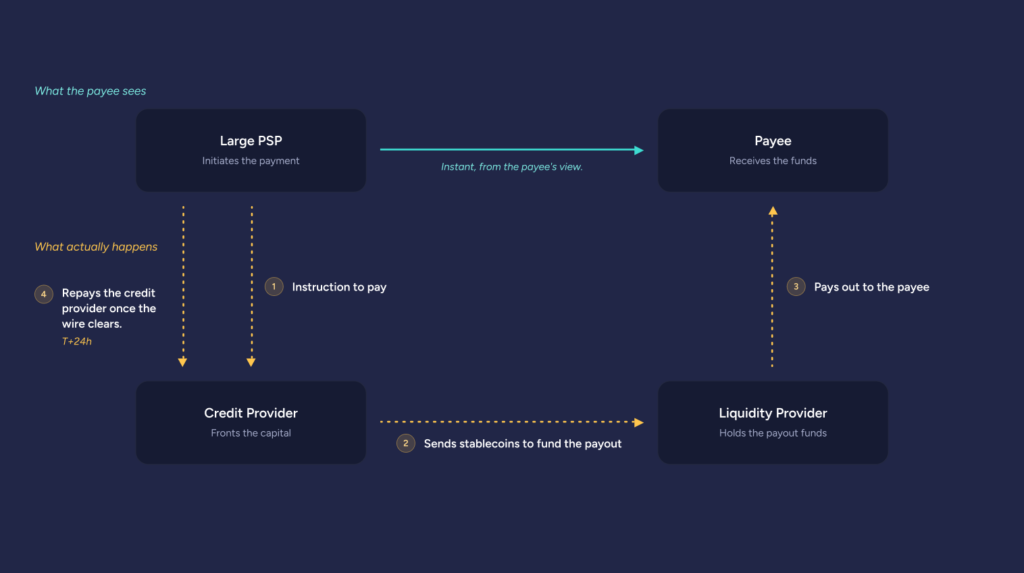
Some companies have negotiated this with their existing banking partners. Others are working with fintech credit providers who have spotted the opportunity. A handful are running it as an internal treasury function, using their own capital to float the gap. None of these are particularly scalable, and none were purpose-built for stablecoin payment operations.
The exception is where the liquidity itself has been productized, with a good example being Arf, a VQF-regulated liquidity provider. Arf bridges fiat and stablecoins to deliver same-day liquidity to B2B payment providers, so their clients can access capital at the moment they need to send rather than after a wire clears. Conduit, one of their clients, more than doubled its liquidity usage and held consistent same-day settlement through the change. Arf itself has processed $18B+ in cumulative settlement with zero defaults across 1,400+ days, tracked live on a public Dune dashboard. Both companies run on Fireblocks (which is how I ended up in these conversations in the first place.)
Another example is Phlebas, which productizes the process rather than the liquidity. The wire-backed credit lines are negotiated one lender at a time, which is exactly why they don’t travel (each one a bespoke deal, which is a polite way of saying a lawyer got paid). Phlebas standardizes the part lenders haven’t built. It scores the borrower, matches each drawdown to lender appetite on score, jurisdiction, size and tenor, and settles from the facility wallet against a specific proof of payment. Lenders underwrite a grade instead of a name, which is what lets a borrower finance a payment without exposing the counterparties and commercial terms behind it.
The reason this is becoming urgent comes down to volume. According to Visa’s Onchain Analytics Dashboard, total stablecoin transaction volume passed $103T across ~18.5B transactions in the last 12 months. When stablecoin payment flows were small, the capital cost of any of these approaches was easy to absorb. As volumes have grown, so has the cost of a credit arrangement. The companies feeling it most acutely have solved the integration problem, the compliance problem, and the corridor problem (the part everyone wrote a blog post about). What they’ve arrived at instead is a capital efficiency problem.
How to Think About Credit in Stablecoin Payments
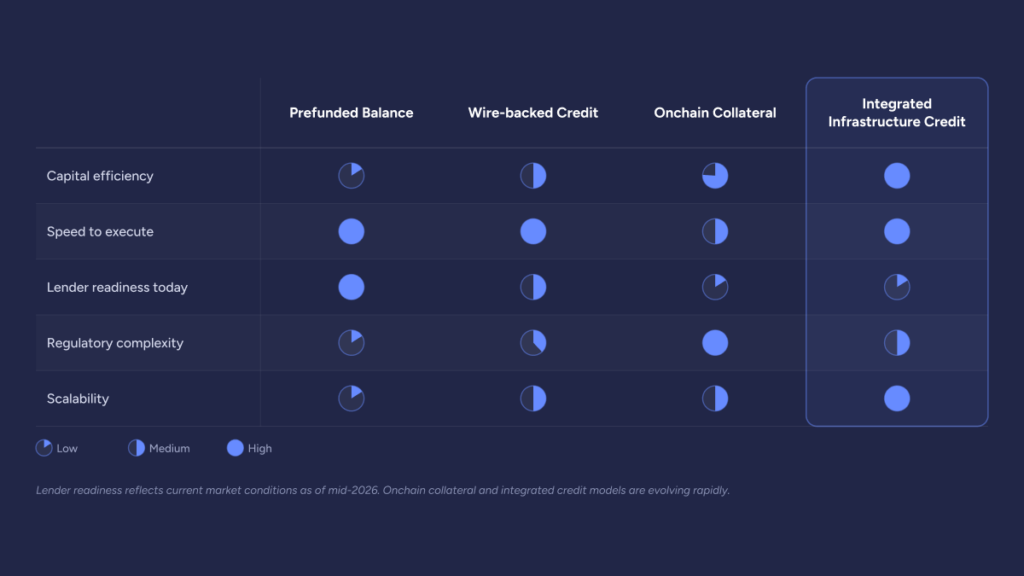
Not all credit approaches in this space are equivalent, and the right answer for a given company depends a lot on where they sit in the market, what their volume looks like, and how sophisticated their treasury operations are.
There are four distinct models worth understanding:
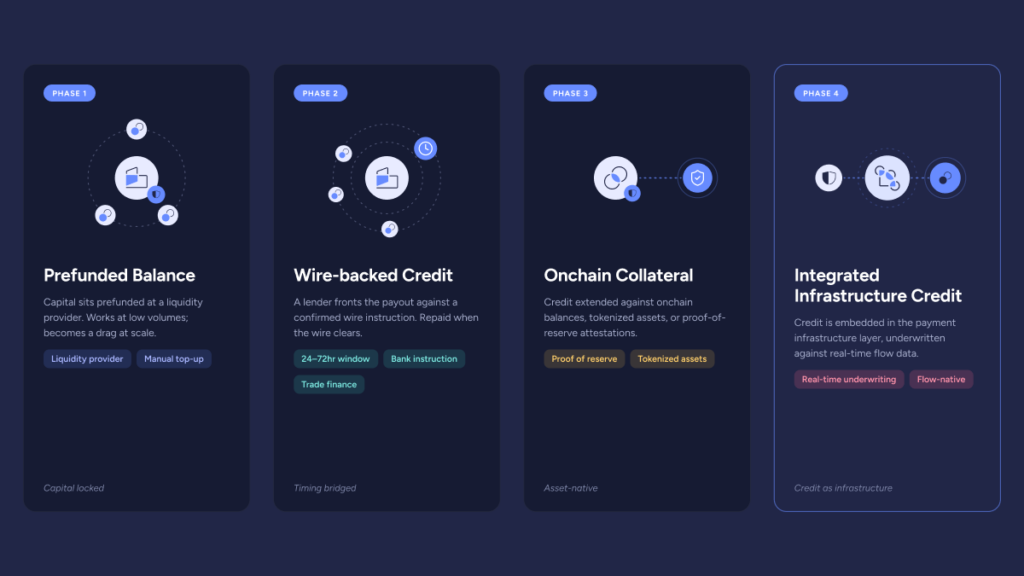
- Prefunded balance. The simplest entry point: park capital with a liquidity provider / on/off-ramp, replenish it on a schedule, and accept the drag as a cost of operating. Most companies start here and discover the limits the hard way, after they’ve already committed to a payout architecture that depends on it. The requirement isn’t universal, though. Cumberland, and some other leading Market Makers, might quote institutional stablecoin liquidity with no prefunding required and market that as capital efficiency ( which means the constraint is a commercial decision).
- Wire-backed short-term credit. A lender extends a short-term credit line against a bank-accepted wire instruction, the payout goes out immediately onchain, and the facility is repaid when the wire settles. The friction here is operational: most lenders haven’t built processes for this use case, so the arrangement works but rarely travels well beyond the first relationship.
- Onchain collateral lending. Credit extended against stablecoin balances, tokenized assets, or proof-of-reserve attestations from regulated custodians. Onchain collateral has genuine advantages over traditional forms: it’s transparent, auditable, and doesn’t require trusting a counterparty’s accounting. But institutional credit processes were built around traditional asset classes, and regulatory treatment varies enough by jurisdiction to create real compliance complexity for lenders operating across markets.
- Credit integrated at the infrastructure layer. A platform already running stablecoin payment flows sits on better underwriting data than any external lender, with visibility into payment volume, counterparty quality, and settlement history by corridor. That data is what makes faster and better-priced credit possible, but the capital still comes from a lender. The infrastructure layer’s job is to put the two on the same rails, so a credit provider can price a facility against flows it can see rather than against a borrower’s own reporting. Arf is probably the closest thing to this in practice today, underwriting against the payment flow it already sits in.

Prefunding was never the point of stablecoins. If capital still has to sit idle to prove it exists, you haven’t improved settlement, you’ve just renamed the wait.
Elbruz Yılmaz
Chief Strategic Partnerships Officer
What Getting Ahead of This Actually Looks Like
For companies building or scaling stablecoin payment operations now, the practical starting point is making sure the infrastructure decisions you’re making today don’t foreclose the credit options you’re going to want later on.
On the lender side, the companies making the most progress are the ones who have identified credit providers who already have the conceptual framework for payment flow as collateral, rather than spending time trying to convince traditional banking partners to develop it from scratch. Trade finance specialists and fintech credit providers who’ve worked in cross-border payments tend to have the right starting point. This doesn’t mean abandoning existing banking relationships. It means being realistic about where the first facility is likely to come from and sequencing accordingly.
The compliance infrastructure is worth investing in now even if the credit relationship is months away. Credit facilities come with audit requirements. If your payment platform can generate transaction history, settlement documentation, and counterparty data in a form that satisfies those requirements, the negotiation moves faster and the ongoing compliance burden is lower. If it can’t, you end up building custom reporting pipelines for every new lender relationship, which adds operational cost and makes the credit infrastructure harder to scale.
Payment Service Providers Are Set to Win, if…
What this ultimately points toward is that payment infrastructure providers who solve credit integration will have a significantly stronger competitive position than those that don’t. The reason is structural. Once treasury operations are built around a credit facility tied to a specific infrastructure layer, the cost of switching is real and the incentive to move is low. That’s the same dynamic that made integrated treasury products in traditional payments so sticky, and there’s no reason to expect stablecoins to be different.
B2C2 has noted that prospects are frequently already on Fireblocks Network, which strips integration friction out of a new relationship before the first conversation, and credit will follow the same pattern: when the lender, the liquidity provider, and the PSP all operate on shared infrastructure, the underwriting data already exists in a common format.
Banks will get to stablecoin payment credit eventually. They always follow volume (any money…), and the volume is clearly heading somewhere that will force their attention. The same logic is true for networks. Visa announced last week that it’s pairing VisaNet settlement data with Credit Coop’s onchain lending infrastructure, so a lender can finance a stablecoin-linked card program against its live settlement performance.
That data infrastructure is only yours if your payment infrastructure is yours. Running on a managed service means the transaction data, the flow history, and the counterparty visibility all sit in someone else’s system, available to you on their terms. You can operate on it, but you can’t own it, and you can’t use it to build a credit case.


