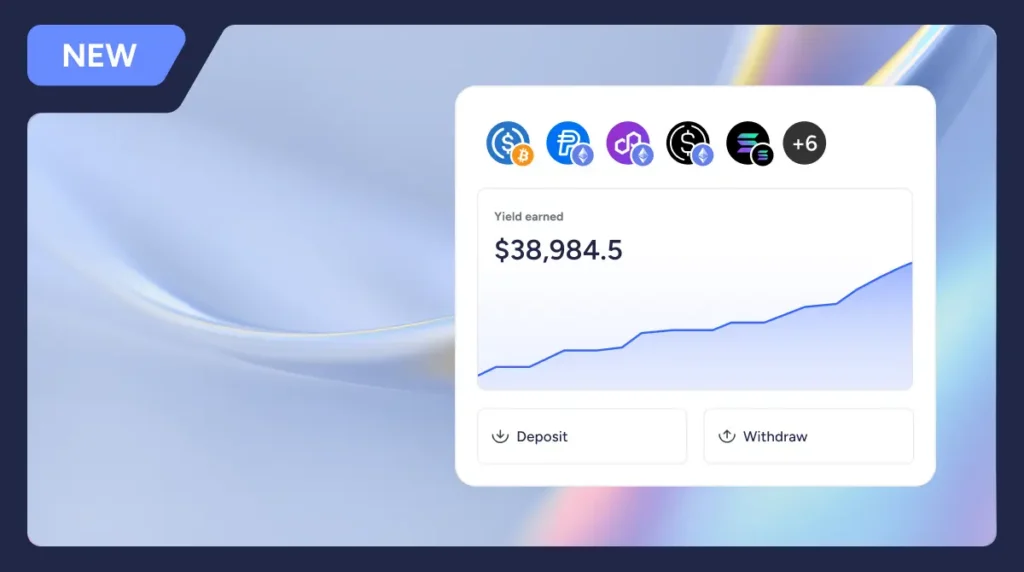
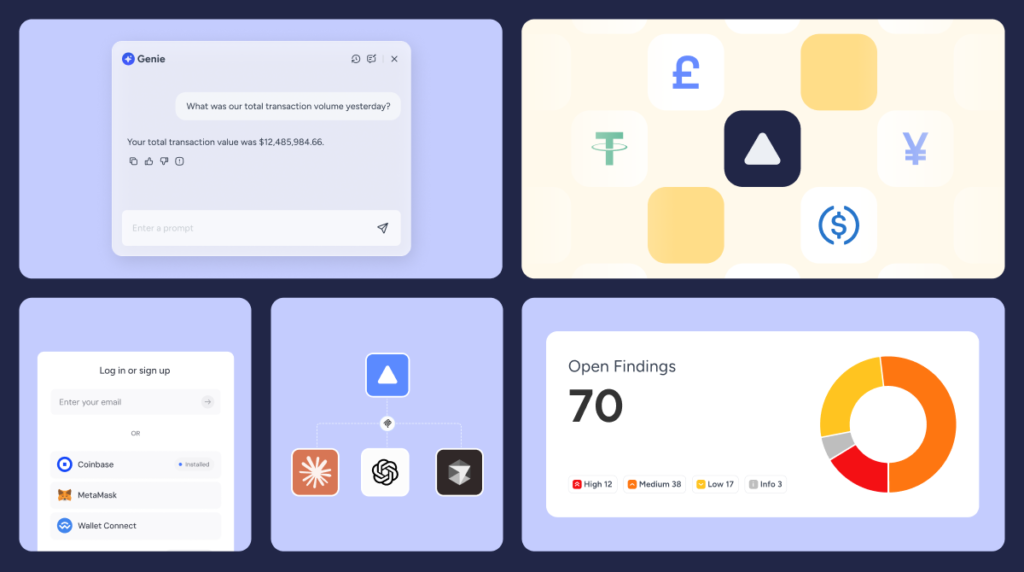


In 2025, we launched 23 products and capabilities across the Fireblocks platform, including Fireblocks Security Posture Management, the new AI Suite, our new embedded wallets capabilities via the Dynamic acquisition, and the Network for Payments.
| Product | Timeline |
| Gasless Transactions | Feb |
| Assets API | March |
| Blockchain API | March |
| Staking API | March |
| Swap API | June |
| COR Compliance | March |
| Gasless on Solana | April |
| Solana Tokenization | April |
| Native Program Calls on Solana | April |
| Next Gen Policy Engine | May |
| DeFi Security Suite | May |
| Gasless Transactions | May |
| Business Continuity Module | May |
| Wallet Tags | Aug |
| Network for Payments | Sept |
| Trust Company | October |
| Fireblocks Security Posture Management (FSPM) | October |
| AI Suite | October |
| Protected Tags | December |
| Blockchain integrations | Throughout 2025 |
| Assets | Throughout 2025 |
But the volume of launches isn’t the story. The story is why we built what we built.
Everything we shipped was in response to how digital asset businesses are fundamentally changing the way they operate.
In 2025, there were four main shifts that converged across digital asset businesses:
- architecture and tooling need to scale alongside demand;
- stablecoins as programmable money for more efficient global finance;
- embedded wallets that abstract the complexity of the blockchain;
- AI that can supercharge operations.
Individually, each is powerful. Together, they redefine how digital asset businesses are built and operate. Underpinning all of this is security, not as a separate consideration or just a checklist, but as a system that works to make each shift possible.
1. Building for onchain finance demands performance at scale
Digital asset infrastructure is only as good as its ability to handle growth without breaking. As global finance looks to onchain solutions to drive greater efficiency and enable new use cases, digital asset transaction volumes surged (and will continue to grow exponentially), and the platforms that couldn’t keep up got left behind.
Last year, Fireblocks processed 300% more stablecoin transfers than the year before. We achieved 100 transactions per second; then immediately shifted focus to going further. We see speed and reliability as foundational requirements to onchain finance, not features.
In 2025, we reinforced that foundation, fortifying our infrastructure and building proactive systems that scale with our clients’ growth. Fireblocks operates as business-critical infrastructure today, and we’re engineering it to stay that way as transaction volumes multiply and use cases expand.
Architectural improvements like Solana’s throughput, batching tools for operations like sweeping, and algorithm optimization for faster signing mean transactions now process 5x faster than before—even as volumes continue to climb. We pushed the limits of scalability with Solana following an unprecedented surge in transaction volume in February last year, and further proved that enterprise-grade blockchain operations can and should be able to handle maximum stress during crypto’s largest liquidation event in October.
Whether you’re moving $10M or $10B, running one wallet or a million wallets, we’ve ensured the platform always handles the load without compromise.
2. Stablecoins crossed the chasm
Stablecoins received a lot of attention as a faster payments rail, and yes the adoption is real.
In 2025, Fireblocks processed over $300B in stablecoin transactions every month, a 300% year-over-year increase. Crypto-native businesses use them for settlement and payouts, trading companies are using them for margin payments and traditional payment companies are moving from legacy rails to blockchain rails.
Stablecoins also cemented their role as programmable financial primitives. Customers like Kast and Rain issued crypto cards, leveraging smart contracts to move millions of transactions every month.
Remittance companies including MoneyGram, Zepz (WorldRemit) and Euronet (Ria) went live with Fireblocks in 2025. They’re thinking from first principles and are completely re-imagining their business models with stablecoins. By using stablecoin infrastructure for fiat treasury operations, for example, remittance providers can establish digital asset wallets, integrate with on/off ramp providers to maximize liquidity, transform operational flows, automate workflows and connect with payout providers. This is the inflection point that is pushing stablecoin payments across the chasm.
When payments scale this way, requirements shift completely. You need global reach, high uptime, traceability, and a network of on- and off-ramps that just works. Security and compliance also becomes more complex. Cross-border flows mean navigating different regulatory regimes. Real-time settlement means policy enforcement needs to happen in milliseconds, not minutes. Transaction monitoring needs to work across multiple chains, currencies, and jurisdictions simultaneously.
Most companies stitch these various components together manually at high cost and high risk, so we spent 2025 building the infrastructure to make it seamless for businesses.
3. Making blockchain complexity invisible is key for consumer adoption
Crypto businesses are increasingly using embedded wallets to reduce onboarding and wallet complexity while maintaining a seamless, unified user experience. To scale these experiences globally requires infrastructure most companies don’t have: operability across jurisdictions, the ability to on-ramp and pay with crypto, support for dozens of blockchains, and varying security requirements.
At the same time, fintechs, marketplaces, and traditional platforms are building embedded wallet experiences that feel like Venmo or Cash App, not crypto apps. With a focus on abstracting away blockchain complexity, these apps are integrating features such as social onboarding and gas sponsorship to lower the barrier of entry for new users.
Crypto-native companies need global scale. Traditional businesses need onchain rails. Both need seamless user experiences that abstract away blockchain complexity and consumer-facing applications that just work.
This is why we acquired Dynamic in October of 2025. Together, Fireblocks and Dynamic deliver the complete stack for onchain finance, from social login onboarding and embedded wallets to chain abstraction and global compliance. Consumer-facing apps today demand seamless UX. Embedded wallets make this possible and are key to unlocking mass adoption.
You can see this live today. Kraken’s Inky reimagines trading with a swipe-and-tap experience that feels more like a social feed than a crypto app. Magic Eden uses Dynamic-powered embedded accounts to support 24/7 trading across chains, without exposing users to blockchain complexity.
4. AI can supercharge operations
Digital asset operations have relied on manual processes with treasury teams reconciling across multiple venues, ops teams exporting spreadsheets to answer basic questions, and more. This was ok for a while, but manual processes that work at $10M in monthly volume collapse at $1B. Teams that could manage complexity with five people suddenly need twenty, and operations became the bottleneck to revenue. This was the pattern we kept hearing from businesses hitting scale. Growth was creating its own friction.
The infrastructure shifts we focused on in 2025 weren’t just about enabling new products, they were about eliminating operational drag. Composable infrastructure eliminates rebuild cycles, consolidated payment networks replace managing dozens of provider relationships, and embedded wallets ensure you can touch millions of individuals without delays.
We also launched our AI Suite to turn everyday questions into actionable insights without manual data gathering. Teams can query their entire infrastructure conversationally and execute workflows directly, reducing the time spent context-switching between dashboards and tools.
What we’re learning quickly from the 50+ design partners using it is how businesses are applying AI across digital asset operations. Some use it to investigate failed transactions in seconds rather than hours. Others use it to configure complex workflows without deep institutional knowledge. The common thread: AI distributes expertise across teams and time zones, making operational knowledge queryable rather than locked in a few people’s heads.
What this all adds up to
My takeaways from 2025 are simple yet powerful:
- We continuously improved our infrastructure to meet demand for increased volume, transactions and wallets, and reached $6T in stablecoin transaction volume in 2025
- Stablecoins officially cemented their role as programmable financial primitives
- Seamless UX for consumer-facing apps became table stakes for unlocking greater crypto adoption
- AI proved itself as a powerful force multiplier for digital asset operations (and we’ve just barely begun to scratch the surface of what’s possible)
Together, these shifts mark the transition from managing crypto infrastructure to operating onchain businesses. We’re building the infrastructure that supports this shift.
Contact our team today to request a more in-depth demo and learn how Fireblocks can support your digital asset journey in 2026 and beyond.