


Introduction: The Remittance Operating Model Today
The traditional remittance infrastructure wasn’t originally designed for speed and efficiency. The fantastic, on-demand service that clients receive today is built on the back of capital concessions. If you’re operating cross-border payment services, you’re intimately familiar with the structural challenges that drive inefficiencies in working capital management and slow down operations. Every efficiency gain you can extract from this system represents direct margin improvement, and the difference between competitive pricing and leaving money on the table.
Stablecoins fundamentally alter the operational dynamics and introduce new ways to capture revenue from expanded customer relationships. You stand to make gains because settlement becomes continuous instead of periodic, prefunding requirements shrink dramatically, and one-way flow markets become operationally simpler. This blueprint provides a practical implementation guide for internal cross-border operations and stablecoin payments.
Use Case: Treasury Optimization for Internal Cross-Border Operations
Stablecoins for internal treasury
This initial use case phase focuses on internal operations: using stablecoin infrastructure to move funds between your own entities in order to fund partners more efficiently.
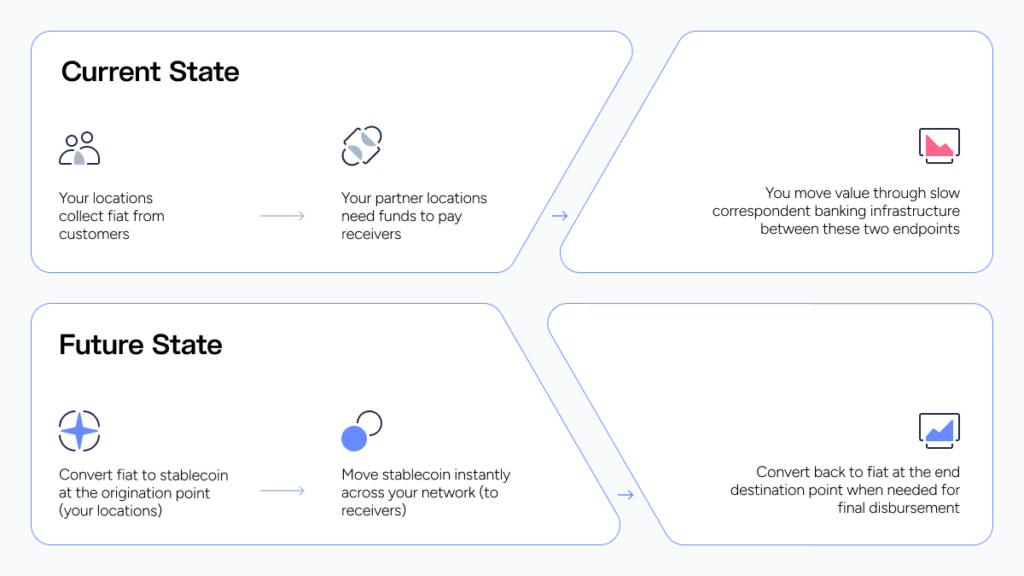
Given a fixed amount of capital, you can only process a certain number of round-trips using the funds you have. The more round-trips you complete with your capital, the more profit you generate. The catch is that with traditional correspondent banks, these transfers can take days and operate only during banking hours, forcing you to maintain massive capital reserves just to cover the lag between collection and settlement.
With stablecoins, funds settle in as little as 5 minutes and operate 24/7/365. Your capital cycles faster, sometimes completing multiple roundtrips in a single day. This creates a compounding effect: faster capital turnover means less pre-funding required, reduced FX exposure windows, and the ability to serve more customers with the same balance sheet. This is explained in depth in our report State of Stablecoins 2025: The Payments Infrastructure Reset.
A Step-By-Step Operational Blueprint
Step 1: Establish Stablecoin Infrastructure
Deploy enterprise-grade treasury management: This will serve as your core stablecoin treasury management system, with the security, operational controls, and multi-party computation (MPC) technology needed to safely manage stablecoin treasury operations at scale so you can build an entire operational framework for digital value movement.
Mirror your business structure: Design your treasury management system to reflect your physical operational reality. For example, if you have locations in 150 cities across 5 countries, you can create corresponding stablecoin payment accounts like sub-accounts that map to locations, with hierarchical controls that match your treasury management policies. Each location gets its own segregated account that holds stablecoins independently while remaining under centralized oversight and control.
Build governance and controls: Establish who can approve workflows at what thresholds, what policy rules govern automated operations, and how exceptions get handled. Design it with the same logic you apply to traditional banking controls, and set up treasury management hierarchy and controls that reflect your organizational structure. By encoding these business rules directly into the infrastructure, you ensure that treasury operations follow defined procedures automatically.
“We are leading the next era of money movement by enabling money to move instantly across any channel – fiat or stablecoin. Fireblocks accelerates this vision by giving us the secure, programmable infrastructure to transform global payments at scale.”
Anthony Soohoo
Chairman & CEO, MoneyGram
Step 2: Identify and Integrate On/Off-Ramp Providers
The liquidity bridge: Stablecoins are digital, but your business still touches fiat at collection and payout points that ultimately fund your internal treasury. You need providers to convert local currency to stablecoins (on-ramp) and convert stablecoins back to local currency (off-ramp) in each geography where you operate.
In this use case, the focus is on how remittance providers build the right solution to move their own funds across borders for internal treasury operations. Here, the business needs two liquidity providers (one for each side of the transaction), to convert your own money from fiat to stablecoins and send funds to your other entities or partner network in different countries.
Provider criteria: Identify licensed providers in each geography who offer on/off-ramp services. These providers need to be properly licensed for money transmission in their jurisdiction and have reliable liquidity in both local currency and stablecoins. Look for licensed money services businesses or payment institutions with:
- Local regulatory compliance and proper licensing
- Competitive conversion spreads
- Sufficient liquidity depth for your volume
- API integration capability for automated operations
- Settlement reliability and uptime
Note: How remittance companies build their payment flows depends on the use case. For those that are building a solution to support other businesses for cross-border treasury payments, they will typically be the licensed party on the send-side of the transaction to on-ramp stablecoins for customers (if not both send and receive). Therefore, in some cases this will require a licensed receiver provider to help off-ramp stablecoins in the markets in which they wish to expand operations. These connections may already exist for fiat payouts, but shifting to stablecoin operations can change the payout provider landscape.
The cross-border payments market is at an inflection point, and remittance is one of the corridors where stablecoin rails are proving out fastest. Here’s the broader analysis of where disruption is happening and why now.
Step 3: Implementing the Stablecoin Flow
With infrastructure and liquidity partners in place, you’re ready to orchestrate the end-to-end payment flow to convert your treasury operations from fiat correspondent banking to stablecoin flows.
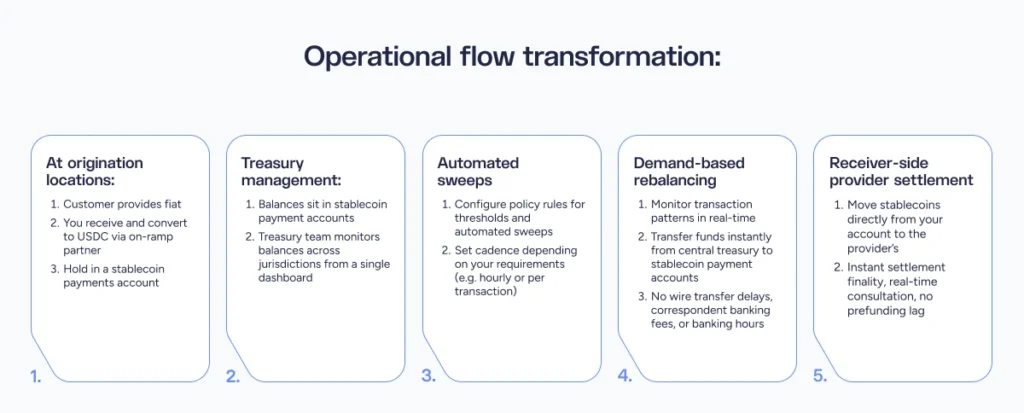
Test the payments flow end-to-end before deploying it live into production, and start realizing capital efficiency gains via continuous, automated treasury management.
For remittance providers working with bank partners on the receiving end, understanding how those banks approach stablecoin infrastructure will increasingly determine which corridors are viable. This piece covers what bank-issued stablecoin infrastructure looks like from the issuer’s perspective.
Step 4: Deploy Automations and Workflow Controls
Set workflow authorization rules, configure access, and monitor transactions
Build a treasury operation that runs itself within defined parameters, responds instantly to changing liquidity needs, and provides complete visibility to your finance team.
Automated sweep configurations: Set rules for automated sweeps, defining thresholds and frequencies. For example: “Every hour, sweep any amount over $50,000 from location-specific stablecoin payment accounts to central treasury” or “Every day at 6pm, rebalance all locations to maintain a minimum $20,000 float at each stablecoin payment account.” These rules encode your treasury management strategy and execute automatically without human intervention.
Rebalancing intelligence: Configure approval workflows for larger treasury rebalancing decisions. While routine sweeps should be fully automated, you may want treasury manager approval for larger strategic movements. For instance, moving $500,000 from US treasury to European operations requires additional oversight.

Operational dashboard: Monitor all locations through a real-time dashboard showing current stablecoin balances, recent transaction activity, automated sweep history, and any policy violations or unusual patterns. Your treasury team gains unprecedented visibility into liquidity across your entire network with refresh rates measured in seconds rather than end-of-day batch reports.
Step 5: Implement Provider Settlement via Stablecoin Rails
Once you’ve optimized internal treasury operations, the natural next step is applying the same stablecoin infrastructure to settlement with payout providers.
- API-driven settlement: Build settlement flows via API or configure them with your stablecoin infrastructure provider
- Real-time reconciliation: Transaction-level matching between your systems and partner systems
- Instant finality: Settlement completes in minutes, not days
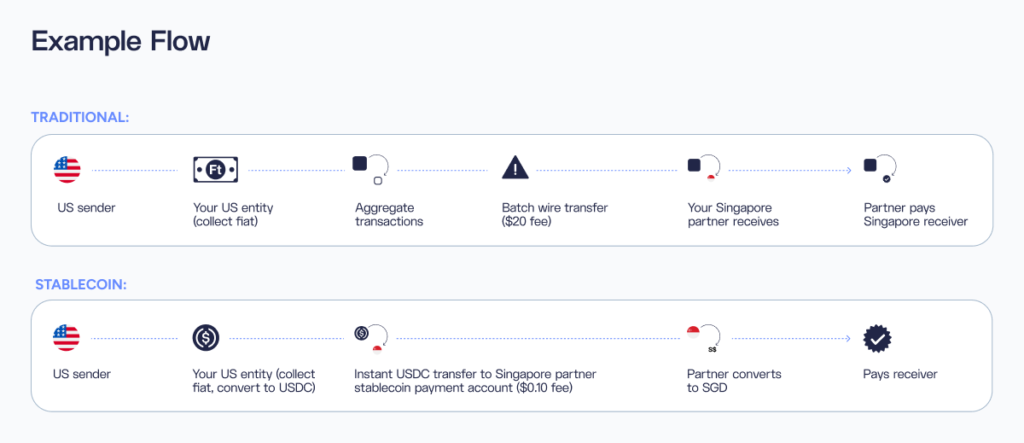
- Transparent pricing: Sub-dollar transaction fees instead of $15-20 per wire
What this means at the provider level:
- Prefunding requirements can be eliminated, with settlement per transaction if economical
- Real-time reconciliation can be enabled without batching
- Fee structures are transparent even before a payment is initiated
- Treasury operations can be made available 24/7, not limited by banking hours
- Payouts to receiver partners can be settled faster for an improved customer experience
“Remittances are lifelines. By integrating Fireblocks, we’re improving speed, cost, and transparency for families who rely on us every day – and we’re doing it in a way that’s secure and scalable across our global footprint.”
Mark Lenhard
CEO of WorldRemit
The operational transformation: Your treasury team shifts from executing manual wire transfers and reconciling batch settlements to monitoring automated flows, optimizing policy rules, and managing exceptions. The infrastructure handles routine operations; your team focuses on strategy and optimization.
The pay-in side of the equation, i.e. how PSPs and merchants receive stablecoin payments and settle to fiat, involves a different set of infrastructure decisions than the treasury optimization covered here. We cover the PSP pay-in and merchant settlement architecture in this blueprint.
Summary: Requirements for Stablecoin Remittance Operations
Implementing stablecoin operations for remittances requires institutional-grade infrastructure that meets the security, compliance, and operational requirements of regulated financial services.
- Flexible treasury management system: Structure wallets and stablecoin payment accounts to mirror your existing business operations. Whether you need separate accounts for each physical location, segregated accounts for different business lines, or hierarchical treasury structures with multiple approval layers, remittance companies require a platform that adapts to your organizational structure rather than forcing you to adapt to rigid technical limitations.
- Operational simplicity at scale: As your stablecoin operations grow from pilot corridors to company-wide infrastructure, remittance companies need a platform that can scale alongside the business without requiring fundamental architectural changes. The same security model, policy engine, and operational workflows that manage thousands of dollars in a pilot corridor should work identically when managing millions in production volume. You build once and scale confidently.
- Automated reconciliation and reporting: Comprehensive transaction history, real-time balance tracking, and API access are crucial for integrating with your existing accounting and ERP systems. Because all stablecoin transactions are recorded onchain with complete auditability, reconciliation becomes significantly simpler than traditional correspondent banking where you’re matching records across multiple institutions with different systems and timing.
- Embedded Compliance: Compliance embedded directly into the transaction layer helps translate requirements across markets into a unified framework. Every payment should carry the necessary AML/KYT and sanctions checks, beneficiary data, and wallet verifications, and be able to handle travel-rule requirements, for example via integrations with Notabene, Elliptic and Chainalysis. Remittance companies can expand into new jurisdictions while maintaining a consistent standard of security, transparency, and regulatory readiness.
- Best-in-class security architecture: For remittance companies handling customer funds, enterprise-grade security is non-negotiable. Regardless of wallet configuration (hot, warm, cold), private key management setup, and on-premise vs. cloud deployment, you need an infrastructure provider capable of securing trillions in stablecoin and digital asset transfers, powered by multi-layered defense and proactive threat detection.
- Pre-configured partner integrations: Immediate access to vetted liquidity providers, on/off-ramp partners, and payment counterparties removes the need to build custom integrations for each relationship. This dramatically accelerates deployment timelines and reduces ongoing technical maintenance burden. New corridors or partnerships can be activated in days rather than months of integration work.
“Recent regulatory clarity and advances in technology now allow us to enhance the way we move money, making transactions more efficient and secure. Fireblocks provides the additional security and connectivity we need to expand our payment offering at scale.”
Juan Bianchi
EVP & CEO – Money Transfer, Euronet
By following the steps laid out in this blueprint, you’ve now transformed your internal operations and created the technical foundation to extend stablecoin benefits directly to customers in the next evolutionary phase of implementation and expanding your use cases.
See how payments customers like Euronet, Zepz and MoneyGram are using Fireblocks wallet infrastructure to power stablecoin remittances today.
Request a demo to learn more and talk to our payments experts.