


Banks make money from trading and brokerage. JP Morgan’s Markets division: $31 billion in 2024 and Goldman Sachs: $26 billion, according to private industry analysis. Morgan Stanley’s wealth division made $28 billion. Digital assets don’t change the role banks play to earn this revenue. In fact, they extend it.
But activity is migrating. Coinbase generated $4 billion in transaction revenue in 2024, the same intermediation function banks provide. As equities, bonds, money market funds, and structured products move onchain as tokenized assets, banks face a choice: extend their trading and custody infrastructure onto digital rails, or watch execution and intermediation revenue migrate to crypto-native platforms built for tokenized markets.
1.6% of USD M1 is already onchain, stablecoin payments are growing at 350% yoy, and tokenized money market funds are growing at 200%+ CAGRs in recent years. The question is how banks position themselves to protect trading, execution, and custody revenue as tokenization scales.
This blog is the third chapter in our series on how banks are preparing for this shift:
- Asset issuance
- Custody as a strategic control layer
- Trading and brokerage: the subject of this blog
The central question is how these assets trade, clear, and settle once they move into day-to-day client flows. That shift introduces choices about operating model, governance, and where banks want to position themselves in the value chain as activity and revenue scales.
Why Banks Are Turning to Digital Asset Trading and Brokerage Now
Banks act as financial infrastructure today, this is why there are too-big-to-fail regulations and enhanced capital adequacy ratios for G-SIBs and D-SIBs. To continue acting in this capacity for tokenized forms of money and financial instruments and to bring crypto trading within their perimeter, banks need to build digital asset capability.
Two underlying revenue drivers consistently come up in our conversations with banks.
First—for retail banks—their clients are already active with crypto: 1 in 6 Gen Z and Millennial customers report that the last account they opened was with a crypto exchange. These segments hold 25% of their net worth in cryptocurrencies. This is activity almost exclusively happening outside the banking perimeter today.
Second, global markets and wealth divisions generate material portions of bank revenue from:
- agency execution,
- spreads and liquidity provision,
- financing and leverage,
- collateral mobility, and
- structured products.
Crypto asset trading and brokerage today may be a niche, but profitable, business, but digital asset trading and brokerage capabilities are necessary for banks to enable tomorrow’s tokenized equities, bonds, funds, structured products and stablecoins—where clients will expect the same execution quality, liquidity, and post-trade reliability they receive in established markets.
Building digital asset trading and brokerage capabilities now keeps these revenue streams inside the institution and prepares banks for the next generation of financial services.
How Banks Build Their Trading and Brokerage Capabilities
As banks move from early digital money initiatives into live client flows, a clear pattern is emerging. Institutions are building capability in stages, and the common thread is the need for enterprise-grade wallet infrastructure that the bank controls and operates.
With the right infrastructure in place, a bank can facilitate agency or proprietary trading, integrate new venues, add tokenized assets, and support more advanced market services without rebuilding its architecture.
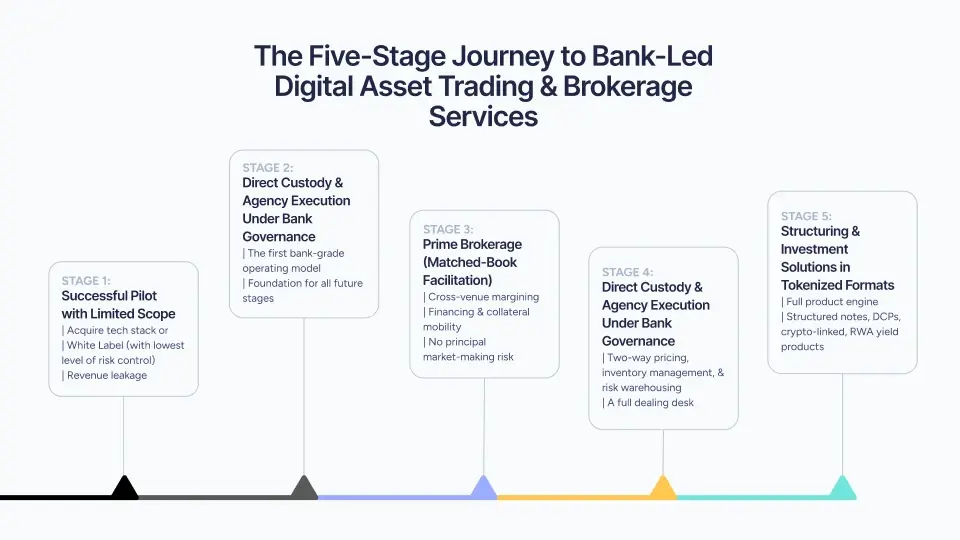
The progression often follows a familiar five-stage sequence as seen in the diagram below, with variations across spot and derivatives markets, retail and institutional businesses, and models built on Group 1 versus Group 2 assets. Each business may navigate a specific path.
Stage 1: Pilot
Some banks begin a spot business for retail or wealth with a pilot. This may take the form of limited scale offering with employees or ‘friendlies’, either with their own technology that they intend to scale or by whitelabelling a combined broker–custodian to get to market quickly.
Whitelabelling is a low-build, but low-control model: trade execution and custody sit with a partner, governance uplift is limited, and revenue is shared. Integration remains necessary for features like balance display, which creates technical debt as future integrations will be needed with the bank’s custody/wallet stack and other providers like an OEMS. It works for basic buy/sell access in early wealth segments, but it leaks value.
There is no best execution, no multi-venue connectivity, and clients typically migrate to deeper platforms as allocations grow. That’s why banks tend to move on quickly: this stage is useful for testing demand, not for building a scalable markets business.
Stage 2: Direct Custody and Agency Execution Under Bank Governance at Scale
The first real shift occurs when banks bring custody and trade execution back inside their perimeter. Institutions begin operating their own wallet infrastructure with policy-based governance, approvals, entitlements, and chain-level controls. They also establish agency execution, routing client orders across multiple approved venues under their own predefined rules. This is also the point where trading flows integrate with existing treasury, compliance, and surveillance processes, giving the bank market-grade control and oversight. Many banks now are skipping Stage 1 and instead start here for both retail and institutional businesses.
For banks, Stage 2 becomes the foundational layer for scaling client flows safely and consistently, and the operating base that future tokenized assets can plug into as markets mature.
Revolut offers all of these services and more in production today. Its Fireblocks-based stack gives it direct custody, policy-driven governance, controlled execution routing, and integrated settlement and compliance workflows, all inside one governed environment.
Stage 3: Prime Brokerage (Matched-Book Facilitation)
Once custody and agency execution are in place, banks can start looking at prime brokerage functions. These include:
- consolidated access across exchanges, OTC desks, market makers, and onchain venues;
- cross-venue margining;
- unified collateral management; and
- client financing on a matched-book basis.
Inventory is held only for settlement and facilitation, not for quoting, meaning banks are not taking directional market-making risk. These offerings are required if the service is to become institutional.
Many clients will also demand an off-exchange settlement model here that keeps client assets in a governed digital escrow. Such assets are untouchable by either party unless predefined conditions are met, enabling safe, capital-efficient trading across venues.
This is viable today for clients who trade without leverage, banks offering finance against tokenized Treasuries, and other Group 1b assets, as well as for derivatives. Without Basel III reform, however, banks cannot extend the business to taking crypto assets as collateral.
Stage 4: Dealing and Liquidity Provision (Principal Trading)
The next stage is a full dealing function: quoting two-way prices across approved crypto and tokenized assets, running a principal book, hedging exposures, and internalizing client flow. This is where banks re-establish themselves as price makers, in the same role they play today in FX, rates, and credit but extended onto chain-based infrastructure.
Today some banks offer some of these services for crypto derivatives products, including Goldman Sachs, but it is structurally impossible for regulated institutions to carry out these activities in the spot crypto markets from on balance sheet entities. Meaningful participation across all products depends on two unlocks:
- supervisory rules that determine whether holding crypto-asset inventories become viable with sensible capital charges; and
- deep enough tokenized markets (away from crypto) to support two-way liquidity.
Regulators have made direct crypto asset holdings effectively uneconomic for banks. The ECB’s latest Financial Stability Review shows Euro area banks hold only around €1M of crypto assets on their own balance sheets. This is a clear signal that today’s capital rules prevent meaningful inventory, thereby preventing dealing.
However, should capital treatment evolve, the firms already operating custody, execution, and governance in an integrated stack will be the first to expand into financing, leverage, and collateral mobility for tokenized assets.
Several global banks experimenting with tokenized HQLA see this as a future-state capability, contingent on both market depth and supervisory approval for principal trading in new asset classes.
Stage 5: Structuring and Investment Solutions in Tokenised Formats
With the first four stages in place, banks would then extend the structured and yield-based products they already manufacture into tokenized formats. This includes tokenized structured notes, dual-currency products, equity-linked instruments, deposit products, and a wide range of RWA-backed yield solutions. Lifecycle events (couponing, resets, redemptions) can be automated through programmable settlement, and collateral can move in near real time. This is the point where banks stop replicating today’s business onchain and begin expanding it.
Many banks are already issuing bonds and structured note products with non-crypto underlyings, such as HSBC, UBS, and ABN-AMRO. This is when tokenized finance becomes a multi-trillion dollar business. The firms with Stages 1–5 in place will lead distribution, liquidity, and product manufacturing, and will capture the cost and efficiency gains of onchain finance.
How Banks Will Build for Digital Asset Trading and Brokerage Services
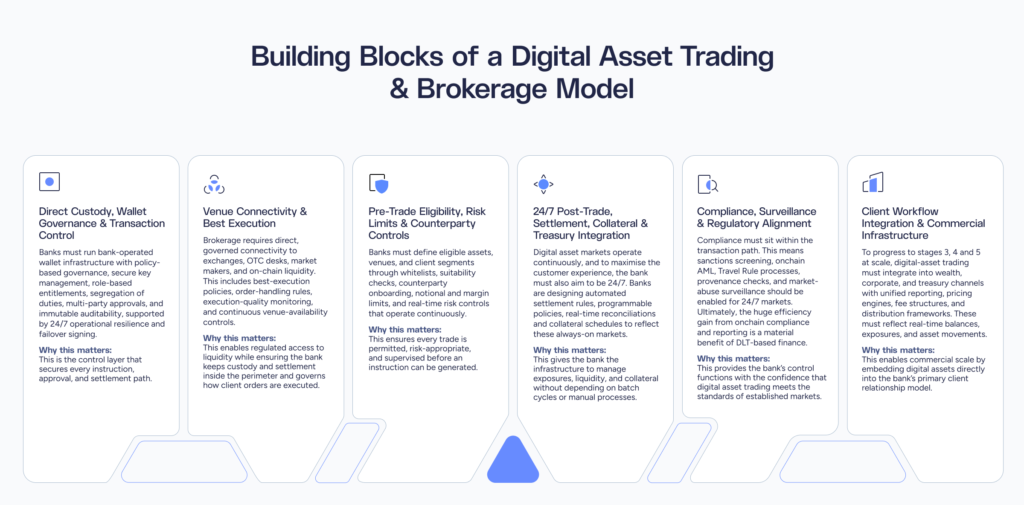
A bank-aligned digital asset trading model typically includes the following building blocks:
- direct custody, wallet governance and transaction control;
- venue connectivity and best execution;
- pre-trade eligibility, risk limits and counterparty controls;
- 24/7 post-trade, settlement, collateral and treasury integration;
- compliance, surveillance and regulatory alignment; and
- client workflow integration and commercial infrastructure.
These components give banks the foundation to bring digital asset trading into their existing governance perimeter with the same reliability, safety, and supervisory alignment applied to traditional markets businesses. By building on this architecture, institutions can meet today’s client demand while preparing for the tokenized financial products that will follow.
The Institutions That Act Now Will Lead
Fireblocks works with more than 100 banks globally and the direction is consistent. Institutions want to offer clients safe, supervised access to digital asset trading and brokerage, maintain control of custody and governance, and build on an operating model that can support other digital asset solutions as demand evolves.
The journey outlined here shows the range of paths available. Each bank will choose the entry point and progression that fits its strategy, and the institutions that build trading and brokerage on a controlled, scalable foundation will be the ones shaping how these services take hold in the financial system.
Frequently Asked Questions: How Banks Govern Digital Asset Trading and Brokerage
-
What governance standards apply when a bank operates digital asset trading and brokerage?
Banks must run digital asset trading inside the same supervisory perimeter that governs established markets. That includes clear rules for which assets, venues, clients, and counterparties are in scope, and policy-based controls over how transactions are initiated, approved, and executed. Supervisors expect the same standard of control, auditability, and separation of duties that apply to FX, equities, and high-value payments. -
What pre-trade perimeter controls are required before a bank can route or execute digital asset flows?
Banks define eligibility criteria for assets, approved venues, and counterparties, supported by client classification, suitability checks, and portfolio-level limits. These controls set the boundaries of the operating environment and ensure all trading and brokerage activity occurs within an agreed risk framework. -
What execution controls ensure digital asset trading aligns with supervisory expectations?
Execution must follow the same policy-driven standards used in established markets businesses. That includes wallet governance, role-based access, segregation of duties, multi-party approvals for sensitive flows, sanctions and screening processes, and real-time exposure monitoring—all ensuring the bank controls every transaction path. -
How do banks maintain post-trade oversight in near-instant settlement markets?
Post-trade oversight remains a supervisory priority even when settlement is rapid. Banks apply the following to maintain continuous visibility and control:
– automated settlement and collateral rules
– real-time reconciliations
– provenance checks
– onchain AML and Travel Rule compliance
– immutable audit trails -
What operational resilience requirements support digital asset trading and brokerage?
Digital asset operations must align with resilience standards used for high-value payments, custody, and treasury. This includes several other elements including segregation of operational roles, redundant and failover infrastructure, 24-hour incident response, complete traceability from intent to settlement, and alignment with frameworks such as NIST CSF and DORA.