


69% of APAC financial institutions are already live or running client-facing pilots for digital assets. APAC’s 2026 deployment numbers do not reflect a sudden acceleration. They reflect years of deliberate investment in capability and laying institutional groundwork, achieved through dedicated innovation labs, specialist hiring, regulatory sandboxes, and infrastructure experiments. The region did not arrive at this moment by moving fast. It arrived by starting earlier and building new digital muscle.
The region’s ambition is clear. Our Financial Grid report on Asia-Pacific institutions shows they are further ahead than any other part of the world and they are prioritizing differently from every other region. Where others lead with payments and issuance, APAC puts custody first.
That sequencing has direct consequences for the infrastructure decisions happening right now. Custody is not a back-office function in a digital asset context, which is quite the paradigm shift. It is the decision that determines what your institution can and cannot do for the next decade.
The reality is that you cannot retrofit institutional-grade custody into a digital asset business that was built without it. The banks that will scale in 2026 and beyond made this call first, now able to focus on delivering use cases and product outcomes.
Why the Data Says APAC Is Ahead on Digital Assets
62% of APAC financial institutions had already committed budget for digital asset infrastructure before 2026 began. That compares to 27% in North America, 41% in Latin America, and 50% in Europe. But budget commitment is only one measure.
The external pilot pipeline is where the picture becomes genuinely distinctive. 46% of APAC institutions are in external pilots with clients, the highest of any region by a wide margin. A further 23% are already in production. Combined, 69% of APAC institutions are either live or running client-facing tests. Only 3% cite limited client or counterparty adoption as a concern. The constraints to APAC’s digital asset build are not external.
The regulatory picture reinforces this. 97% of APAC institutions expect the regulatory outlook to be favorable or very favorable, and only 39% cite regulatory and legal uncertainty as a constraint, the lowest of any region. Frameworks such as those from MAS and HKMA have done significant work, and momentum is building across the region: Japan’s three largest banks are running a stablecoin PoC under JFSA oversight, and Australia’s Senate has endorsed a digital assets licensing framework that brings custody platforms under its financial services regime.
What are APAC Banks Actually Building?
APAC is the only region in this survey where digital asset custody leads the use case priority ranking. In every other region, 24/7 settlement is the top priority. In APAC, something else comes first.
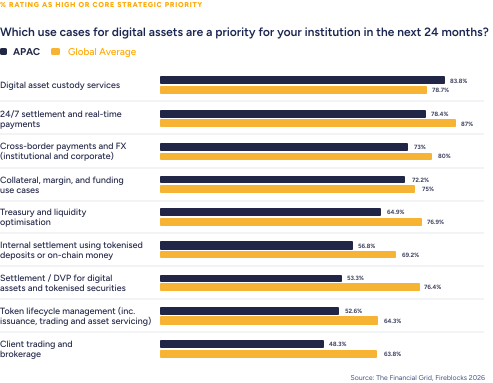
The asset type data confirms the same sequencing. 68% of APAC institutions plan to use tokenized securities in a live environment in 2026, the highest of any region. Tokenized money market funds follow at 58%, also the highest globally. Third-party stablecoins sit at 52%, showing stablecoin capability is firmly in the build.
Own-institution stablecoin issuance sits at 16%, the lowest of any region. That is a 2026 deployment horizon, not an ambition ceiling. For example, SMBC is developing a framework for yen stablecoin issuance and circulation, exploring use cases including wholesale payments between financial institutions and settlement of tokenized financial assets and real-world assets. That is not hesitation. It is sequencing.
APAC institutions are building the foundation that every other use case for digital assets can run on.
The Custody Decision is APAC’s Infrastructure Decision
That foundation is custody. In digital assets, custody is not the decision it looks like in traditional finance. Control that sits inside core systems in a traditional bank has to be applied at the wallet layer. The architecture choices made now determine what a bank can build, at what scale, and how fast.
The provider selection data in The Financial Grid points to where Asia-Pacific institutions are concentrating. Compliance and regulatory alignment is the critical factor for 66% of APAC institutions when selecting a digital asset infrastructure partner, 25 percentage points above the global figure and the highest of any region.
That compliance premium has a practical dimension. In conversations across the region, the MPC-versus-HSM debate is more active here than anywhere else, and it is regulatory requirements driving it, not just technical preference. Institutions are making digital asset architecture decisions that will shape what they can build and how fast they can scale.
What Will It Actually Take for APAC to Get Digital Assets to Production?
The talent that APAC institutions built during its innovation phase is now the talent making the infrastructure decisions in the delivery phase. That continuity matters. It means the people evaluating custody architecture today were in the room when the first pilots ran. They know what was built on assumptions and what was built on foundations.
And key enablers in the ecosystem exist in Fintech providers and partners. Firms have increasingly reached inflection points where decisions on vendors and solutions that were adequate for a 12-month proof of concept, are not the same decision that supports cross-border settlement, tokenized fund distribution, and institutional DeFi connectivity running concurrently. Banks that conflated those two decisions are now facing the consequences.
The institutions across APAC that committed to getting custody as the foundation layer right from the start are not waiting for production to arrive. They are already deep in the build, and the infrastructure decisions they made early are the reason the path ahead is clear.
Reach out to discuss how your bank can ensure you are building the digital asset infrastructure that will support production at scale across any use case, including custody, stablecoins, tokenized deposits, and capital markets, ready for when you need to go live.
Read The Financial Grid APAC for more data points from our 2026 survey andThe Financial Grid flagship report for the global view.