


A year ago, Fireblocks published the State of Stablecoins, surveying banks, fintechs, and payments providers globally. The European story was about moving MiCA-compliant stablecoins from concept into production. The regulatory framework existed. The first movers were named: Banking Circle had launched EURI, and SG-Forge had brought EURCV to market.
The market has moved. EUR-denominated stablecoins processed at retail VASPs grew 12-fold growth in 15 months to $777 million. Still early in absolute terms. Clearly not standing still.
The Financial Grid, our 2026 survey of 600+ C-suite and senior decision-makers at financial institutions and corporates globally, picks up on that thread. The continental European and UK data shows how far the industry has moved compared to the rest of the world.
Continental Europe vs. UK: Different Regulatory Timelines, Same Digital Asset Destination
The conversations we have with European banks have shifted from being about regulatory sequencing to focusing on infrastructure: which use cases to prioritize, what to build first, and how fast they can get to production.
That shift looks the same across continental Europe and the UK. In our Financial Grid survey, 99% of continental European institutions and 100% of UK institutions expect the regulatory direction to be favorable or very favorable. They have confidence in the specification they’re building to.
Continental European institutions have MiCA. The framework is in force and the budget reflects it: 53% had already committed digital asset infrastructure budget going into 2026, above the global average of 42%.
UK institutions are building toward a framework still being written. That is not hesitation. The competitive pressure driving digital asset investment does not pause for regulatory finalization. What the unsettled framework changes is the risk calculus around every infrastructure decision, which we will come to.
The destination is the same, the distance to it is not.
Stablecoins are Continental Europe’s Entry Point and The Tokenization Build Follows
What I see from continental European banks is a build that starts with stablecoins. MiCA created the framework; European banks are now building the capability to operate within it. The asset mix that follows, tokenized money market funds, tokenized securities, tokenized deposits, layers on top of that foundation.
Chart: Digital asset types planned for live production in 2026
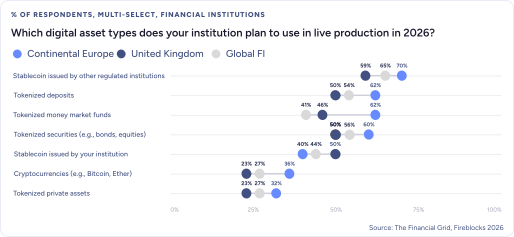
The chart tells that story clearly. Continental European institutions are moving on stablecoins issued by other regulated institutions first, with own-institution issuance following. Tokenized securities and money market funds are close behind, and continental Europe leads globally on both.
Qivalis is the clearest expression of where that stablecoin build is heading. 37 major European banks, including BNP Paribas, BBVA, ING, UniCredit, and SEB, building a MiCA-compliant euro-backed stablecoin on Fireblocks infrastructure. The consortium model gives member banks distribution at scale from day one, shared regulatory burden, and a balance sheet model that opens the digital asset economy to institutions that have not yet defined their own strategy.
For those banks, Qivalis is a way to participate while that strategy develops. And at a market level, a regulated euro-backed stablecoin operating across twelve major European banks could be the liquidity infrastructure catalyst that European capital markets tokenization has been waiting for.
UK Banks Are Not Waiting for the Regulatory Framework. Their Digital Asset Build Is Already Underway
The UK picture is different, and the data shows it. Where continental Europe has a clear entry point in stablecoins, the UK build is broader across the asset mix from the start. Tokenized deposits at 54% is the standout: the UK is moving into tokenized deposit infrastructure ahead of a settled regulatory framework.
The GBTD (Great British Tokenised Deposits) initiative, which is being explored by a number of pillar banks including Barclays, Natwest, and Lloyds Banking Group, confirms this point. That is deliberate sequencing, not impatience.
Own-institution stablecoin issuance sits at 44% in the UK, above continental Europe at 40%. However, it is the tokenized deposits signal that defines the UK’s distinct position. UK banks are not waiting for the specification to build the capability. They are building durability into their infrastructure now, so that when the framework lands, the foundation is already there.
What Is the Most Important Decision in a Bank’s Digital Asset Build? It’s Not the Use Case.
Whatever the model, whatever the instrument, the infrastructure question is the same. As I tell the banks we work with: building a common core infrastructure stack will help you deliver across any use case. While you might start with stablecoin transaction banking, you might quickly move on to asset custody or tokenized securities. We see this as building a horizontal platform that banks can use to deliver across the use cases they are prioritizing today as well as the solutions they will need in the future.
That is what The Financial Grid data reflects. Both continental European and UK institutions are not selecting infrastructure providers for individual capabilities. They are selecting a provider that can hold the infrastructure together as their digital asset build scales.
Read The Financial Grid Europe and the UK for all of the regional data. And if you want to talk through your bank’s digital asset strategy, reach out to our banking team. Fireblocks already works with 100+ banks building this foundation globally.