


I’ve spent a lot of time over the past few years talking about stablecoins not as a “crypto thing,” but as what I believe it truly is – payments infrastructure. Perhaps even, to dumb it down, (just) another payment rail. I pushed people to take a hard look at wallet technology, at the underlying infrastructure, because I believe it matters. But I was obviously not objective. Well, thank you FXC for making my life easy.
FXC Intelligence has named Fireblocks a Market Leader in Stablecoin Infrastructure in their February 2026 Buyer’s Guide: Stablecoin Payments Infrastructure. We’re the only company to hold that position in the Foundational Infrastructure category. That’s not a coincidence, and it’s not just a badge. It reflects what our customers already know from running production workloads through our platform, and it’s a broader reflection of what the payments landscape demands today. I’ll be specific for a second – we moved $5.9T last year. Most didn’t even move 10% of that. Infrastructure is not a joke.
Let me break down what this report actually says, as we’re in a time when many are making decisions that will affect their future and product for years to come.
The market has arrived
FXC Intelligence puts it plainly: in 2024, stablecoins were a fringe technology adopted by specialists. By the end of 2025, almost every major payments company had either launched a stablecoin solution or announced plans to do so, including companies like MoneyGram, Thunes, Worldpay and Zepz.
The numbers are real: USDC market cap climbed roughly $20bn in a single year, representing a 75% increase in market cap in 2025 alone. Major infrastructure providers saw 120%+ volume growth in 2025. And the total addressable market? FXC sizes it at $17.9 trillion and climbing.
Notably, what also became clear is that the “stablecoin sandwich,” where a payment starts and ends in fiat but rides stablecoin rails in the middle, wasn’t actually where early enterprise adoption landed. The real early use case was payouts – first movers using stablecoins to make business payouts faster and more cost effective, e.g. creator payouts, contractor payments, marketplace settlements, etc. This is where we’ve seen the most traction, with use cases like corporate treasury also topping the list. (We’ve been saying this for a while. It’s nice when the data catches up.)
What “Market Leader” actually means
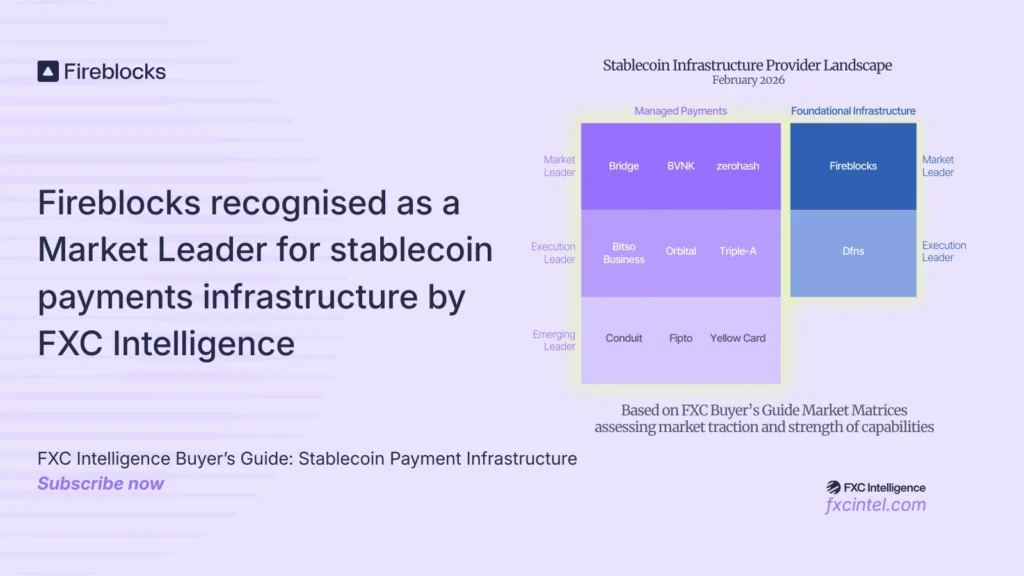
FXC evaluated 11 companies for this guide and assessed them across two categories:
- Foundational Infrastructure: covering self-managed payments and wallet infrastructure
- Managed Payments: covering providers who handle a broader end-to-end stack
Within each category, vendors are ranked as Market Leader, Execution Leader, or Emerging Leader based on market traction, strength of capabilities, volume, customer type, and geographic reach.
Fireblocks sits squarely at the top of Foundational Infrastructure.
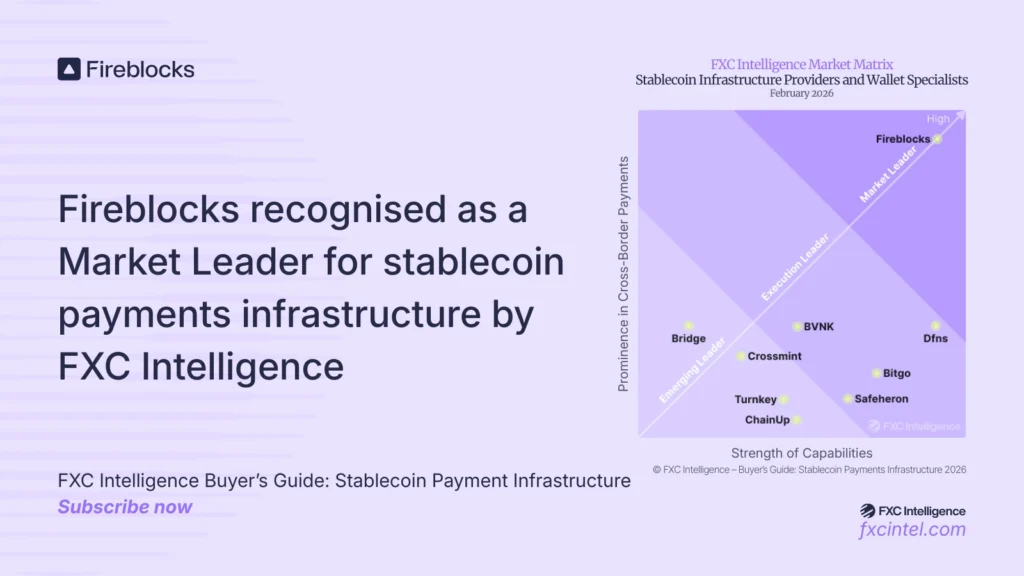
In the wallet-as-a-service matrix specifically, FXC notes that we are “by far the biggest in terms of market traction” and that we underpin many of the leading managed payment providers in the market as well. This market traction is a result of securing 550M+ wallets and facilitating $5.9T in digital asset transactions in 2025.
So even when you’re not seeing the Fireblocks brand at the surface, there’s a good chance the infrastructure underneath is ours.
What we do (and don’t do)
This is worth being precise about, because it actually explains why we win.
Fireblocks is infrastructure. A hyperscaler for digital assets.We don’t act as a payment provider. We’re the operating system for your stablecoin stack, the infrastructure layer that sits underneath and lets businesses orchestrate everything: wallets, fiat rails, on- and off-ramps, stablecoin access, compliance controls, reporting, and reconciliation, via a single API or console.
Think of it this way: if you’re a PSP or a bank building a stablecoin payment product, you still need to connect to on-ramp providers, liquidity sources, local rails, and stablecoin issuers. Fireblocks lets you do all of that through one integration and design the exact payment flow your business needs, whether that’s a stablecoin sandwich, a fiat-to-stablecoin treasury flow, or a corporate-to-consumer wallet experience that can be launched in a matter of weeks.
FXC specifically highlights three capability pillars that drive this:
Wallet infrastructure
From corporate treasury management to programmatic end-user wallet issuance at scale, with both direct custody and non-custodial embedded wallet options depending on your regulatory and operational requirements.
Stablecoin access
The underlying technology layer to access stablecoins and orchestrate the entire fiat-stablecoin payment journey, including monitoring and digital asset compliance controls built into every transaction.
Network access
The Fireblocks Network for Payments, launched in September 2025, which gives customers single-integration access to the broadest ecosystem connectivity, including on- and off-ramp providers covering 60+ fiat currencies and all major stablecoins (USDC, USDT, PYUSD), without needing to manage separate technical integrations for each.
Customers include Worldpay, Revolut, Visa, MoneyGram, Bridge, and Euronet. And as FXC points out, it’s common for organizations to use Fireblocks alongside other stablecoin providers. We’re designed to work that way for a truly interoperable, composable infrastructure that prioritizes optionality.
What the FXC Intelligence report is honest about (and so are we)
FXC also calls out some limitations that are worth mentioning.
The requirement for separate commercial onboarding with each network partner adds complexity. We’re actively working to streamline this, particularly around document collection, and it’s a priority in our product roadmap. The on- and off-ramping user experience is not yet fully unified within a single interface. That’s a real friction point, and one we’re heads-down on. And for businesses outside the US that want to fully outsource custody, our model where clients hold control won’t fit everyone. (The Fireblocks Trust Company does serve US clients as a qualified custodian, for those who need qualified custody for diversified asset support.)
These aren’t surprising limitations if you understand what we’re building: a production-grade, enterprise-scale infrastructure platform, not a simplified plug-and-play service. The tradeoff is real, and it’s intentional.
Why this recognition matters right now: the triple point
The entire crypto market is reaching a triple point of inflection in 2026 where three main business models are colliding and the line between crypto-native and traditional players continues to blur.
Crypto trading, traditional, and crypto utility business models are intersecting across assets and use cases. Fintechs are moving onchain, traditional b2b payment providers are moving value on stablecoin rails, institutions are tokenizing assets in the wake of the GENIUS Act, and major global marketplace platforms are using stablecoins for creator payouts. The underlying theme? Real-world utility.
Banks and financial institutions are actively exploring blockchain to protect existing models while gaining competitive advantage. Payments firms, fintechs and innovative enterprises are using it for real-world applications at scale. Stripe acquiring Bridge and Privy, Robinhood launching tokenized US equities on Arbitrum, and Nubank using USDC in their payment stack are all examples of how this is playing out across the globe.
Now that we’ve officially won and crossed the chasm, the real work begins. Fireblocks has built (and been recognized for) the infrastructure that moves trillions securely and at scale. Let’s work together to continue powering the future of finance with real-world crypto utility.
Want to explore what Fireblocks can do for your stablecoin payments stack? Download the full FXC Fireblocks Buyer’s Guide.