

1. Introduction: What it Takes to Secure Digital Assets
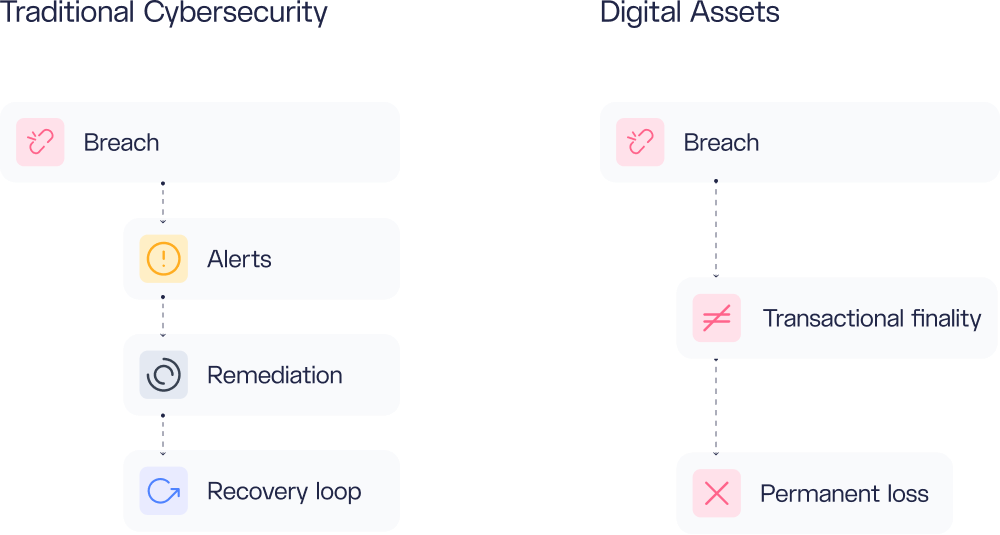
In digital assets, attackers need to succeed only once. When a malicious transaction reaches finality on the blockchain, there’s rarely a way to recover funds.
This makes the domain fundamentally different from traditional cybersecurity, where breaches can mean system downtime, leaked sensitive data, or compliance penalties—problems that are serious but often recoverable. With digital assets, the risk is direct and irreversible loss of funds, posing an existential threat to the growing number of businesses managing these assets for their own operations or on behalf of customers.
The primary objective of security in digital assets, therefore, is to protect assets from theft or loss.
This can be daunting given the ever-evolving threats in the blockchain landscape. But with the right approach that takes into consideration multiple attack vectors and sophisticated actors, it is possible to effectively mitigate threats and better protect funds.
In this paper we outline a comprehensive framework for protecting digital assets against modern threats. We provide an overview of some of the most concerning attack vectors in the space, and show how Fireblocks’ defense-in-depth security protects your operations even when individual components are compromised.
2. The Blockchain Threat Landscape
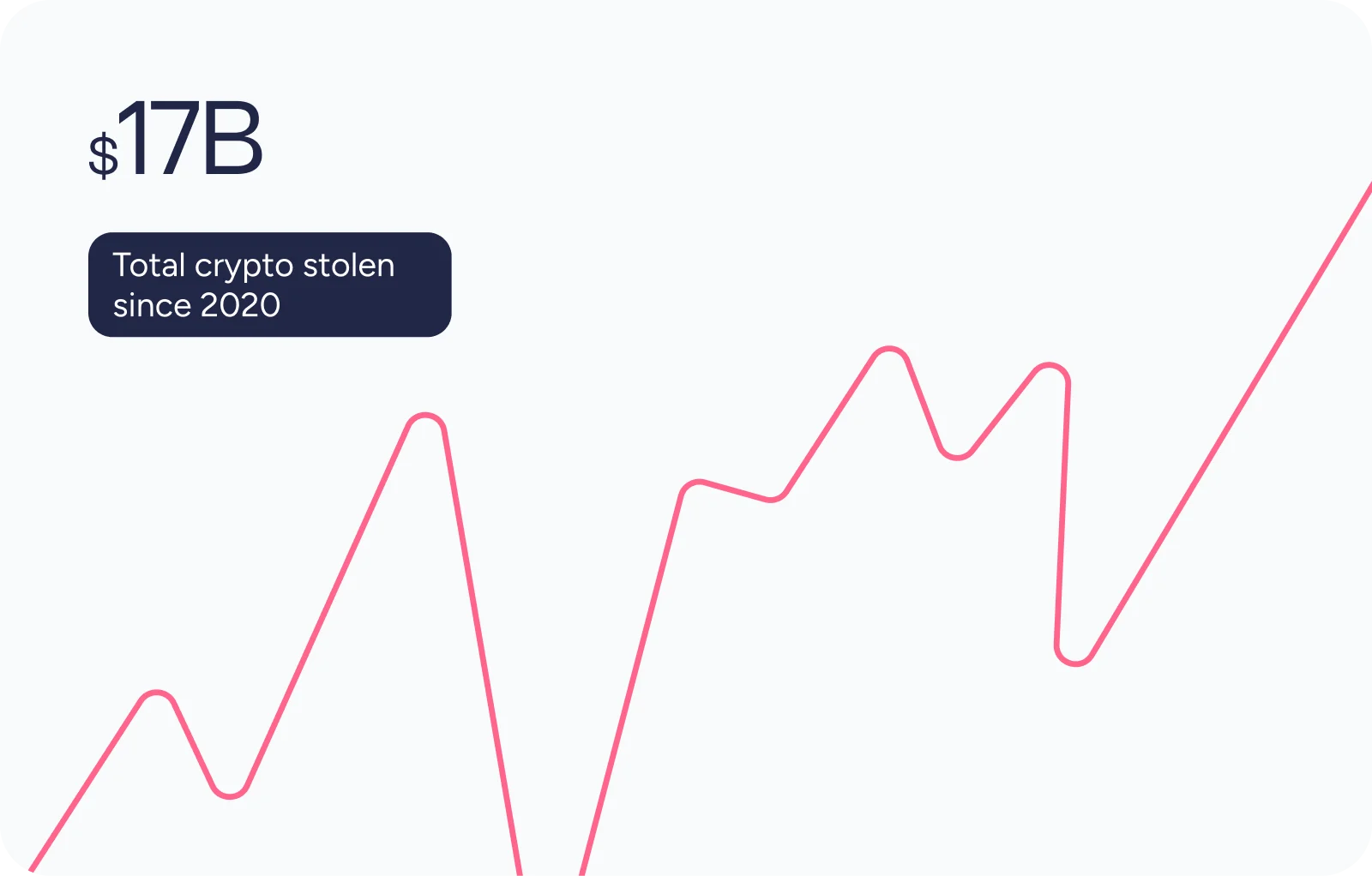
The blockchain ecosystem is one of the most lucrative targets for cyber adversaries, with cryptocurrency-related theft reaching unprecedented levels. In 2025 alone, hackers stole over $3.4 billion worth of cryptocurrency, with stolen totals since 2020 now surpassing $17 billion. As digital asset adoption expands and valuations climb, the space becomes even more attractive to malicious actors.
The threat landscape ranges from sophisticated nation-state operations to commoditized services that give even non-technical actors access to wallet-draining tools. It is crucial for institutions in the digital asset space to understand these adversaries and their methods.
Threat Actors
State-Sponsored Actors: The Democratic People’s Republic of Korea (DPRK)
North Korea is the most significant nation-state threat to digital asset security, with state-sponsored hacking operations serving as a critical revenue stream for the regime’s weapons programs. Since 2017, DPRK-linked actors have stolen approximately $6.75 billion in cryptocurrency. They account for three-quarters of all attacks on crypto platforms, with operations nearly five times larger on average than other threat actors.
If you think your organization is too small to attract North Korean attention, think again. While headline-grabbing breaches like the $1.5 billion Bybit hack dominate the news, Fireblocks Security Research shows many DPRK attacks target smaller platforms for single-digit millions or less. The regime’s cyber operations, conducted primarily through the Reconnaissance General Bureau (RGB), cast a wide net. Unlike traditional state-sponsored groups focused on espionage, DPRK operations blend intelligence gathering with direct financial theft, targeting institutions of all sizes.
The Lazarus Group: DPRK’s Premier Cyber Weapon
The Lazarus Group, also known as APT38, is the most notorious and capable threat actor targeting the cryptocurrency ecosystem. Operating under DPRK’s RGB, Lazarus has evolved from conducting disruptive attacks, such as the 2014 Sony Pictures breach and the 2017 WannaCry ransomware outbreak, to becoming the world’s most prolific cryptocurrency thief. Their February 2025 breach of Bybit is currently the largest cryptocurrency heist in history.
DPRK threat actors employ multiple attack vectors:
Operation Dream Job (active 2019-2020) and Contagious Interview (active since 2023) are North Korean social engineering campaigns targeting employees in defense, aerospace, and cryptocurrency sectors. Using fictitious LinkedIn profiles and fake job offers from prestigious companies, attackers deliver malware through trojanized documents, malicious coding tasks, and compromised repositories during fabricated application and interview processes. These campaigns have successfully compromised major cryptocurrency platforms and industry leaders.
Transaction Manipulation Attacks target private key infrastructure and signing processes. The Bybit attack involved compromising a developer machine to alter what signers saw in the multi-signature wallet UI, causing them to unknowingly approve malicious transactions. Similar transaction manipulation techniques have been documented to steal over $1 billion from industry leaders in recent years.
IT Worker Infiltration involves North Korean operatives using fraudulent identities to obtain remote technical positions at crypto and technology companies. In the best case scenario, the target organization unknowingly funds a sanctioned regime through salary payments. In the worst case, operatives exploit their privileged access for reconnaissance or future attacks.
Once an exploit has succeeded, DPRK actors maintain highly efficient laundering pipelines utilizing mixers, cross-chain bridges, no-KYC exchanges, and Chinese-speaking OTC networks, frequently laundering entire stolen amounts within 48 hours of theft, including operations exceeding hundreds of millions of dollars.
Organized Cybercrime: Drainer-as-a-Service (DaaS)
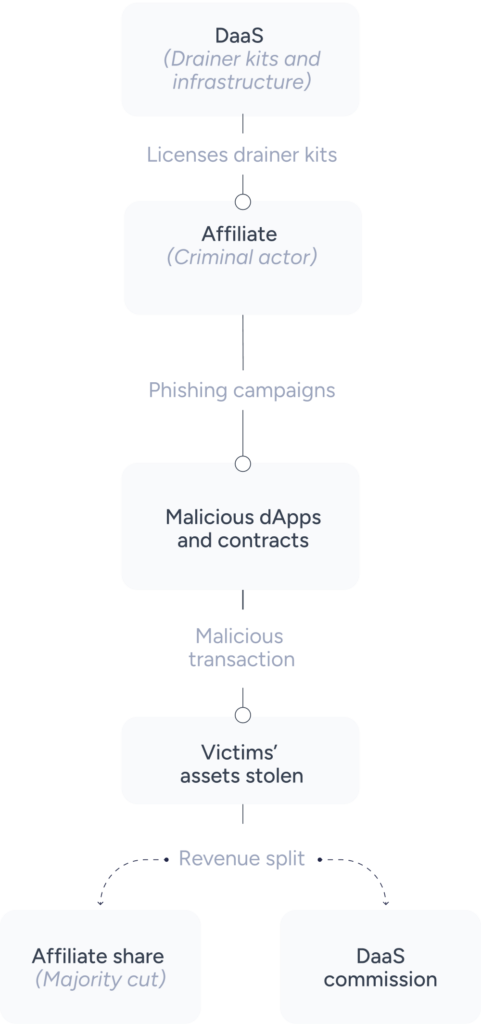
Organized cybercrime in the digital asset space has become increasingly professionalized and service-oriented. Drainer-as-a-Service (DaaS) operations represent the most visible example of this shift by packaging sophisticated theft tools for non-technical criminals. In this model, DaaS developers create wallet-draining kits and license them to affiliates—the criminals who deploy phishing campaigns and execute attacks—on a revenue-share basis. Affiliates retain the majority of stolen assets while developers collect a commission, enabling theft at scale by actors who lack specialized skills.
Inferno Drainer: A Case Study in DaaS Evolution
Inferno Drainer is the most notorious example of the DaaS model. It provided turnkey phishing infrastructure that enabled non-technical affiliates to deploy high-quality phishing pages impersonating over 100 legitimate cryptocurrency brands, including Seaport, WalletConnect, and Coinbase. When victims interacted with these fake interfaces, they unknowingly authorized fraudulent transactions that drained their wallets, with stolen funds split between affiliates and the drainer developers.
The revenue-share model proved extraordinarily successful, enabling theft from over 167,000 victims with total losses exceeding $250 million across more than 16,000 unique phishing domains.
Unorganized Cybercrime: Opportunistic Exploitation
Beyond state-sponsored operations and organized DaaS ecosystems there is a substantial threat from individual actors and loosely-coordinated groups exploiting vulnerabilities opportunistically. These threat actors lack the resources and sophistication of nation-state operators but compensate through volume and adaptability.This category encompasses individual hackers and small groups exploiting various vulnerabilities in the digital asset ecosystem. Indictments that illustrate the varied nature of these threats include:
- Liquidity Pool Manipulation (Feb 2025): A hacker exploited DeFi protocols through manipulative trading, draining $65 million from liquidity pools.
- Multi-Year Phishing Campaign (Nov 2024): Five individuals ran a multi-year phishing campaign spoofing authentication portals, stealing millions in cryptocurrency and compromising confidential data from tech companies.
- Social Engineering Scheme (Aug 2024): Criminal associates impersonated tech support staff to steal authentication credentials and obtain 4,100 Bitcoin ($263 million) from a Washington DC victim.
- Transaction Validation Manipulation (May 2024): Two MIT-educated brothers exploited Ethereum transaction validation protocols to steal $25 million in 12 seconds.
- Flash Loan Exploit (July 2022): A former security engineer exploited DeFi smart contracts via flash loans, stealing over $12 million.
Beyond external attackers, malicious insiders including employees, contractors, or partners with legitimate access can exploit their privileged positions to steal private keys, manipulate transaction signing processes, or disable security controls. The cryptocurrency industry’s rapid growth and competitive hiring environment can result in insufficient background verification, while the high value of accessible assets creates significant temptation.
Threat Vectors
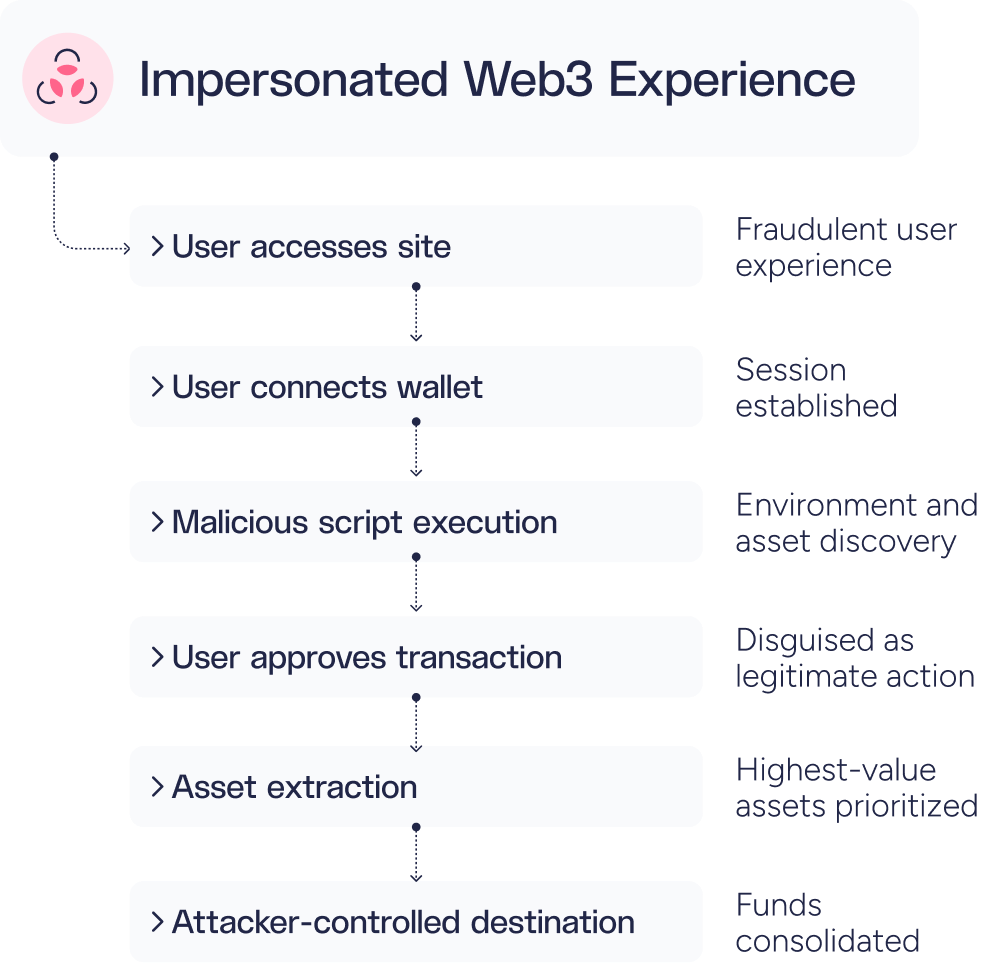
Crypto Phishing and Wallet Drainers
Wallet drainers are malicious scripts designed to siphon assets from cryptocurrency wallets by tricking users into authorizing fraudulent transactions. Attackers deploy phishing sites that impersonate legitimate web3 services, token airdrops, or NFT mints, prompting victims to connect their wallets and sign malicious transactions. Drainer scripts automatically identify and steal the wallet’s most valuable assets. The proliferation of DaaS platforms has made these attacks accessible to low-skilled operators, establishing wallet drainers as one of the most pervasive and dangerous threat vectors in DeFi.
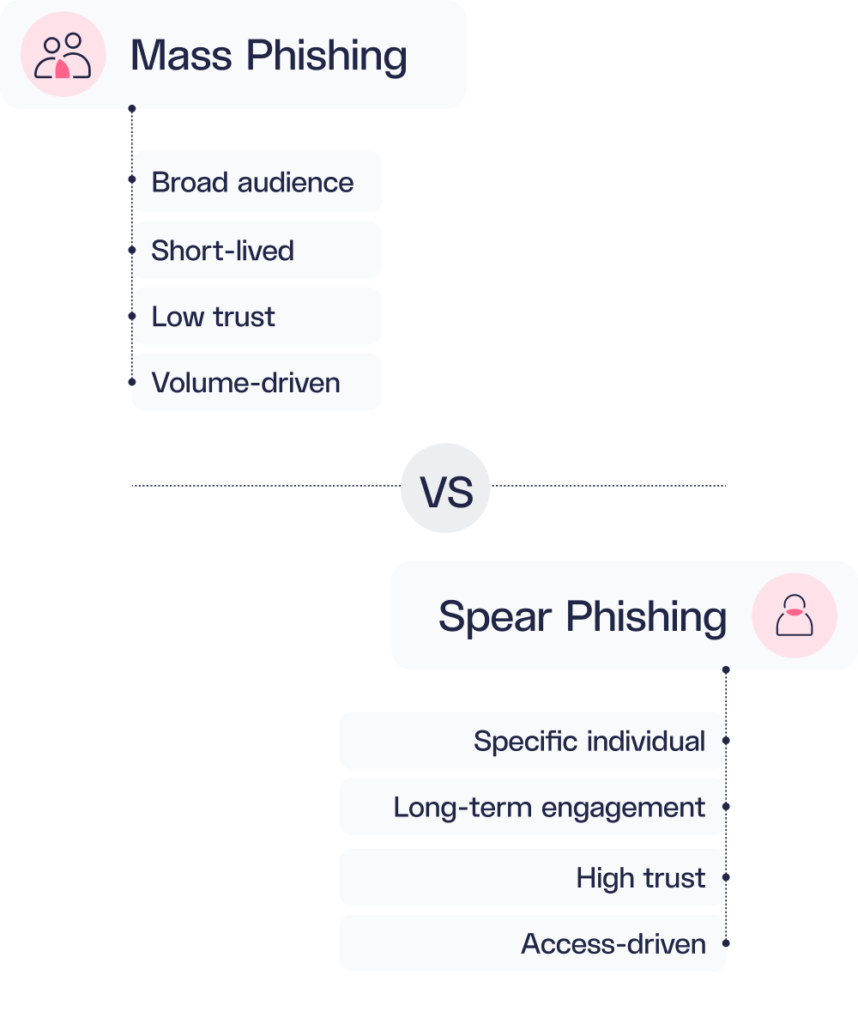
Spear Phishing and Social Engineering
Unlike broad phishing campaigns, spear phishing involves highly targeted attacks against specific individuals with privileged access. Attackers conduct extensive reconnaissance to craft personalized lures, such as fake job offers, investment opportunities, or partnership proposals tailored to the target’s role and interests. These campaigns often involve prolonged engagement through LinkedIn, email, phone calls, videoconference calls, or messaging platforms to build trust before delivering malware or extracting credentials. Contagious Interview exemplifies this approach, successfully compromising employees at defense contractors and cryptocurrency firms through fabricated recruitment processes.
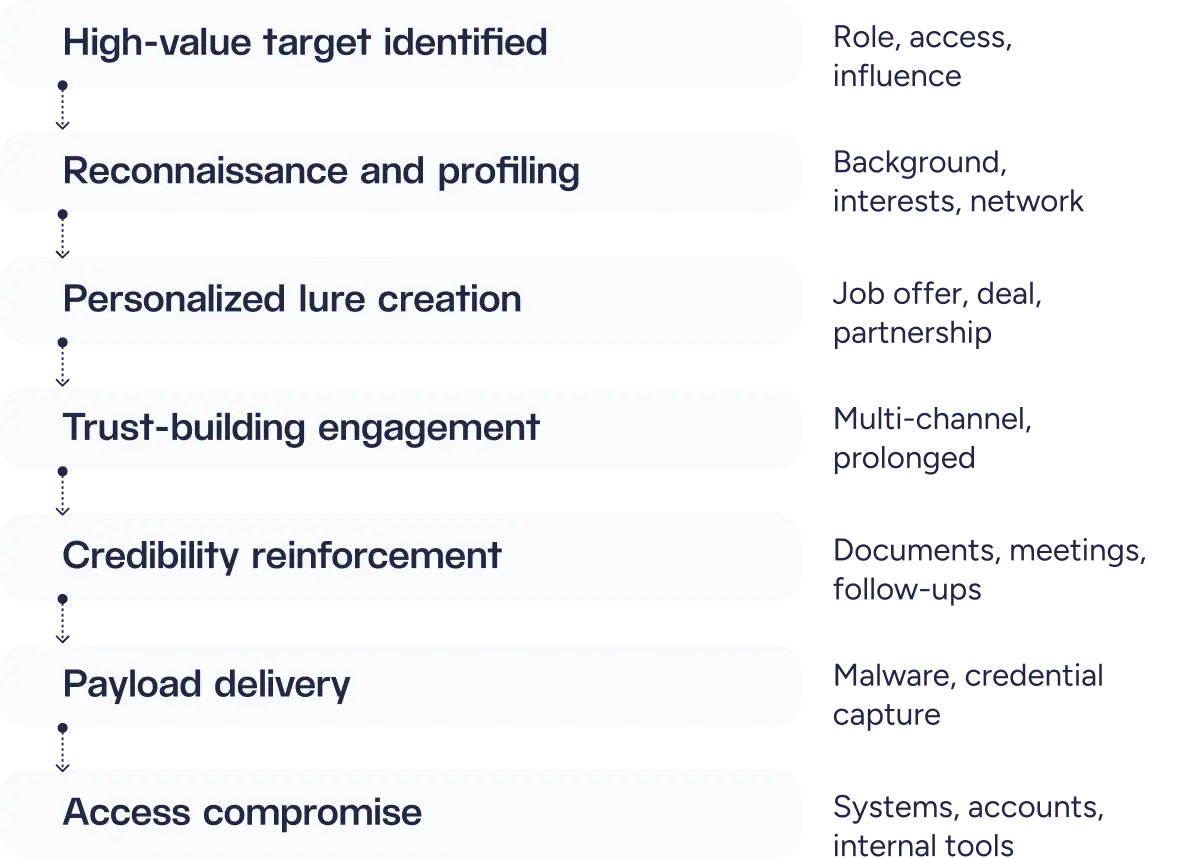
An evolution of this tactic involves fake videoconference meetings. Attackers compromise Telegram accounts to impersonate trusted contacts, then guide victims to fake Zoom or Teams calls using pre-recorded footage of real individuals from previous hacks or public sources. During the call, the attacker claims audio issues and sends a “patch file” or requests an SDK update to “fix” the problem, which actually installs Remote Access Trojan (RAT) malware granting complete system control. This method has proven highly effective, stealing over $300 million from cryptocurrency executives.
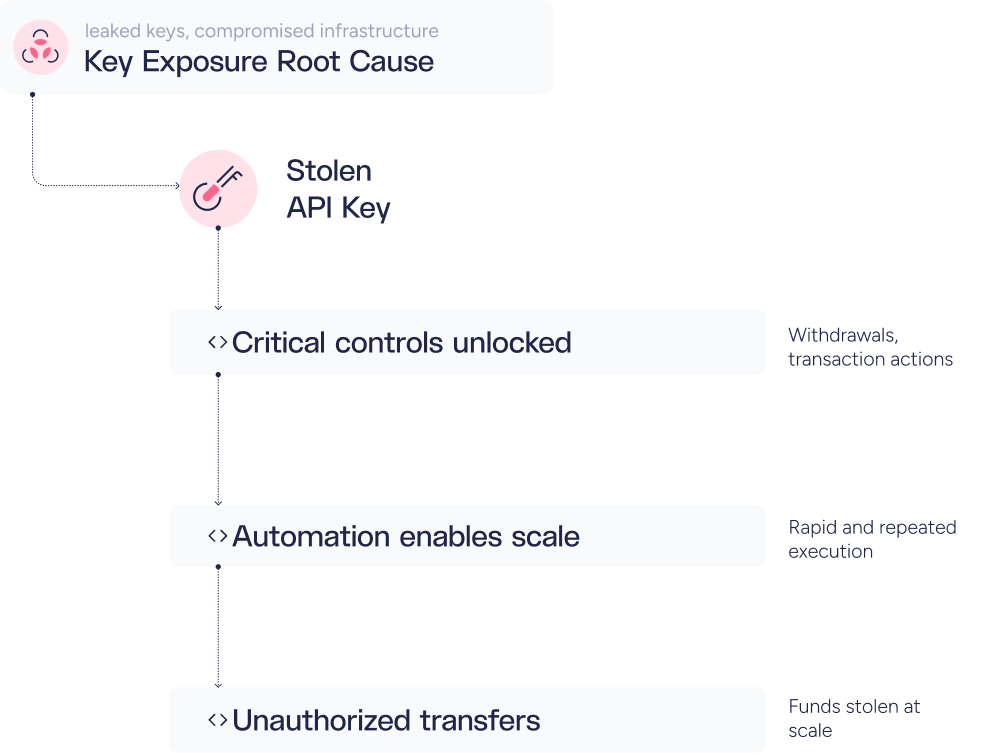
API Compromise
API compromise, particularly through stolen API keys, has become one of the most common attack vectors against cryptocurrency platforms. Attackers compromise developer machines, internal systems, or legitimate users to steal API credentials that control critical functions such as withdrawals, transaction signing, or account management. With these stolen keys, attackers can take over transaction management systems, identify vulnerabilities in authorization logic, and execute unauthorized fund transfers at scale, often bypassing user-facing security controls entirely. The automated nature of API access enables rapid, large-scale theft once credentials are obtained.

Privilege Abuse
Privilege abuse occurs when individuals with legitimate system access such as employees, contractors, or compromised administrator accounts exploit their permissions for unauthorized purposes. This may include direct theft of funds or private keys, manipulation of transaction approval processes, disabling of security controls or monitoring systems, and theft of sensitive customer or operational data.

Private Key Compromise
Private key compromise remains the most consequential attack vector, as control of private keys grants complete authority over associated assets. Attackers target keys through malware, phishing for seed phrases, exploitation of insecure key storage, or compromise of key management infrastructure.

Blind Signing
Blind signing occurs when users or operators approve transactions without full visibility into what they are authorizing. Attackers exploit this by manipulating transaction data, compromising signing interfaces, or presenting malicious transactions through legitimate-appearing workflows.

Address Poisoning
Address poisoning exploits user reliance on transaction history for address verification. Attackers monitor the blockchain for active wallets then send negligible transactions from addresses that visually resemble the victim’s frequently-used addresses, matching the first and last characters while differing in the middle. When victims copy addresses from their transaction history without careful verification, they inadvertently send funds to the attackers’ lookalike address.
3. Fireblocks’ Defense-in-Depth Approach to Security
Fireblocks was founded by cybersecurity veterans who spent years defending critical nation-state infrastructure. From day one, the platform was built with an adversarial mindset, anticipating sophisticated attackers would probe every layer and that no single security control could be considered unbreakable. This founding philosophy remains core to Fireblocks’ solutions as the platform evolves to meet increasingly complex and diverse institutional requirements.
As our customers’ activities have grown from securing static treasury holdings to managing high-frequency trading operations, complex DeFi strategies, tokenization programs, and cross-border payment flows, our architecture has evolved in parallel. What began as a focus on private key protection through multi-party computation (MPC) has expanded into a comprehensive framework. Each new capability is designed as an integrated layer within a holistic security system, where multiple independent controls work together to help prevent, detect, and contain threats.
The result is a multi-layered security architecture where the compromise of a single component should not by itself enable unauthorized access to funds. In an environment where nation-state actors, organized crime networks, and malicious opportunists pose persistent threats, organizations need security systems designed to withstand sophisticated, multi-vector attacks.

Zero-Trust Architecture
Fireblocks’ platform is designed with zero-trust principles as a foundation: it denies implicit trust to internal systems, requiring explicit validation for all authentication attempts. From development and deployment, to data storage, to transaction verification and authorization, critical operations execute within hardware-isolated secure enclaves to help protect cryptographic material, algorithms, and sensitive code from both external attackers and malicious insiders.
Key capabilities:
- Cryptographic enforcement: Sensitive operations (transaction initiation, approval, signing) are cryptographically enforced to originate only from the user’s trusted (non-Fireblocks) environment
- Hardware isolation: Critical operations execute in hardware-isolated environments (SGX/Nitro enclaves and other TEEs), protecting MPC key shares, policy enforcement, transaction serialization, and operation approval flows
- Attestation: End-to-end attestation verifies that authorized code runs within secure enclaves (TEEs)
- Inter-module authentication: Inter-module communication is cryptographically authenticated
- Zero-trust DevOps: Zero-trust principles applied to privileged back-end operations, including code deployment, updates, ongoing system administration, and troubleshooting
- Encrypted enclave-protected storage: Sensitive data (MPC shares, credentials, secrets) and integrity-critical data (whitelisted addresses, approval keys, policy rules) are stored in encrypted databases running inside secure enclaves, accessible only to attestated services
- Distributed data verification: Co-signers independently verify cryptographically signed transaction data and state across the entire flow, helping to prevent single-point data manipulation and support transaction immutability
- Zero-trust verification model: Signing callbacks enable customers to cryptographically verify that both the signing process and transaction data match their original requests, eliminating reliance on trust in Fireblocks’ infrastructure alone
Multi-Device Approval
Sensitive operations require multi-device and user approval, separating transaction initiation from authorization and signing to help prevent single point of compromise. Approval and signing devices leverage trusted execution environments (TEEs), biometric authentication, hardware-backed authenticators such as YubiKey and PIN code, and system integrity checks to help ensure that transaction approvals and signing can be performed only by authorized users on uncompromised devices and that cryptographic signing operations are executed in a tamper-resistant environment.
Multiple device types are available for sensitive approval operations, providing device diversification to reduce platform-specific risks. Approval and signing interfaces clearly display human-readable transaction data, mitigating threats of blind signing, data manipulation, or address manipulation.
Key capabilities:
- Transaction initiation: Transactions can be initiated via web console, API, or integrations
- Independent approval: Approval occurs independently via Fireblocks’ mobile app with biometric authentication (FaceID/TouchID) and PIN code, or through customer-managed co-signer infrastructure that enables integration of custom authorization logic via secure callback mechanisms
- Device integrity verification: System checks help verify that devices are not jailbroken or compromised before approval
- Payload verification: Transaction payloads are cryptographically signed and verified end-to-end across devices and services
- Approval and signing key isolation: Approval and signing keys are stored in hardware-isolated secure enclaves (TEEs)
- Diversified approval device support: Support for iOS devices, Android devices, Intel SGX, AWS Nitro, GCP Confidential Spaces, and others, with diversified operating systems and TEE options
- Transaction clarity: Transaction details are displayed to approvers in clear, contextual, human-readable language with built-in transaction simulation
- Multi-factor authentication: PIN code, biometrics, and optional YubiKey help protect against unauthorized mobile app access
- Push notification system: Real-time push notifications enable flexible approval and signing from any authorized location
- Asymmetric API authentication: API authentication uses asymmetric cryptography, minimizing the risk of API secret exposure and unauthorized fund movements
Distributed Wallet Infrastructure
By default, MPC-based private keys are distributed across multiple isolated environments with cryptographic guarantees to mitigate single points of compromise while giving clients control of their assets. Key material should not exist whole at any point, whether during generation, storage, or signing, to help prevent any single component from resulting in key extraction or unauthorized transaction signing.
Key capabilities:
- Distributed key generation: MPC-CMP protocol generates and stores private keys as shares that never combine
- Flexible deployment models: Customers can deploy MPC key shares across a hybrid SaaS model with shares distributed between Fireblocks and customer infrastructure, self-hosted private cloud (SGX), self-managed HSM environments, or custom in-house signing infrastructure
- Flexible storage models: Support for hot, warm, and cold storage configurations
- HD wallet architecture: Hierarchical Deterministic (HD) wallets mitigate seed phrase vulnerability
- Blockchain agnostic: Universal signature generation supporting ECDSA and EdDSA algorithms
- Key refresh and rotation: Optional automated key refresh and rotation capabilities
- Peer-reviewed protocol: Open-source MPC-CMP protocol audited by leading security firms
Policy and Governance Engine
The Fireblocks Policy Engine enforces granular transaction authorization rules across digital asset operations, creating separation of duties that helps prevent internal collusion and cryptographically enforces approval quorums. Policies themselves are designed to operate in a zero-trust manner, are protected within secure enclaves (TEEs), and require a quorum for modification. Maker-checker quorums are available for all sensitive operations.
Key capabilities:
- Granular transaction controls: Rules based on source, destination, asset type, amount, and onchain operations including smart contract methods (EVM) and program calls (Solana)
- Multi-user approval workflows: Customizable quorums and role-based permissions for transaction authorization
- Custom callbacks for policy and verification: Customer-driven co-signer integrations for independent transaction verification and extended policy enforcement prior to signing
- Risk-based automation: Automated and manual approval paths triggered by configurable risk thresholds
- Admin quorum protection: Multi-administrator approval requirements for policy modifications and configuration changes
- Address whitelisting: Interactions restricted to pre-approved addresses only
- API permission scoping: Programmatic access limited to explicitly defined operations per API user
- Compliance integration: Native integration with compliance screening for AML, KYT, and sanctions checks
- Multi-layer enforcement: Policy validation occurs at initiation, validation, and signing stages
- Comprehensive audit trail: Comprehensive logging of policy decisions, approvals, and authorization events with real-time streaming to external logging and analytics platforms
Policies are the first line of defense.
As enterprises scale their digital asset operations, manual security reviews can struggle to keep pace with frequent updates to settings and workflows. Policy drift can accumulate unnoticed until an incident occurs.
Fireblocks’ Security Research shows nearly all digital asset theft incidents stem from misconfigured policies leading to unintentional authorizations. Policies are the most critical line of defense, and a single overlooked setting can expose an organization to significant risk. Fireblocks Security Posture Management (FSPM) is the first security posture management solution purpose-built for digital assets. FSPM acts as a dedicated security advisor, continuously monitoring configurations and providing clear guidance on how to remediate issues before they become incidents.
Secure Operations Environment
Fireblocks provides secure-by-design pathways for digital asset operations, enabling direct interactions with CeFi and DeFi applications without requiring external connections that increase attack surface. Native integrations for staking and token swaps allow users to access institutional validators and decentralized exchanges directly through the Fireblocks platform, protecting against risks associated with browser extensions and unvetted dApps.
The Fireblocks Network extends this secure interaction model to counterparty transfers, providing authenticated channels between institutional participants. Encrypted tunnels verify destination addresses at the source, protecting against man-in-the-middle attacks, address poisoning, and human error in address handling. The Network connects over 2,500 institutions, including exchanges, banks, and liquidity providers, facilitating secure, direct transfers without the need for manual address exchange.
Key capabilities:
- Native financial operations: Integrated DeFi operations, including staking and swaps, reduce exposure to external connection risks and unvetted applications
- Direct counterparty connections: Elimination of manual address exchange between network participants
- End-to-end encryption: Encrypted tunnels protect deposit address queries throughout transmission
- Hardware-terminated connections: Secure enclaves utilized on both sending and receiving endpoints
- Cryptographic attestation: Source attestation cryptographically proves destination address authenticity
- Automatic address rotation: Option to automatically rotate UTXO addresses to preserve transaction privacy
- Fail-close architecture: Automated blocking of transfers upon detection of attacks or anomalies
- Network profile management: Institutional counterparty management and deposit routing without direct address sharing
- Attack vector mitigation: Protection against clipboard malware, phishing, and address poisoning attacks
Transaction Scanning and DeFi Threat Detection
Real-time threat intelligence and transaction simulation protect against malicious apps, compromised contracts, and hidden exploits. Transaction clarity decodes complex smart contract interactions into human-readable actions, enabling informed approval decisions rather than blind signing.
Key capabilities:
- Transaction simulation: Pre-execution simulation displays exact transaction outcomes before approval
- Smart contract analysis: Automated identification of suspicious or malicious contract behavior
- Real-time threat intelligence: Integration with blockchain security vendors and OSINT for recent threat data
- Malicious dApp protection: Real-time risk analysis and blocking of dangerous dApp connections
- Transaction decoding: Raw call data translated into human-readable actions and operations
- Typed message interpretation: Signature requests decoded to reveal true intent (permits, approvals, transfers)
- Permission risk detection: Identification of unlimited token approvals and high-risk permission grants
- DeFi-specific policies: Granular controls for contract interactions, asset approval operations, and dApp connectivity
- Anomaly detection: Automated flagging of unusual transaction patterns or suspicious destinations
Backed by Certified Security Practices
Fireblocks’ defense-in-depth architecture is independently validated through rigorous third-party certifications: SOC 2 Type II with zero material findings, ISO 27001/27017/27018/22301, and the industry’s gold standard C4 CCSS Qualified Service Provider Level 3. Fireblocks was the world’s first platform to achieve this certification.
These certifications are backed by continuous operational vigilance. We maintain a 24/7 Security Operations Center (SOC), with analysts distributed across the US, EMEA, and APAC, providing round-the-clock monitoring and real-time threat response.
This combination of rigorous third-party validation and continuous operational monitoring enables our defenses to evolve to address emerging threats.

4. How Fireblocks Defenses Are Designed to Mitigate Threats
The following section maps Fireblocks’ security controls to specific threat vectors through a comprehensive coverage matrix and detailed attack scenarios, demonstrating how our defense-in-depth architecture uses layers of controls to help defend against unauthorized fund movements.
Threat-to-Defense Mapping Matrix
The matrix below shows how these security layers work in concert to mitigate threat vectors. Crypto phishing attacks must overcome multi-device approval, policy engine restrictions, and DeFi threat detection. Private key compromise attacks, which are a primary vector for nation-state actors, face distributed key shares that never exist whole, hardware-isolated enclaves protecting those shares, and multi-device approval requirements. These identified threat vectors face at least three independent security layers, with most confronting four or more.
| Threat Factor | Zero Trust Architecture | Multi-Device Approval | Distributed Wallet Infrastructure | Policy & Governance Engine | Secure Operations Environment | Transaction Scanning & DeFi Threat Detection |
| Crypto Phishing & Wallet Drainers | ⚪ | ⚫ | ⚪ | ⚫ | ⚪ | ⚫ |
| Spear Phishing & Social Engineering | ⚫ | ⚫ | ⚪ | ⚫ | ⚫ | ⚪ |
| API Compromise | ⚪ | ⚪ | — | ⚫ | — | — |
| Privilege Abuse | ⚫ | ⚫ | — | ⚫ | — | ⚪ |
| Private Key Compromise | ⚫ | ⚪ | ⚫ | ⚪ | — | — |
| Blind Signing | ⚪ | ⚫ | — | ⚫ | ⚪ | ⚫ |
| Address Poisoning | — | ⚪ | — | ⚫ | ⚫ | ⚪ |
⚫ Primary Defense: Core control specifically designed to prevent threat
⚪ Secondary Defense: Provides additional protection or detection capability
— Indirectly applicable to this vector
Attack Scenario Walkthroughs
Sophisticated threat actors employ multi-stage attacks that target different aspects of digital asset operations. Fireblocks’ defense-in-depth architecture is designed to protect against these complex attacks by significantly increasing the difficulty and cost for attackers at each stage.
Scenario 1: Nation-State Attack on Asset Manager Treasury
Threat Context
An asset management firm’s treasury wallet is targeted by a sophisticated threat actor employing tactics consistent with DPRK-affiliated groups. The attackers aim to manipulate the transaction signing process to redirect funds to attacker-controlled addresses, mirroring the techniques used in the Bybit breach where attackers compromised signing infrastructure to display fraudulent transaction details to approvers.
Hypothetical Attack Flow:
Stage 1: Initial Compromise
- Attackers conduct reconnaissance on the firm’s employees, identifying operations staff with transaction approval responsibilities. Through a targeted spear phishing campaign, they deliver malware to a senior operator’s workstation.
Stage 2: Infrastructure Manipulation
- With persistent access to the compromised workstation, attackers monitor transaction workflows and identify the signing process. They deploy tools to intercept and modify transaction data displayed on the compromised machine, similar to the Bybit attack where the Safe{Wallet} interface was manipulated to show legitimate-appearing transaction details while the underlying payload contained malicious instructions.
Stage 3: Execution Attempt
- The attackers wait for a routine large transfer and attempt to substitute the destination address with an attacker-controlled wallet. The compromised workstation displays the expected recipient address to the initiating operator while the actual transaction payload targets the malicious address.
Fireblocks Defense Layers Activated
| Layer | Control | Action |
| Multi-Device Approval | Independent mobile verification | Transaction details rendered on separate, uncompromised mobile devices show the true destination address, revealing discrepancy with workstation display |
| Transaction Scanning & DeFi Threat Detection | Transaction decoding | Mobile app displays decoded transaction details including actual recipient, amount, and contract interactions; approver sees true transaction intent |
| Policy & Governance Engine | Destination restrictions | Transaction to non-whitelisted address automatically blocked; requires address to be pre-approved through separate quorum process |
| Policy & Governance Engine | Amount thresholds | Large transfer triggers enhanced approval requirements; multiple independent approvers required, each viewing transaction on separate trusted devices |
| Zero-Trust Architecture | IP whitelisting | API calls and transaction initiations restricted to pre-approved IP ranges; attempts from unauthorized network locations blocked |
Outcome Objective
The hypothetical attack should fail at multiple independent points, even with full control of an operator’s workstation. The multi-device approval architecture is designed to render transaction details on trusted, hardware-secured devices outside attacker control. Policy controls provide additional layers to help block unauthorized destinations and enforce approval quorums, while IP restrictions reduce the attack surface. Implementing the defense-in-depth approach helps prevent a compromise of a single component, including an employee workstation, from resulting in unauthorized fund transfers.
Scenario 2: Wallet Drainer Targeting DeFi Operations
Threat Context
A digital asset fund employs traders who interact with DeFi protocols as part of their investment strategy. A threat actor targets these operations by deploying a wallet drainer designed to harvest unlimited token approvals and permit signatures.
Hypothetical Attack Flow
The attacker deploys a fraudulent site mimicking a legitimate DeFi protocol, embedding malicious JavaScript that manipulates the interface to deceive users into signing:
- Unlimited ERC-20 token approvals to attacker-controlled contracts
- Offchain permit signatures granting spending authority without onchain approval transactions
Fireblocks Defense Layers Activated
| Layer | Control | Action |
| Transaction Scanning & DeFi Threat Detection | dApp scanning | dApp connection is scanned to identify compromised malicious indicators and known drainer infrastructure, alerting user before any transaction is initiated |
| Transaction Scanning & DeFi Threat Detection | Transaction scanning | Behavioral and technical heuristics evaluate pending transactions for anomalies including interaction with flagged addresses and deviation from expected contract behavior; user alerted to specific risks before signature |
| Policy & Governance Engine | Address whitelisting | Transaction to non-whitelisted addresses automatically blocked; attacker-controlled approval target must first pass through separate approval and whitelisting process |
| Policy & Governance Engine | dApp access policy | Access restricted to pre-approved dApps only, limiting the attack vector at the interface layer |
| Policy & Governance Engine | Typed message policies | Typed message initiation and signing restricted to specific users and conditions only |
Outcome Objective
The hypothetical attack should fail at multiple points before asset theft can occur. Real-time threat intelligence is intended to help identify the impersonating dApp upon connection attempt, alerting users before transaction initiation. Should a user proceed, transaction-level analysis should help detect the anomalous transaction patterns and flag interaction with suspicious destination addresses. Policy controls provide additional defensive layers: dApp access policy prevents connection to unapproved or fraudulent sites, address whitelisting blocks transactions to non-approved contracts, and typed message policies enforce additional approval requirements for offchain signatures. This defense-in-depth approach helps prevent a convincing protocol impersonation from resulting in unauthorized transactions and asset theft.
Scenario 3: Malicious Insider Threat
Threat Context
A senior employee authorized to approve transactions decides to exploit their position to steal funds. The insider holds legitimate credentials and is an authorized approver within the organization’s transaction workflow. This scenario represents one of the most challenging threats: an adversary operating with valid authorization, institutional knowledge, and an understanding of operational procedures within the organization.
Hypothetical Attack Flow:
The insider attempts to execute an unauthorized withdrawal to an external wallet under their control. As a legitimate approver, they expect their authorization to be sufficient, or attempt to manipulate timing and procedures to complete a transaction without proper oversight.
Fireblocks Defense Layers Activated
| Layer | Control | Action |
| Policy & Governance Engine | Approval quorums | Transaction authorization requires multiple independent approvers; the insider’s legitimate approver status provides only one of the required signatures |
| Policy & Governance Engine | Destination whitelisting | Transfers restricted to pre-approved addresses; adding new destinations requires separate quorum that prevents unilateral approval |
| Policy & Governance Engine | Role-based permissions | Approval authority scoped to specific transaction types and amounts; elevated withdrawals require additional independent approvers |
| Multi-Device Approval | Independent device verification | Each approver authorizes on their own hardware-secured device; insider cannot access or impersonate other approvers’ sessions |
| Multi-Device Approval | Biometric authentication | Approval requires biometric verification on enrolled device; credential knowledge insufficient without physical device and biometric presentation |
Outcome Objective
The hypothetical attack should fail despite the insider holding legitimate approval authority. Policy restrictions are intended to prevent a single individual from unilaterally authorizing transactions. The insider can initiate a transaction and provide one approval, but should not be able to complete the required quorum or add unauthorized destinations without collusion from independent parties outside their control.
Fireblocks’ security layers provide overlapping controls that help protect against sophisticated threats, but their effectiveness depends on proper implementation and ongoing maintenance. Strong security posture requires continuous monitoring of configurations, regular review of policy settings, and prompt remediation of gaps or misalignments as operations evolve. For organizations seeking additional assurance that security controls remain properly configured at scale, Fireblocks Security Posture Management (FSPM) provides automated monitoring, helping to identify configuration drift, policy weaknesses, and potential vulnerabilities before they can be exploited.
5. Conclusion: Staying Ahead of Evolving Threats
The digital asset security landscape continues to evolve. Nation-state actors conduct sustained campaigns with advanced technical capabilities and long-term persistence as a strategic revenue generation engine. Organized crime has professionalized, with criminal networks operating like legitimate SaaS businesses. Meanwhile, artificial intelligence is amplifying threat sophistication, enabling unprecedented phishing personalization through deepfake impersonations, AI-assisted social engineering, and automated vulnerability discovery that evolves faster than traditional defenses can adapt.
In this environment, legacy security approaches designed for simpler times and more limited use cases will not suffice. What remains constant, however, are the fundamental principles that enable organizations to stay ahead:
Defense in depth is non-negotiable. No single security technology can protect against the full spectrum of modern threats. Comprehensive security requires multiple independent layers that maintain protection even when individual controls are compromised.
Assume breach, architect for resilience. Security systems must be designed with the assumption that attackers will gain some level of access. The question is not whether defenses will be tested, but whether the architecture contains and limits damage when they are.
People, process, and technology must align. Technical controls are effective only when combined with sound operational security, including proper access management, personnel vetting, continuous monitoring, and incident response capabilities. The most sophisticated cryptography cannot protect against social engineering if approval processes lack adequate scrutiny.
Transparency enables trust and detection. In an environment where threats constantly evolve, the ability to audit, monitor, and verify security controls in real-time is essential. Transaction clarity prevents blind signing, comprehensive logging enables forensic analysis, and continuous anomaly detection identifies suspicious patterns before they result in losses.
Security must enable operations, not obstruct them. A secure system that cannot support business requirements will be circumvented. Effective security architectures balance protection with operational efficiency, enabling high-frequency trading, automated workflows, and complex DeFi strategies while maintaining strong controls.
Organizations entering or expanding digital asset operations face well-resourced attackers that continuously adapt their tactics. Success requires comprehensive defense-in-depth architectures that address threats from multiple angles through coordinated, overlapping controls. Organizations that implement robust security frameworks and maintain them as threats evolve can confidently leverage the transformative potential of digital assets while protecting against even the most sophisticated adversaries.

Appendix: Defense-in Depth Readiness Assessment for Digital Asset Operations
Use this assessment to evaluate whether your security architecture can withstand modern digital asset threats.
This is not a compliance checklist. It is designed to test whether your controls could remain effective under realistic failure conditions, including compromised endpoints, stolen credentials, malicious insiders, and manipulated transaction interfaces.
Answer each question using an assume-breach mindset: if a single user device, admin account, cloud environment, or integration were compromised, would independent controls still prevent unauthorized fund movement? “Yes” should mean the control is enforced by architecture and cryptography, not dependent on procedure, trust, or manual review.
Any uncertainty is a signal to investigate, as attacks in digital assets typically exploit the gaps between people, process, and technology.
Transaction Intent and Initiation Controls
Protect against phishing, UI manipulation, API compromise
- Does your system require independent verification for transactions, even if a workstation, browser, or CI/CD pipeline is compromised?
- Are transaction initiation channels (UI, API, integrations) cryptographically authenticated to a trusted execution environment?
- Are API credentials:
- Least-privileged by default?
- Bound to IP ranges and environment context?
- Unable to trigger withdrawals without additional independent approval?
- Does your system prevent display manipulation attacks that show operators different data than what is signed?
If transaction intent can be altered upstream of signing without independent verification, you are exposed to Bybit-style attacks.
Transaction Approval & Human Verification
Protect against blind signing, social engineering, insider coercion
- Do approvers view transaction details on independent, hardware-secured devices?
- Are approval devices isolated from:
- The initiating workstation?
- Corporate endpoint management systems?
- Is the transaction data:
- Decoded into human-readable actions?
- Simulated against the current blockchain state?
- Are unlimited approvals, hidden token transfers, and signature requests that grant unintended spending rights flagged before signing?
If approvers rely on a single UI or sign opaque payloads, this creates a blind-signing risk; even with multi-sig.
Private Key and Wallet Architecture
Protect against private key compromise, insider access, infrastructure attacks
- Are private keys prevented from ever existing in full at any point, including generation, storage, signing, and backup?
- Are key shares:
- Distributed across independent fault domains?
- Protected inside hardware-isolated secure enclaves?
- Are cloud administrators, DevOps staff, and SREs prevented from:
- Accessing key material?
- Influencing signing logic?
- Can key shares be rotated or refreshed without changing wallet addresses?
If any individual, machine, or cloud environment can reconstruct keys, you have a structural single point of failure.
Policy, Governance, and Change Management
Protect against insider threat, collusion, privilege abuse
- Are transaction policies:
- Cryptographically enforced?
- Protected from unilateral admin modification?
- Do policy changes require:
- Multi-party admin quorum?
- Independent device approval?
- Is there a complete, immutable audit trail for:
- Policy changes?
- Approval overrides?
- Admin actions?
- Are administrators prevented from unilaterally reducing approval thresholds or whitelisting destinations?
Insider risk is not solved by trust. It is solved by enforced separation of authority.
Onchain Interaction and DeFi Risk Controls
Protect against wallet drainers, malicious contracts, and address poisoning
- Are smart contract interactions restricted to pre-approved, reviewed contracts?
- Can transactions be simulated and decoded before approval, not only after execution?
- Are high-risk patterns explicitly flagged, including unlimited token approvals and signature requests that grant unintended spending rights?
- Are all deposit addresses exchanged through authenticated channels, eliminating manual copy-paste?
- Are address poisoning and clipboard malware attacks prevented from routing funds to attacker-controlled wallets?
Allowing users to interact freely with arbitrary contracts or addresses keeps DaaS and address-poisoning viable.
Resilience, Detection, Blast-Radius Control
Protects against major damage if breach occurs
- If one security layer fails (endpoint, admin account, cloud region), do additional independent controls prevent unauthorized fund movement?
- Can you:
- Detect anomalous behavior in real time?
- Attribute actions to specific identities and devices?
- Are signing components geographically and operationally isolated?
- Can operations continue if a subset of infrastructure is disabled or compromised?
Resilience matters as much as prevention when attackers are persistent and well-resourced.
Organizational Readiness and Accountability
Aligns people and process with technology
- Are roles clearly separated between:
- Initiators?
- Approvers?
- Policy administrators?
- Infrastructure operators?
- Are high-risk actions:
- Rare by design?
- Observable by default?
- Do incident response plans explicitly cover onchain theft scenarios, not just IT breaches?
Security technology requires organizational discipline and accountability to be most effective.
If these questions reveal any uncertainty, ambiguity, or reliance on trust rather than enforced controls, your organization could be exposed to the same failure modes used in recent billion-dollar attacks.
Fireblocks’ defense-in-depth architecture is designed to address these gaps—not through point solutions, but through layered, cryptographically-enforced controls.
This architecture is trusted in production by over 2,500 enterprises, has secured more than $16 trillion in digital asset transactions, and has created over 750 million wallets globally.
Download the full white paper here and to learn more, speak to an expert.