The Financial Grid is Fireblocks’ 2026 flagship survey report, based on responses from more than 600 C-suite and senior decision-makers at financial institutions and corporations globally. It maps where banks stand in integrating a digital asset layer into the existing financial grid: what they are building, where the build is hard, and how that picture differs by region.
88% of financial institutions have committed or will commit budget to digital asset infrastructure in 2026. Only 16% have reached production. That gap between production-scale spending and production-scale capability is the central finding of The Financial Grid.
The global report maps each institution connecting to the Financial Grid at a different layer. Europe and the UK are connecting at the same layer but on different timelines: continental European institutions are building to a regulatory specification that already exists, while UK institutions are building toward one still in formation. The destination is the same. The distance to it is not.
Building To Specification: Europe’s Framework Is Established, The UK’s Is In Formation
On one measure, continental Europe and the UK are identical: 99% of European institutions and 100% of UK institutions expect the regulatory direction to be favorable or very favorable for digital asset adoption.
Continental European institutions are building to a clear, established framework: MiCAR regulatory clarity is reflected in budget commitment: 53% of continental European institutions had already committed budget going into 2026, above the global average of 42%.
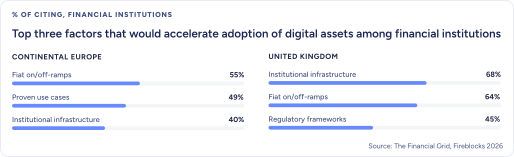
Given the defined regulatory path, the external unlocks are clear: 55% cite reliable fiat on/off-ramps as the primary factor that would accelerate adoption of digital assets, 49% cite proven production-scale use cases, and 40% cite institutional-grade infrastructure.
The expectation extends to financial market infrastructure. When asked what role FMIs should play in realizing the benefits of digital assets, 57% of continental European institutions rated driving the definition of standards as a critical role, the highest of any region, from Africa and Middle East at 47% to North America at 32%.
Even without a final regulatory framework in place, UK institutions are not hesitating. 36% had already committed budget going into 2026, with an additional 59% committing in 2026. When asked what would accelerate adoption, the external constraints they identify are institutional-grade infrastructure and operating support at 68%, fiat connectivity at 64%, and regulatory clarity at 45%.
Inside the Build: Internal Blockers Across Continental Europe
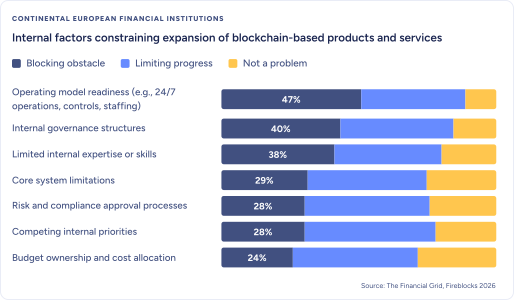
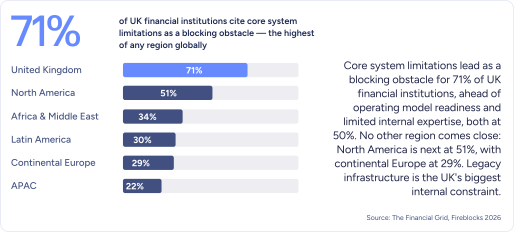
Continental European institutions face an internal constraint profile that is operational in nature, not technological. Operating model readiness leads at 47% as a blocking obstacle, reflecting the challenge of adapting governance structures, staffing, and controls to a 24/7, multi-jurisdictional digital asset infrastructure. Internal governance structures follow at 40%, and limited internal expertise at 38%. Unlike in the US, where 55% of banks rate it a blocking factor, core system limitations register at 29% in Europe.
In The UK, Technology Is The Biggest Blocker
What Europe And The UK Are Building
The use case and asset type data are precise about what is being built. Both markets lead with settlement. Across the nine use cases surveyed, 24/7 settlement and real-time payments tops the priority list in continental Europe at 86% and the UK at 82%, with settlement/DVP for digital assets and tokenized securities and cross-border payments close behind in both. On six of the nine use cases, the two markets are closely aligned.
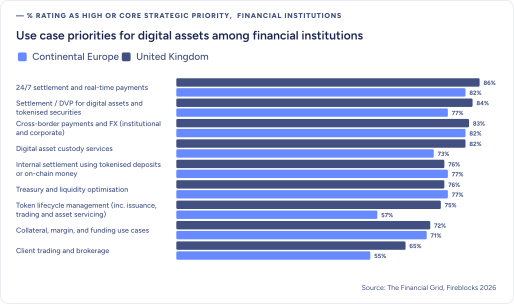
The standout gap is token lifecycle management. Continental Europe at 75% sits above the global average of 70%. The UK at 57% sits well below it. The UK build is broad and consistent across settlement, payments, custody, treasury, and collateral: the digital asset infrastructure layer. Token lifecycle management, which covers issuance, trading, and asset servicing of instruments, is where the UK pulls back.
The asset type mix sharpens the picture. Continental European institutions lead globally on tokenized money market funds at 62%, against 45% in the UK and a global average of 41%. Tokenized securities follow at 60%, against 50% in the UK and 36% in the US. Tokenized deposits at 62% sit above the UK at 50% and the global average of 54%. These are the instruments the European regulatory frameworks were designed to govern.
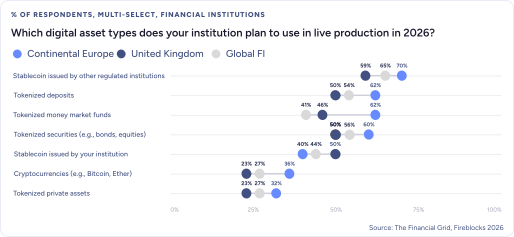
One figure runs in a different direction. UK institutions plan to issue their own stablecoins at 50%, above continental Europe at 40% and the global average of 46%. The US, where own-institution stablecoin issuance is the defining theme of the build, sits at 68%.
Selecting For The Full Stack
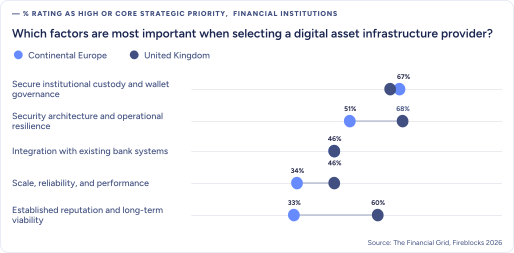
When continental European institutions select a digital asset infrastructure provider, secure institutional custody and wallet governance leads at 67%. Integration with existing bank systems and scale, reliability, and performance at production volumes follow, both at 46%. The selection profile reflects the build: institutions working through operating model and governance constraints are anchoring their provider decisions in custody first.
The UK profile is led by security architecture and operational resilience at 68%, with custody close behind at 64%. The standout figure is established reputation and long-term financial viability, cited as critical by 60% of UK institutions against 33% in continental Europe. Compliance and regulatory alignment follows at 48%, against 38% in continental Europe. Building without a settled regulatory framework raises the stakes on counterparty durability.
Across both markets the expectation is consistent: full-stack delivery. Neither market is selecting for individual capabilities. Both are selecting a provider that can hold the infrastructure together as their digital asset builds scale.
Read the flagship Financial Grid report for more insights and global data from Fireblocks’ 2026 survey. Read The Financial Grid USA for insights on US financial institutions’ survey results. For Asia Pacific bank insights, read The Financial Grid APAC. Read our wallet infrastructure blueprint for banks to learn more about key criteria for digital asset infrastructure.