

Liquidity is the lifeblood of any payments business, yet for most it’s abstracted away. You make payments and assume it’s there, until the moment it isn’t. On stablecoin rails, that moment is arriving faster than before, because the front end just moved to the speed of the internet. Your customers expect value to move instantly, around the clock, anywhere in the world. That goes for a remittance, a merchant payment, or a gig worker’s salary, and stablecoins are proving to be the rail that can deliver that. On average, more than $300 billion in stablecoin volume moved across Fireblocks each month over the past year. But the rail is only as good as the liquidity behind it.
The Manual Workflow Behind Stablecoin Liquidity
In practice today, payment companies and trading firms source their stablecoin liquidity from a handful of OTC desks. Quoting happens over Telegram, sometimes email, or each desk’s own portal, one desk at a time. Credit lines, balances and live prices sit in separate places, tracked by hand. To compare prices you’re flipping between screens while a quote expires in front of you.
That works with two or three OTC desks, but it stops working the moment you try to scale, which is exactly when stablecoins should be taking you from a handful of markets into many. When you expand into a new market, you often need a new provider, because the best OTC desk for one corridor might not be the best for the next. Your customers want faster money sooner than you can procure, integrate and consolidate a new desk.
OTC Desks Are Becoming the FX Desks of Stablecoin Payments
The largest liquidity providers in this market have become, in effect, FX desks for stablecoins, on-ramping fiat globally into stablecoins and passing wholesale liquidity to the biggest names in stablecoin payments. For a growing number of them, this is now their fastest-growing segment. On Fireblocks specifically, payments is now the fastest-growing segment of their flow, up 110% year on year.
One Quote Board Across Every Desk You Trade With
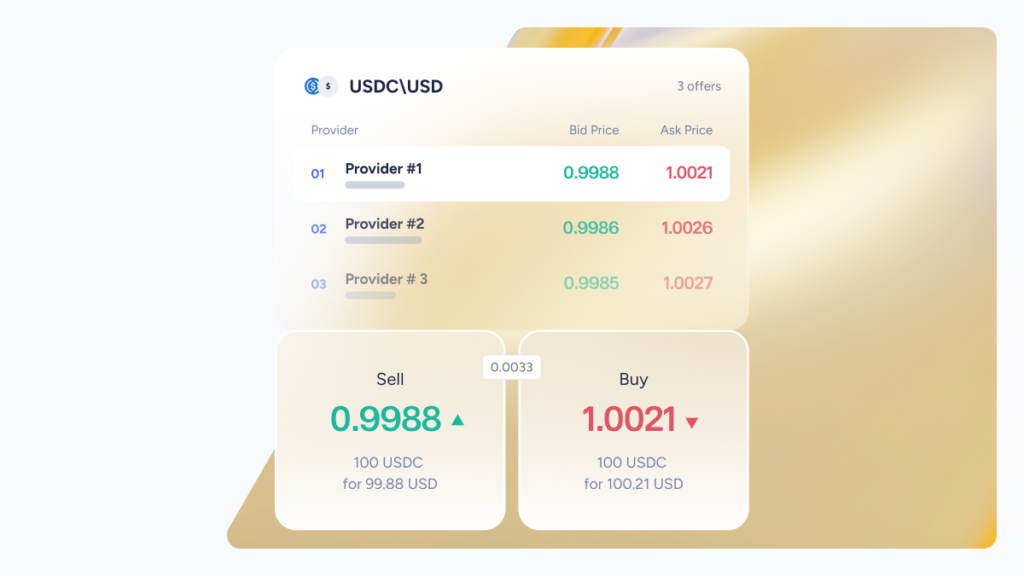
Fireblocks Liquidity Market lets payment companies, and any business sourcing liquidity from OTC desks, request quotes from every desk they work with at once, compare them side by side, and execute against the best price, all without leaving Fireblocks.
It works the way the rest of Fireblocks already works:
- Connect the OTC desks you trade with as connected accounts, and reach their liquidity directly inside Fireblocks.
- See credit and balances across every connected desk in one place, your limits, what’s left, margin, and balances, instead of tracking them desk by desk.
- Work from a live, multi-dealer quote board that pulls two-way RFQs from the desks you work with today, and those you don’t, so you see the whole market.
- Tie every execution back to its quote and desk, with full history and status.
- Enforce access controls through the Transaction Authorization Policy, so every workflow follows your governance.
- Secured by the same Fireblocks infrastructure protecting the rest of your operations, down to API key management.
- Use it as a Console workflow or an API integration, whichever fits how your teams work.
Both Sides of the Trade Already Run on Fireblocks
The desks that hold this liquidity, and the payment companies that need it, already run on Fireblocks. More than 10 non-bank desks supply payment companies on the platform at multi-billion-dollar scale, and more than 325 payment companies are Fireblocks customers. What’s been missing is the connection between them at the moment of pricing a trade. And because Fireblocks Network stays neutral, never taking the other side of your trade, coming into the flow of funds, or taking possession of your assets, both sides can meet on infrastructure neither has to second-guess.
Liquidity Market goes live the week of Money20/20, with B2C2 and Zodia Markets as our first liquidity providers, and more desks joining in the directory shortly after. In the meantime, learn more about Liquidity Market.