

A payment platform can accept cards, bank transfers, and local rails, and still turn away a customer who wants to pay from the wallet or exchange where their money actually sits. The lost volume never appears in a failed transaction log. It just never arrives on the platform.
The businesses running Fireblocks Flow in production already had a working checkout. They had existing payment flows, merchant relationships, licenses, and in several cases years of transaction history. What they were missing was the settlement component. That is the piece that lets a payment arrive as a digital asset from any wallet or exchange and land as the single stablecoin the business is prepared or permitted to hold.
2,500+ businesses run on Fireblocks, and monthly stablecoin volume now exceeds $300 billion across hundreds of payment providers. A fintech, PSP, trading firm, or marketplace does not need to rebuild its payment stack to take a share of that. Acceptance can be added to a flow that is already live.
Accept Any Asset, Settle in the One You Hold
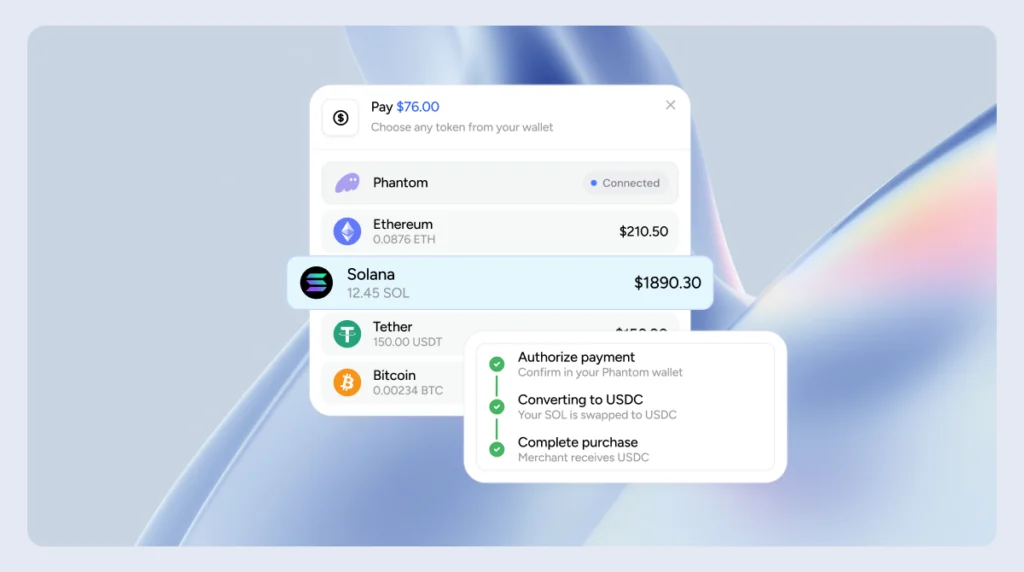
Flow can simply be added to an existing checkout or deposit flow, where it handles one job end to end. A payer brings any wallet and deposits in any token they already hold. The receiving platform gets the settlement asset it configured, with the conversion, screening, and routing handled behind the scenes. One SDK or API covers all of it.
The sequence for a payment through Flow runs like this:
- The payer connects an existing external wallet or an exchange account through Fireblock’s wallet connectors
- Flow issues this user a one-time deposit address scoped to that specific transaction
- Flow simulates the transaction before execution so network fees are accounted for and the receiver gets the exact amount expected
- The transaction is then processed, with any conversion and bridging happening under the hood through a third-party DeFi liquidity provider so that the receiver ends up with their desired asset
- The wallet is screened against the authenticated user session so screening runs at the level of the person paying, with geographic rules applied per transaction
- Funds settle into a Fireblocks Vault, a business-controlled embedded wallet, or an external address the business specifies
Flow supports deposits from 800+ external wallets and major exchanges. Anything sent to an address that has already been used refunds automatically to its source, with no operator intervention.
Five Businesses, Five Problems, One Stablecoin Acceptance Solution
What follows are five scenarios covering businesses with different goals, different regulators, and different definitions of a good outcome. In each case, the blocker was the same. Accepting a stablecoin payment meant accepting whatever asset the payer chose to send, along with the operational work behind it. Someone has to reconcile it, bridge or swap it into something usable, and screen the wallet it came from.
A PSP Adding Crypto Checkout for Its Merchants
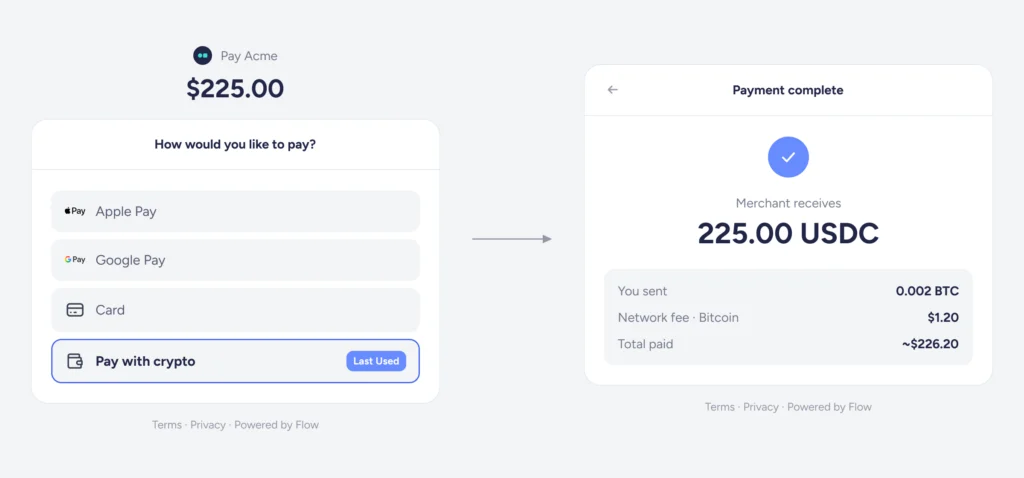
A payment provider serving tens of thousands of onboarded merchants, processing more than a hundred million transactions a year at an average ticket under $100, wanted to let those merchants accept digital assets. A meaningful share of surveyed merchants said they were open to it, and the provider already owned the relationships, the checkout, and the settlement rails to the merchant’s account.
Merchants in this arrangement do not hold a wallet themselves. The group’s licensed crypto arm holds the wallet, handles the conversion to local currency, and settles to the payment provider, which settles to the merchant exactly as it does for card volume. Three parties, each staying inside its own regulatory permissions.
The problem was that the amounts never landed exactly. A merchant expecting a set amount for a specific basket cannot absorb a network fee shortfall, and on thin payment margins nobody in the chain can quietly cover the difference either. Any variance between what the payer sends and what the merchant receives creates a reconciliation problem on every transaction.
Pre-transaction simulation removed that, so the merchant receives the full expected amount and the network fee lands with the payer at checkout rather than the merchant. Additionally, the PSP adds digital assets as a payment method without adding a wallet product, a compliance vendor, or a conversion partner. Its merchants see a new option at checkout, while its finance team sees the same settlement asset it already handles.
Flutterwave, one of Africa’s largest payment service providers, is currently live on Flow for merchant checkout.
A Fintech or Trading Platform Funding User Accounts
Users of trading platforms and consumer fintech apps already hold balances on exchanges or in self-custody wallets. When a platform cannot accept a deposit or payment from those sources, the user rarely goes looking for a workaround. The account stays unfunded, and the deposit lands somewhere else with competitors who accept digital assets.
Every additional deposit source a platform adds is funded account volume it was previously turning away. The reason most platforms never add them is that wallet and exchange connectivity, conversion, and reconciliation each arrive as a separate vendor contract, and the integration work does not end at launch. New wallets and chains keep shipping, and each one adds maintenance.
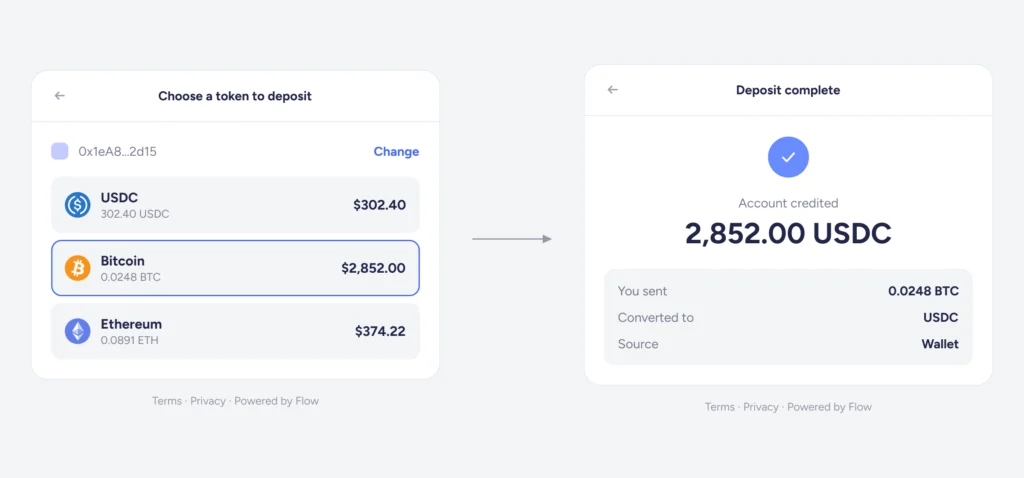
Flow adds those sources through one integration, and the platform’s ledger stays clean. A trader deposits from the wallet and token they already hold. The receiver only ever sees the stablecoin it configured arrive in the account it controls. The same applies to geography. A licensed platform can only accept deposits from the regions it is authorized to serve, and Flow blocks deposits from outside those regions before funds move.
Blipply, a financial inclusion app operating in 80+ countries, uses Flow for deposits.
An iGaming Operator Accepting Player Deposits
Deposit preferences vary by market, and in many of them a meaningful share of players hold digital assets rather than a usable card. Card rails also carry their own failure rate at checkout, and that rate tends to be highest in the same markets. An operator that cannot take a digital asset deposit is losing players at the moment of highest intent, usually to an operator that can.
Accepting the deposit is the easy half. A licensed operator cannot end up sitting on an asset outside what its license and accounting model contemplate, which means the deposit method has to control what arrives, not just accept it. Configuring the settlement asset is how an operator holds one position across every market it serves, even where the permitted asset differs by jurisdiction.
Flow enforces that per transaction. Whatever the player sends, the operator’s vault only ever receives the asset it configured. Screening and geographic rules run before funds move rather than surfacing in a report afterward, and every deposit is captured with amounts, fees, and timestamps against the reporting these platforms already owe their regulators.
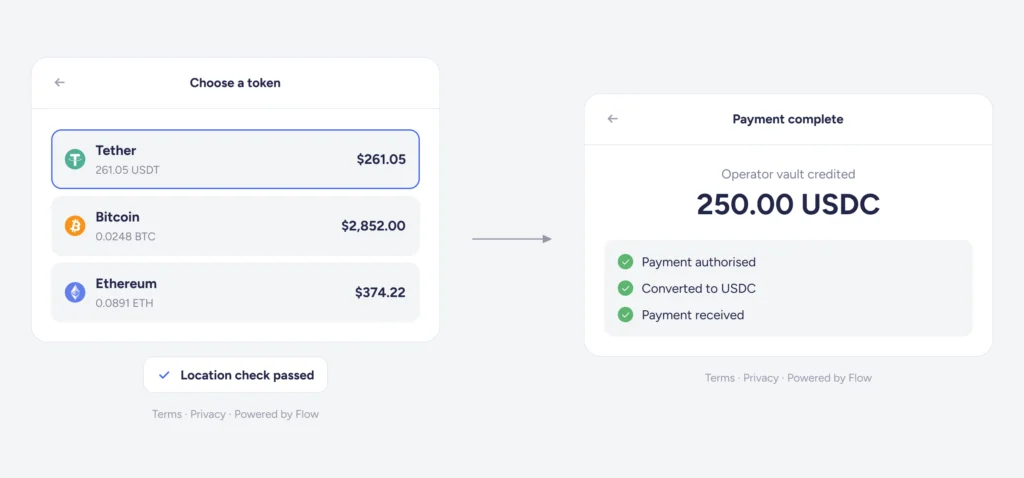
A Bank Letting Customers Deposit and Withdraw Digital Assets
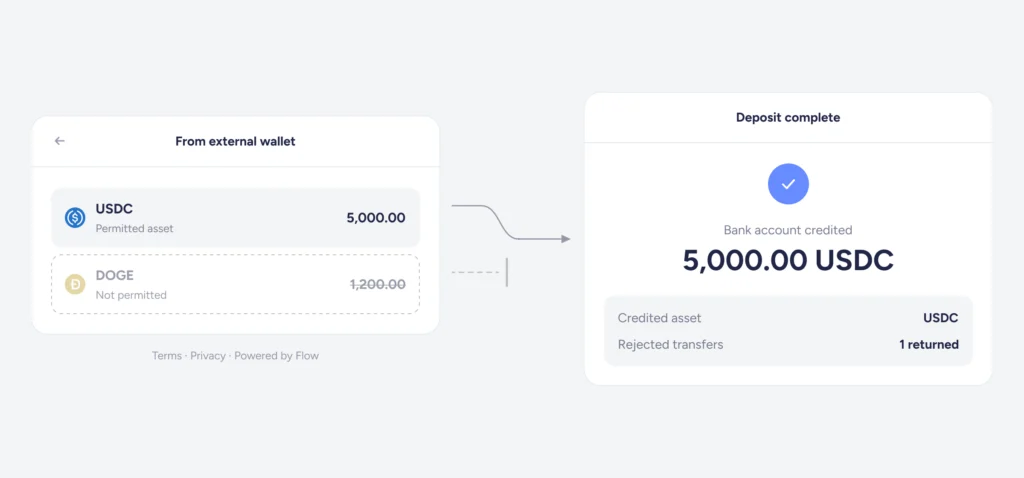
A bank operating under close regulatory supervision kept every digital asset movement inside its own walls. Customers deposited fiat, the bank held a dollar stablecoin in the background as an accounting layer, and funds moved between vault accounts inside its own workspace without ever touching an external wallet. Customers could not deposit digital assets in, and could not send them out.
Opening that up meant publishing a deposit address, and that was the problem. The bank has explicit commitments with its regulator about which assets it is permitted to hold. Publish an address and eventually someone sends a different token, at which point the bank is holding something it is not authorized to hold through no action of its own. The compliance exposure here is immediate.
Flow is what made opening it up possible, not just easier. One-time deposit addresses paired with a restricted asset list mean the bank receives only its single permitted stablecoin on a single chain, regardless of what a customer sends. Anything sent to a spent address refunds automatically to source, so the bank never has to intervene, and never holds the asset in the first place.
Worth being precise about what this is not. Custody does not change, and the scope of what the bank does with digital assets stays the same. It added deposit and withdrawal channels on top of the existing custody model. Security came first, and the growth followed from it.
A Marketplace or Platform Paying Out Creators and Sellers
A marketplace paying thousands of individual creators and sellers is not solving a merchant problem. Its recipients are spread across markets where card rails are unreliable and currency controls make a bank transfer slow or impossible, and a payments provider built for corridors between institutions does not reach most of them. The money is owed either way. Getting it to the recipient is the part that breaks.
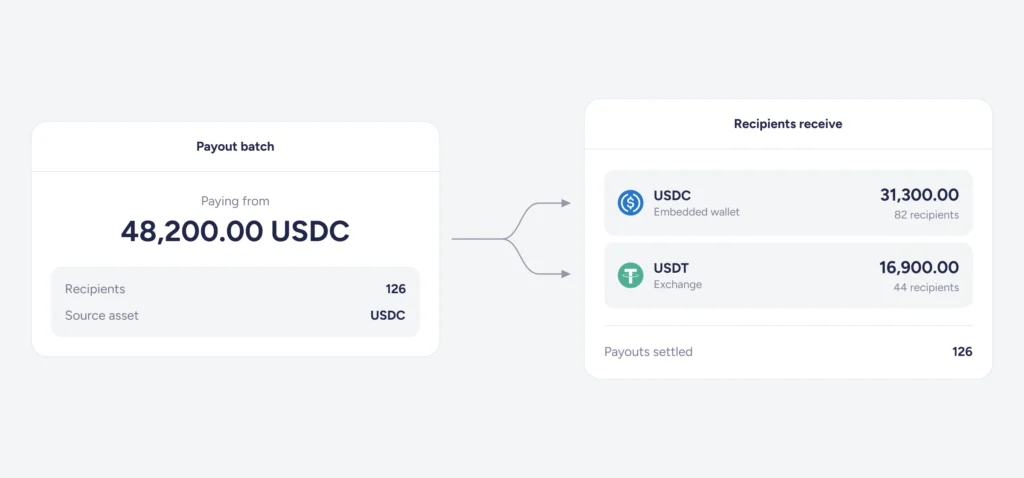
Paying out in stablecoins solves the reach problem, but creates a new one. Recipients want different assets in different places, and a platform that accommodates that ends up holding a spread of assets it never chose. Screening each new payout wallet by hand is not an option at that volume either.
Flow runs the same mechanism outbound. The platform pays from the single asset it holds, and the conversion and delivery to whatever wallet or exchange account the recipient specifies happens behind it. The recipient is screened before the payout moves rather than in a review afterward.
Where Flow Goes From Here
The five examples above are a starting point, not the limit of what Flow can do. The common denominator is broader than any of them. It is any business that already collects payments, wants to accept a wider set of assets, and cannot afford to change what it holds in order to do it. That description covers remittance providers, marketplaces, on and off ramps, brokerages, and a long list of businesses whose checkout works fine, but whose deposit coverage does not.
Flow is available now across Ethereum, Solana, Bitcoin, Tron, Sui, and the broader EVM ecosystem, and it supports bring-your-own address screening for businesses running their own compliance stack. Next, PSPs will be able to add their own markup on top of conversion, turning acceptance into a revenue line rather than a pass-through cost. Payment links are on the way too, letting a business set an amount and collect it by simply sending a link.