



Banks are issuing their own stablecoins. This includes Tier 1 institutions like ANZ and ABN AMRO, and major regional players like Wenia, Braza Bank, Banking Circle, and Oddo. The drivers are clear: defending and modernizing core business, capturing new payments and treasury flows, sustaining deposit strength, maintaining compliance, and remaining competitive as digital assets reshape money itself.
Doing so lets banks serve clients with all the benefits of digital money (speed, programmability, global reach) while keeping client funds, data, and trust within the regulated banking perimeter.
And turning strategic intent into production-ready operations requires infrastructure built for regulated finance from day one.
The Real Challenge in Stablecoin Issuance: Embedding Controls at Deployment
Any engineering team can launch an ERC-20 smart contract by afternoon. That is not the challenge. But deploying a token with the right control paradigm embedded from the start is what separates proof of concept from production at scale.
In October 2025, Paxos accidentally minted $300 trillion of PayPal’s PYUSD stablecoin, an amount exceeding twice the world’s GDP. While the excess was burned within 22 minutes, the incident exposed a fundamental truth: when minting controls aren’t properly designed from the start, even regulated institutions can create unauthorized supply at catastrophic scale. The real issue wasn’t the fat finger error itself; it was that the infrastructure allowed it to execute without automated safeguards.
The challenge for your bank is deploying with the right control paradigm embedded from the start.
The decisions made at deployment are baked into the smart contract itself, including how minting permissions are structured, what governance controls are embedded, how compliance policies are enforced, and how assets are frozen or recovered. Retrofitting institutional-grade controls after launch is, at best, extremely difficult, and in many cases architecturally impossible.
Banks moving toward stablecoin issuance have already made their strategic call. The question now is execution: can they deploy infrastructure that meets regulatory, operational, and security standards from day one?
Production Operations: The Four Non-Negotiables
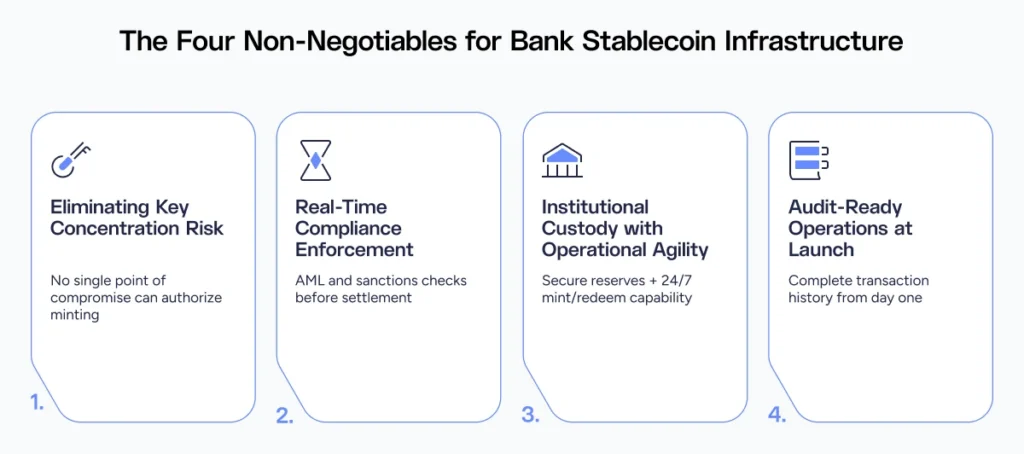
Regulated production environments require a departure from crypto-native operating models. Working with institutions globally, we see successful issuance depends consistently on four architectural requirements:
- Eliminating key concentration risk: Billions in token supply cannot depend on key material that never exists whole in a single location. The cryptographic architecture must ensure that no individual, and no single point of compromise, can authorize minting, and that the signing process itself doesn’t create onchain visibility that exposes transactions before execution. Regulators expect nothing less.
- Real-time compliance enforcement: AML screening, sanctions checks, and transaction limits must execute before transactions settle. Blockchain transactions are irreversible and settle in seconds; reactive compliance reviews do not work when the transaction is already final.
- Institutional custody with operational agility: Reserve assets need secure custody. But operations teams also need to mint and redeem around the clock based on market demand. Traditional custody models were not built for this tempo.
- Audit-ready operations at launch: Transaction history, proof of reserves, and compliance controls that cannot be reconstructed after the fact must be operational before your first mint, not your first audit. Regulators are setting precedents with every digital asset examination, and the institutions examined earliest are shaping the standards to which everyone else will be held. The infrastructure needs to provide answers, not explanations.
This is critical financial infrastructure. It needs to work like core banking systems: reliably, securely, with complete auditability and no room for error.
How Banks Operationalize Stablecoin Infrastructure
The institutions that have successfully launched stablecoins did not adopt cryptocurrency operating models. They built on infrastructure that adapts to how banks already work.
Most digital asset platforms assume you will organize teams around the technology, with new roles, new processes, and new organizational structures to accommodate the platform. That’s the wrong approach for institutions where treasury teams have established workflows, compliance has proven processes, operations has tested runbooks, and security models reflect years of refinement around separation of duties and risk management. Infrastructure designed for institutions should serve these teams immediately, not after months of change management.
In practice, production environments distribute stablecoin responsibilities across four existing functional areas:
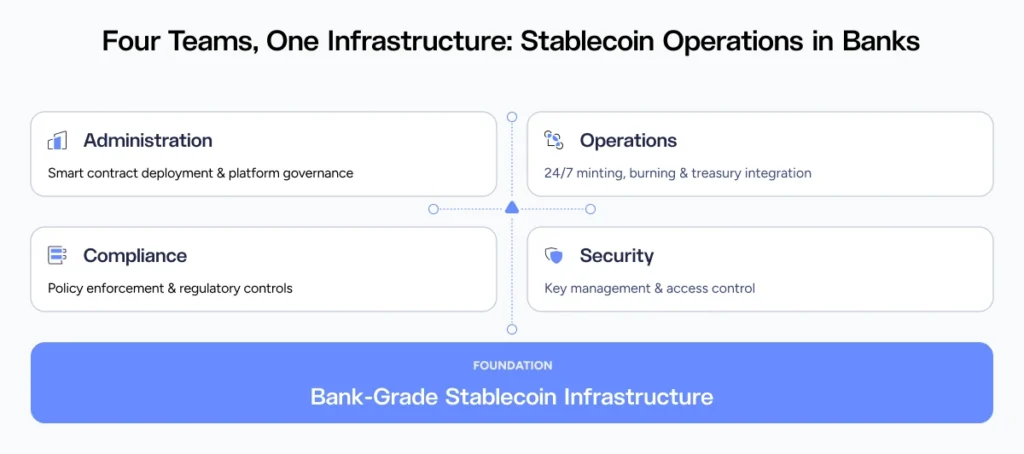
Administration
Administration manages smart contract deployments with the same rigor applied to core banking system changes, setting platform-wide security parameters with cryptographic enforcement underneath, including MPC technology and policy engines.
Operations
Operations executes day-to-day token operations, minting against reserve deposits, burning against redemptions, through familiar workflows integrated with treasury systems. The infrastructure handles transaction construction, gas management, and confirmations invisibly. Teams monitor token supply through dashboards they already understand, not blockchain explorers.
Compliance
Compliance defines policies in business terms: transaction limits, velocity restrictions, screening requirements. The infrastructure enforces these at the protocol level; a transaction that violates policy is blocked before execution. When law enforcement identifies fraud or courts order asset recovery, compliance acts through control interfaces they already use, and the infrastructure translates those governance actions into onchain execution automatically.
Security
Security manages onchain access registries, such as deny lists for sanctioned addresses and blocked entities, through access control interfaces integrated with existing identity systems. These controls are enforced onchain before any transaction executes, extending institutional security models to the blockchain with familiar governance and audit trails.
By anchoring these roles in cryptographic enforcement rather than manual policy alone, the infrastructure closes the gap between what regulators ask and what institutions can demonstrate. Stablecoin operations run with reliability comparable to core banking systems.
Navigating a Fragmented Regulatory Landscape
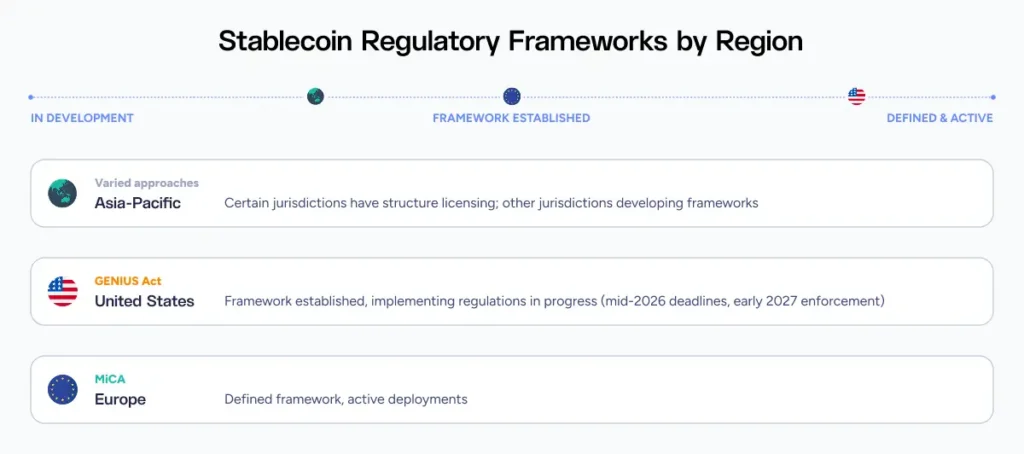
Regulatory divergence matters for infrastructure decisions. A stablecoin program designed solely around one regulatory regime could face costly re-engineering as it scales across borders. The institutions making durable choices are building on platforms flexible enough to accommodate different compliance requirements, reserve structures, and reporting obligations as regulations evolve.
For banks considering stablecoin issuance, early regulatory engagement appears to matter as much as technology selection. In most jurisdictions, frameworks are still being refined, and institutions that participate in sandboxes and demonstrate compliant implementations may help shape the rules rather than simply respond to them.
Beyond Vendor Selection
Evaluating infrastructure for stablecoin issuance is not a vendor selection exercise. It is a strategic decision about control and operational independence.
The institutions moving forward with confidence own their minting keys, define their own compliance-related controls, and maintain operational independence, but they are not building from scratch. Institutional-grade infrastructure takes years and significant investment to develop, and the cost of getting it wrong is not just financial. A compliance failure at launch can set back your bank’s digital asset ambitions by years and invite regulatory scrutiny well beyond the stablecoin program itself.
Stablecoins also present a balance sheet considerations that are easy to overlook. Without careful planning, the use of third-party stablecoins for settlement can result in corporate deposits effectively leaving the bank to reside in an external issuer’s reserve accounts. Whether to issue independently or join forces with other institutions is itself a strategic decision with significant implications for governance, distribution, and competitive positioning, one that deserves careful consideration alongside the infrastructure question.
Meanwhile, the institutions that establish stablecoin infrastructure now are building operational muscle, including internal expertise, compliance playbooks, and client integrations, that may be difficult for later entrants to replicate quickly. The pattern has played out before with electronic trading, real-time payments, and API-based banking: early movers did more than gain a product advantage, they developed organizational capabilities that compounded over time. Corporate clients are increasingly requesting stablecoin capabilities, and the infrastructure decisions institutions make now will likely shape their competitive positioning for years to come.
Building on the Right Foundation
Fireblocks sets the infrastructure standard for institutional digital assets. We enable banks to issue and manage stablecoins with the risk management, compliance, and operational standards that regulated finance demands. Our stablecoin infrastructure provides lifecycle management from deployment and minting to burning and compliance enforcement, with enterprise-grade security including MPC-based custody, policy engines, and full audit trails. Compliance tools integrate transaction monitoring, screening, and policy enforcement directly into operational workflows.
Designed for regulatory scrutiny from day one, Fireblocks supports development, testing, and production environments handling billions in daily volume. For institutions evaluating stablecoin issuance strategies specific to their market and regulatory context, Fireblocks offers professional services to support implementation alongside our technology.
Explore our tokenization infrastructure and solutions for financial institutions, or get in touch to discuss your requirements.