


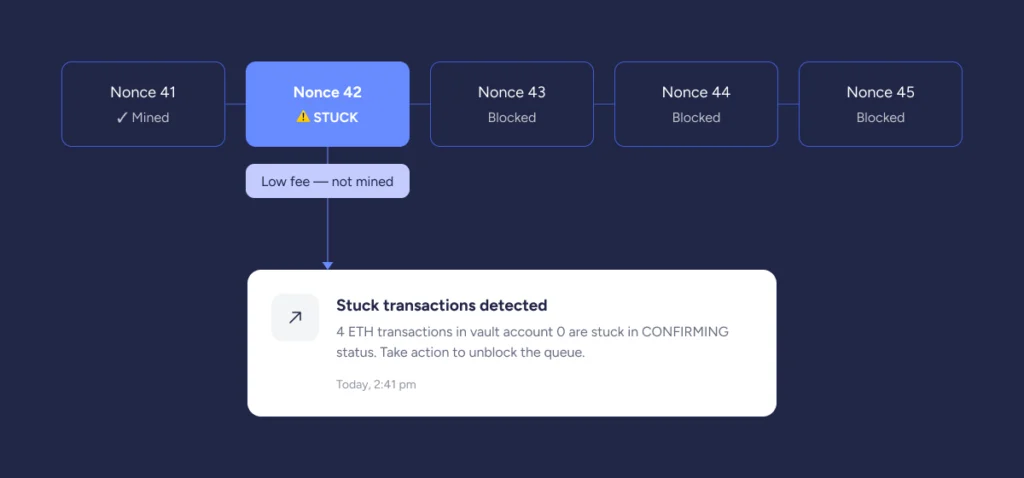
When a digital asset operation grinds to a halt, the cause is almost never the blockchain going down. It’s something far more common: a single transaction gets stuck, and every transaction lined up behind it is now stuck too.
This is a structural property of blockchain networks like Ethereum. Transactions from the same account are processed in strict sequence by nonce, meaning there’s no way to skip over a stuck transaction. Effectively, it holds the whole queue behind it hostage. For a payments company or an exchange moving hundreds of transactions a minute, that line backs up fast, stalling withdrawals and pushing settlements past their window.
Until now, the playbook for fixing it has been highly manual: notice something’s wrong, open a support ticket, wait while someone reads the logs, and then act on what they tell you.
We believe this high touch workflow is not adequate for high throughput scenarios. So we rebuilt how Fireblocks handles the full life of a transaction, from the moment it’s submitted to the moment it lands onchain, around a single principle: your operation should keep running even when an individual transaction doesn’t.
That comes down to three capabilities working together across the transaction lifecycle.
Before broadcast: “fail fast” and stop waiting on doomed transactions
Every transaction has two halves. The first runs from submission to signing, which is the part that runs on the Fireblocks platform. The second runs from broadcast to confirmation, out on the chain, where no platform can reach in and change what’s already been sent.
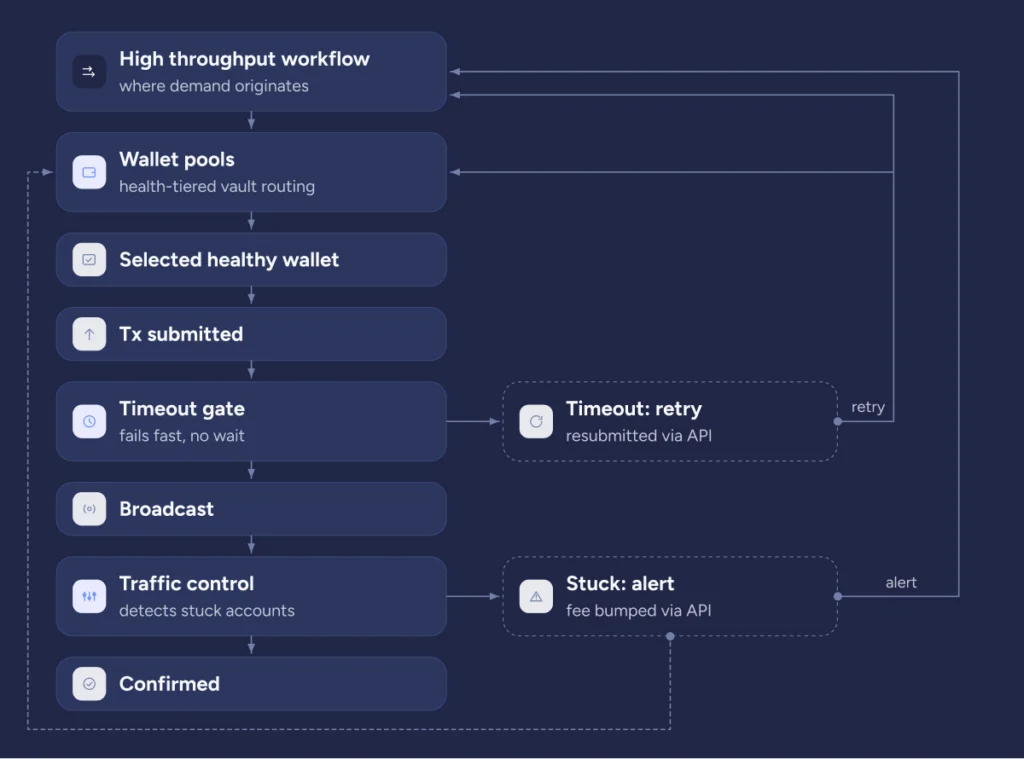
Transaction Timeout governs the first half. You set how long Fireblocks should wait between submission and broadcast, whether that’s a workspace-wide default, a tighter window for automated API flows, or a value on an individual transaction. If a transaction doesn’t make it out in that window, it’s marked FAILED with a clear TIMEOUT status instead of waiting in limbo.
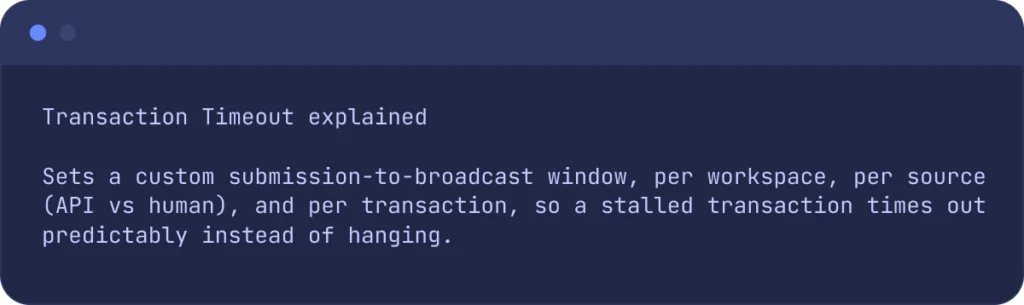
The effect is larger than it sounds. Deterministic failure means your automation can fail fast and retry against a fresh transaction instead of waiting on one that’s effectively dead, and shorter pending windows shrink the surface area where an approval can sit exposed. This is both an operational win and a security one at the same time. You configure it yourself, in the Console, without a support ticket.
After broadcast: know an account is in trouble in minutes, not hours
Once a transaction is broadcast, the platform can’t cancel it for you, but it can watch what happens to it.
Account Traffic Control monitors the health of your accounts continuously and tells you the moment one degrades. It then pushes an alert that identifies the stuck transaction, explains why it’s stuck, and recommends what to do about it (for example, boosting the fee to replace it). The detection that used to depend on a customer noticing and escalating now happens proactively, in minutes instead of hours or days.
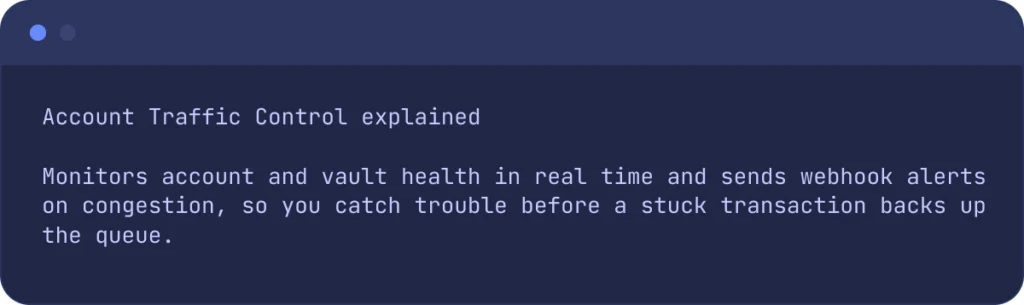
What matters here is more than speed: you’re kept in the know with a monitoring system you don’t need to build and maintain yourself, with a recommended action attached, so your ops team resolves the problem instead of merely discovering it.
Avoiding bottlenecks: don’t let one vault be a single point of failure
Timeouts and monitoring help you fail fast and see trouble coming, but they don’t remove the root cause: as long as every transaction flows through a single vault, one stuck nonce still freezes everything behind it. The solution is to stop depending on any one vault.
Wallet Pools lets you group multiple vaults and use the group itself as the source of a transaction. The vaults in the designated group are screened by the Account Traffic Control monitor to assess asset presence and available balance, then grouped into health tiers. When a transaction is initiated from the Wallet Pool, vaults are selected by a tiered, health-aware round-robin algorithm. This ensures transactions come from the best available tier. One wedged nonce no longer freezes your outflows, because the next transaction simply goes through a healthy vault. As a side benefit, rotating across vaults makes your on-chain footprint less predictable.
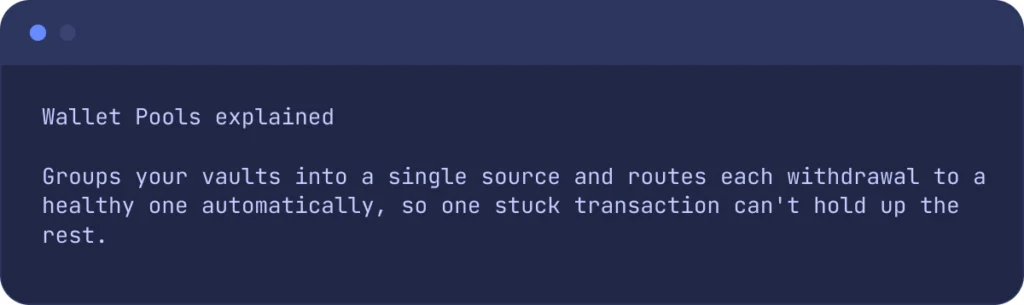
For customers running retail-scale withdrawal flows, this is the difference between a queue that absorbs a stuck transaction and one that freezes entirely.
Why these features add up to greater transaction resilience
Each capability is useful on its own, but together they change what an operation can count on: fast, predictable failure before broadcast; proactive visibility after it; and routing avoids trouble altogether instead of stacking up behind it. The result is the thing every serious operation actually wants, which is the ability to scale transaction volume without scaling your support tickets, your custom monitoring stack, or your operational risk.
Keeping your operation moving shouldn’t require you to know the blockchain intimately, that’s our job. We’ve delivered these capabilities to help you do yours.
Get started
Wallet Pools, Transaction Timeout, and Account Traffic Control are all available today on Fireblocks.