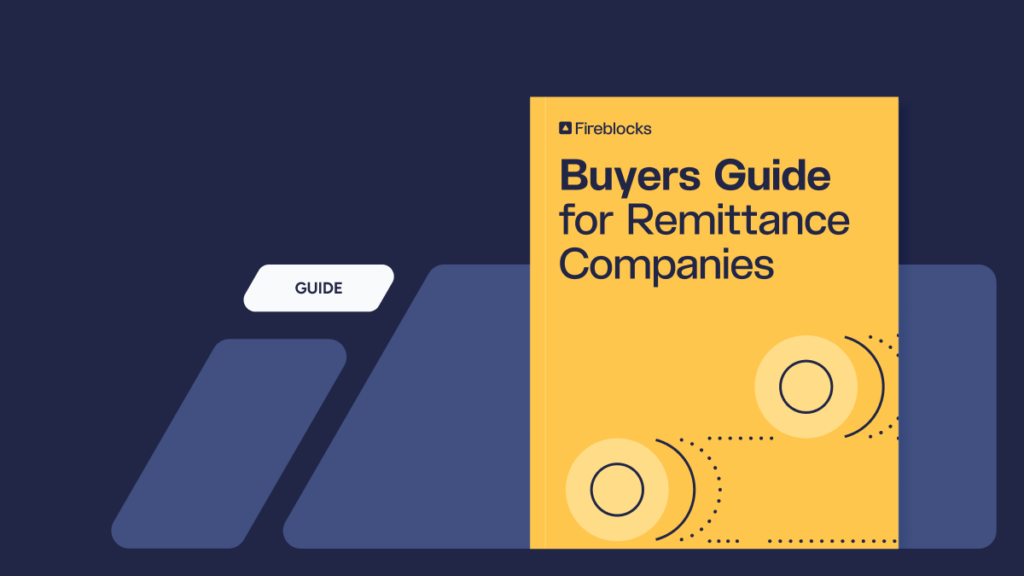


The Infrastructure Decision That Will Define the Next Decade of Remittances
The global remittance market reached $905 billion in 2024, and the rails that money moves on are changing fast. Stablecoins and blockchain-based settlement are no longer a future consideration for remittance companies; they are an active competitive moat. Companies that choose the right digital asset infrastructure today will expand margins, reach new corridors, and unlock customer experiences that legacy payment networks simply cannot support. Those that delay, or choose the wrong partner, will absorb those costs in trapped capital, slow settlement, and mounting compliance complexity.
Fireblocks orchestrates the world’s financial systems. We are bridging traditional finance and digital assets to power cross-border payments, remittances, and institutional settlement on a single, secure platform. Today, over 2,400 organizations globally trust Fireblocks to run their digital asset operations. This spans through payment providers, fintechs, banks, and remittance operators. The guide below is purpose-built for remittance companies ready to harness that infrastructure for their own digital asset journey.
For remittance operators, the highest-stakes decisions typically cluster around three areas:
- Treasury efficiency: eliminating the capital drag of pre-funded accounts across corridors and entities
- Receiver wallet infrastructure: enabling seamless stablecoin receipt and conversion for receivers via stablecoin payment accounts (i.e. wallets)
- Compliance architecture: meeting AML/KYC/travel rule obligations across multi-jurisdictional operations
These are the axes on which your business model turns. Getting them wrong doesn’t just slow growth; it can trigger regulatory exposure or capital inefficiency that competitors will exploit.
Selecting a digital asset infrastructure partner is harder than it looks. Vendors often speak the same language of being “secure,” “compliant,” “scalable”. However they may deliver very different capabilities underneath. The remittance space compounds this challenge because you’re evaluating infrastructure against live operational complexity: multiple currencies, multiple corridors, varying local regulatory regimes, and end users who may have limited digital literacy. This guide is designed to cut through the noise and give remittance providers an honest, structured framework for making the right call.
What Remittance Companies Should Look for in Digital Asset Infrastructure & Payments Solutions
Before entering any vendor conversation, your team should evaluate potential providers against five foundational categories. Each of these categories below map directly to what separates infrastructure that works in production from infrastructure that looks good in a demo. The goal is for compliance-ready global flows from day one, proven reliability at scale, and the flexibility to expand corridors and services without replatforming.
1. Stablecoin Settlement Architecture
The core operational promise of stablecoin-based remittances is near-instant, always-on cross-border settlement without the need for pre-funded local accounts in every corridor. Not all platforms deliver on this equally. Look for:
- native support for major stablecoins (USDC, USDT, and others) across multiple chains
- the ability to automate liquidity rebalancing between corridors
- transparent fee structures that don’t erode the cost advantage at scale
Ask vendors specifically how they handle settlement finality across chains with different confirmation times. That answer will tell you a great deal about the depth of their infrastructure.
2. Security and Asset Protection
Remittance operations move high volumes of funds on tight margins. A single security incident can be catastrophic. Evaluate platforms on their underlying key management architecture (MPC-based custody provides meaningful advantages for operational flexibility without sacrificing security), and how they enforce transaction-level policy controls and automation. Some of these controls can be whitelisting, multi-party approval, and real-time anomaly detection. Security should not be an area where you accept trade-offs.
3. Compliance Tooling: Built In, Not Bolted On
Remittance companies operate under some of the most rigorous AML/CFT frameworks in financial services, and that scrutiny only intensifies when digital assets enter the picture. Prioritize platforms that provide native travel rule compliance (FATF), automated reconciliation and reporting, and the ability to screen counterparty wallets before transaction execution (not just after). Compliance that requires significant third-party integration creates operational seams that regulators notice and that your team has to manage. Ask vendors for documented workflows showing how their platform handles travel rule obligations for both retail and institutional transactions.
4. Receiver Wallet Infrastructure
A critical but often underweighted dimension is the quest of “how does the platform support the beneficiary side of the transaction?” Stablecoin remittances are only as valuable as the recipient’s ability to receive, hold, and convert funds. Evaluate embedded wallet capabilities, off-ramp partner integrations, and whether the platform enables white-labeled end-user wallet experiences that you can control and brand. Platforms that treat receiver wallets as an afterthought will leave you bridging significant gaps at the last mile.
5. Scalability, Developer Experience, and Support
Your infrastructure partner should grow with you, evolving alongside your business and use cases without the need to replatform. Those growth areas can span across corridors, transaction volumes, and product lines. Evaluate API completeness and documentation quality, sandbox access for pre-production testing, and the responsiveness of enterprise support. Remittance operators running 24/7 payment flows need a vendor that treats uptime and response time as a commitment, not a courtesy.
The Fireblocks Advantage: Powering Remittance Company Growth in Digital Assets & Payments
Fireblocks is the enterprise digital asset platform built for institutions that move real money at scale. The platform combines MPC-based wallet security, a purpose-built payments infrastructure, a compliance suite, and a global settlement network into a single, API-first operating environment. For remittance companies specifically, this means you don’t have to assemble a fragmented stack of point solutions and then manage the integrations between them. Fireblocks provides the infrastructure layer that connects stablecoin treasury management, end-user wallets, digital asset compliance, and settlement.
Secure, MPC-Powered Custody at the Core
Every transaction on the Fireblocks platform is protected by Multi-Party Computation (MPC) technology, eliminating single points of failure in key management. Unlike traditional HSM-based approaches, MPC distributes key shares across multiple parties and devices, meaning no single compromise can expose funds. For remittance operators moving thousands of transactions per day across dozens of corridors, this operational security model is foundational.
Payments Infrastructure Designed for Volume
The Fireblocks Payments product is purpose-built for high-throughput, cross-border stablecoin flows. It supports batched transactions, automated liquidity management, programmable policy controls, and real-time settlement monitoring. Remittance companies can automate corridor-level treasury rebalancing, set transaction-level approval policies, and manage multiple stablecoins and chains within a single operational interface.
The Fireblocks Network for Payments
The Fireblocks Network for Payments is a neutral, interoperable settlement network connecting trusted, global payout and liquidity providers via a single connection:
- financial institutions
- payment service providers
- stablecoin issuers
- liquidity partners
- on/off-ramp providers
The Fireblocks Network for Payments delivers direct access to 40+ curated providers across 100+ countries, eliminating the complexity of managing fragmented bilateral relationships. Participants can discover and connect with trusted global providers directly from the Fireblocks Network Directory. This includes on/off-ramp partners, FX providers, and remittance networks.
A single integration replaces the need for bespoke API development with each new provider, while compliance is embedded into every transaction. The integration covers AML/KYT checks, sanctions screening, wallet verification, and Travel Rule requirements. With this, institutions can expand into new corridors quickly and with confidence.
Compliance Built Into the Platform
Fireblocks integrates with leading blockchain analytics providers and provides native travel rule compliance workflows, supporting FATF obligations across jurisdictions. Transaction screening, policy-based controls, and audit trails are built into the core platform. This reduces the compliance integration burden on your operations and technology teams.
For remittance operators, reconciliation accuracy and audit-ready financial reporting are non-negotiable. At Fireblocks, we go further. Robust reporting, reconciliation and analytics are also part of the Fireblocks suite, further enhanced via our acquisition of Tres Finance. Fireblocks provides the secure infrastructure institutions use to build, scale, and manage digital asset operations. In addition, TRES adds the financial intelligence needed to turn that activity into records that align with established ERP, ledger, and reporting workflows. The result is end-to-end visibility across every transaction, from execution to reconciliation, without the manual overhead of stitching together disparate systems.
Embedded and Receiver Wallet Capabilities
Through Fireblocks’ Wallets-as-a-Service and Embedded Wallet products (enhanced by the acquisition of Dynamic), remittance companies can deploy white-labeled wallet experiences for receivers. This enables stablecoin receipt, conversion, and fiat off-ramp at the beneficiary level, closing the last-mile gap that stablecoin remittance infrastructure has historically struggled to address.
Where Fireblocks Excels for Remittance Company Infrastructure Needs
The following framework maps the most critical evaluation criteria for remittance operators to Fireblocks’ capabilities. It allows for direct comparison against industry benchmarks.
| Evaluation Criterion | Industry Benchmark | Fireblocks Capability |
| Settlement Speed | Near-real-time stablecoin settlement across corridors | ✅ Blockchain-native + Fireblocks Network off-chain settlement |
| Key Security Architecture | MPC-based, no single point of failure | ✅ Patented MPC-CMP technology |
| Travel Rule Compliance | Native FATF/travel rule workflows, not third-party only | ✅ Built-in travel rule support with IVMS101 |
| Blockchain Analytics | Pre-transaction screening of counterparty wallets | ✅ Integrated with Chainalysis, Elliptic, and others |
| Stablecoin Coverage | USDC, USDT, and others across major chains | ✅ Multi-chain, multi-stablecoin support |
| Treasury Automation | Automated corridor rebalancing, programmatic liquidity mgmt | ✅ Policy engine + automation layer |
| Receiver Wallet Infrastructure | Embeddable, white-labeled end-user wallets | ✅ WaaS + Embedded Wallets (Dynamic) |
| Network / Liquidity Access | On/off-ramp partners and liquidity providers in-network | ✅ 1,800+ institutions on Fireblocks Network |
| Developer API & Sandbox | Comprehensive REST API, full sandbox environment | ✅ Available; extensive developer documentation |
| Enterprise Support | 24/7 coverage, dedicated customer success | ✅ Global Platinum Support available |
| Regulatory Posture | SOC 2 Type II, multi-jurisdictional compliance support | ✅ SOC 2 Type II certified |
Where the differentiation is sharpest
Fireblocks’ combination of MPC security, a global payments network, and built-in compliance tooling is particularly difficult to replicate with a stitched-together vendor stack. Most alternatives require remittance operators to procure separate solutions for custody, compliance, and network connectivity. This creates integration overhead, support gaps, and audit complexity. For teams prioritizing time-to-market and operational simplicity, the unified Fireblocks platform represents a meaningful structural advantage.
How Remittance Companies Scale with Fireblocks
Fireblocks serves remittance operators at multiple stages of digital asset maturity. The range of companies can be from launching their first stablecoin corridor to established operators managing multi-currency, multi-corridor treasury operations at institutional scale.
Customers in the remittance and cross-border payments space have used Fireblocks to compress settlement times from days to minutes, reduce trapped capital in pre-funded accounts, and expand into underserved corridors where traditional correspondent banking relationships are non-existent. The Fireblocks platform has supported payment operators processing billions in stablecoin volume, with the security and compliance posture required to maintain banking relationships and regulatory standing while doing so.
Additional resources on how remittance operators are implementing stablecoins:
- Leveraging Stablecoins for Fiat Treasury Operations
- Stablecoin Remittances: Receiver Wallet Blueprint
- Top Benefits of Stablecoins for Payments and Remittance Companies
How Remittance Companies Can Engage with Fireblocks
The path from evaluation to production is designed to move quickly, with a structured enterprise onboarding process that includes dedicated support with professional services teams.
Request a demo
The most direct path to understanding what Fireblocks can deliver for your specific remittance use case is a live platform walkthrough with a payments specialist. Request a demo today!
Explore the Developer Environment
If your team wants to begin technical evaluation before a sales conversation, Fireblocks offers sandbox access with full API documentation. You can explore more in our developers area.