

Introduction: The Payment Company Treasury Model Today
Whether you’re a traditional PSP or a B2B payment provider, your treasury operations share a common structural challenge with global working capital and operations management: capital moves too slowly, sits idle for too long, and costs too much to manage.
Every payment company operates with a fixed amount of capital. The number of transactions you can process, the corridors you can serve, and the speed at which you can settle with merchants or business clients all depend on how fast that capital can complete a round-trip from collection to conversion to settlement and back again. With traditional correspondent banking, these cycles take days. Capital sits in prefunded accounts across corridors, waiting. Settlement windows create dead zones where funds are locked. Also every additional geography or corridor you enter multiplies the capital requirements.
This is the fundamental constraint: trapped liquidity due to long settlement periods limits your throughput, compresses your margins, and ties up working capital that could be generating yield or funding growth.
For traditional PSPs, this manifests as a drag on internal operations. Moving funds across borders, paying suppliers, and rebalancing liquidity are all reliant on correspondent banking rails and traditional banking hours, not to mention the fees and FX spreads that come with it. Capital allocation decisions are delayed, internal funds can’t be easily redeployed, and the risk of losing customers and suppliers to competitors increases.
For B2B payment providers, corridor prefunding is the biggest capital trap. Funds must be pre-positioned in destination markets before you can settle. One-way flow imbalances mean some corridors are perpetually over-funded while others need constant topping up. The more corridors you serve, the more capital sits idle, and the problem scales linearly with every new geography you enter.
The competitive reality is accelerating this pressure. Leading PSPs and B2B providers are already moving on stablecoin infrastructure and shipping stablecoin products. The companies that optimize their treasury operations first build the foundation to move fastest on everything that follows.
This blueprint provides a practical, step-by-step implementation guide for transforming your treasury operations with stablecoin infrastructure. It’s the foundational use case. The wallet infrastructure, compliance controls, and liquidity connections you build here become the platform for every stablecoin use case that follows.
Use Case: Corporate Treasury Optimization
What you’re solving
Moving and managing funds across your own accounts, e.g. sweeps, rebalancing, vault management, and FX conversions, is slow and expensive with correspondent banking. Capital sits idle, treasury operations are manual, and visibility is fragmented across banking portals. You’re spending operational resources on processes that should be automated, and you’re losing margin to inefficiencies that compound with every corridor and account you manage.
The stablecoin advantage
Stablecoins introduce a fundamentally different operational model for treasury management:
- Eliminate correspondent banking fees for internal transfers. Moving funds between your own entities no longer requires SWIFT messages, intermediary banks, or multi-day processing. Internal transfers settle onchain in minutes, at a fraction of the cost.
- Sweep funds instantly instead of weekly batching. Traditional treasury operations force you to batch sweeps to offset high per-transaction costs. When each transfer costs pennies instead of dollars, you can sweep as frequently as your business requires, be it hourly, daily, or down to the individual transaction level if it makes sense.
- Rebalance vaults in real-time based on demand patterns. Instead of waiting days for correspondent banking to move capital between corridors or regions, rebalance instantly based on actual demand. If your LATAM corridor is seeing higher volume than expected on a Tuesday afternoon, replenish it from your central treasury in minutes instead of by Thursday.
- Reduce prefunding because capital moves faster. When settlement is instant, you need less capital pre-positioned across corridors and settlement accounts. The float that used to be locked in the settlement cycle is freed up for productive use.
- Smaller FX exposure windows. Capital moves faster between conversion and settlement, which means less time exposed to exchange rate fluctuation and less hedging cost.
- Generate yield on idle balances. Capital that would otherwise sit dormant in bank accounts can potentially generate yield via native staking and DeFi lending markets. Treasury shifts from a cost center to a revenue contributor.
- Automated reconciliation and reporting replaces manual matching across bank statements. Every transaction is recorded onchain with complete auditability, making reconciliation significantly simpler than matching records across multiple institutions with different systems and timing.
A Step-By-Step Operational Blueprint
Step 1: Establish Stablecoin Treasury Infrastructure
Deploy enterprise-grade treasury management. This serves as your core stablecoin treasury management system, with the security, operational controls, and multi-party computation (MPC) technology needed to safely manage treasury operations at scale. You’re building an entire operational framework for digital value movement. Not just a wallet, but the infrastructure that powers every stablecoin use case your business will deploy.
Mirror your business structure. Design your treasury management system to reflect your operational reality. If you’re a PSP with regional operations across Europe, North America, and Asia-Pacific, create corresponding stablecoin vaults that map to your existing entity structure, with hierarchical controls that match your treasury management policies. If you’re a B2B provider managing 15 active corridors, build corridor-specific operating vaults that map to your liquidity deployment strategy.
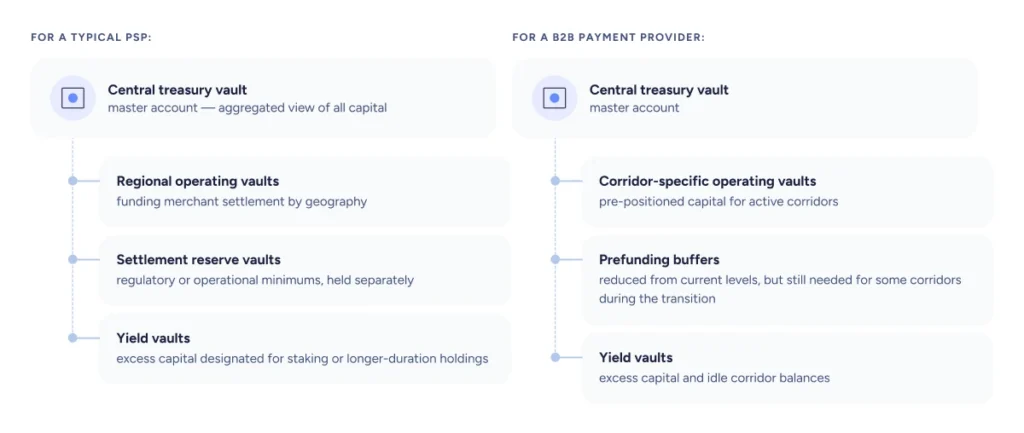
Each vault holds stablecoins independently while remaining under centralized oversight and control.
Build governance and controls. Establish who can approve workflows at what thresholds, what policy rules govern automated operations, and how exceptions get handled. Design it with the same rigor you apply to traditional banking controls:
- Define approval tiers: routine sweeps auto-execute, large rebalancing requires multi-signature approval, yield vault changes require senior treasury or CFO sign-off
- Set maximum exposure limits per corridor or currency
- Configure segregation of duties: separate roles for treasury operations, compliance oversight, and policy changes
- Build exception handling workflows for edge cases and manual overrides
Configure hot, warm, and cold wallet tiers based on your liquidity requirements. Hot wallets for active settlement and high-frequency operations. Warm wallets for intraday liquidity management. Cold wallets for longer-term reserves and regulatory capital. A single solution provides seamless sweeping between storage environments. Capital moves between tiers based on your policy rules, not manual intervention.
By encoding these business rules directly into the infrastructure, you ensure that treasury operations follow defined procedures automatically and that your governance posture for stablecoin operations matches (or exceeds) what you maintain for traditional banking.
Step 2: Configure Security & Governance
Before connecting to any external counterparty or moving capital across entities, you need to establish the security architecture and governance controls that every subsequent step will run through. This is not a configuration task you return to later. The policy engine, transaction controls, and checks you set up here are the operating layer that governs every treasury movement you’ll automate in the steps that follow.
Security architecture
MPC-CMP technology eliminates the single point of failure that defines traditional key management. Private key shares are never reconstructed in any single location. Instead, they’re held across distributed parties in Secure Enclaves (TEEs), so even if one component is compromised, funds cannot be accessed. For payment companies moving institutional capital, this isn’t a technical preference. It’s the foundation of your custodial risk posture.
Configure your key management model to match your operational structure:
- Distributed key shares across your organization, Fireblocks, and optional co-signing parties
- MPC signing that executes without exposing key material at any point in the transaction lifecycle
- Independent recovery options to ensure business continuity without creating centralized key exposure
The same MPC architecture that secures your treasury vaults applies uniformly across hot, warm, and cold wallet tiers. Security posture doesn’t degrade as transaction frequency increases.
Governance and policy engine
Encode your treasury governance directly into the transaction layer. Every fund movement from internal sweeps and corridor rebalancing, to yield vault deployment and external transfers, can be subject to programmatic rules that execute automatically and cannot be bypassed.
Define your approval tiers:
- Routine sweeps under defined thresholds auto-execute without manual sign-off
- Mid-range rebalancing movements require treasury manager approval via multi-signature workflow
- Large strategic movements and yield vault changes require senior treasury or CFO authorization
- Policy changes themselves require a separate elevated approval chain
Set transaction limits per vault, per corridor, and per currency. Configure segregation of duties so treasury operations, compliance oversight, and policy administration are held by distinct roles. Build exception handling for edge cases and manual overrides. Every policy rule is auditable and version-controlled.
The result: your governance posture for stablecoin operations matches or exceeds the controls you maintain for traditional banking relationships.
Step 3: Connect to Liquidity Infrastructure
The liquidity bridge. Stablecoins are digital, but your business still touches fiat at collection and settlement points. You need providers to convert local currency to stablecoins (on-ramp) and convert stablecoins back to local currency (off-ramp) in each market where you operate.
Onboard with one or more liquidity providers to establish the conversion flows that bridge your fiat and stablecoin operations. The goal is to connect once to a network that gives you access to multiple providers across multiple corridors, rather than building and maintaining dozens of point-to-point integrations.
Multi-provider access is critical, especially for B2B providers. Payment companies managing liquidity across multiple corridors cannot afford to be locked into a single liquidity provider. A single provider means you’re bound to their FX spreads, their corridor coverage gaps, their pricing power, and therefore a lack of liquidity depth (particularly for exotic currencies or corridors). Multi-provider access lets you route each conversion to the best-priced provider for that corridor at that moment, while optimizing for cost, speed, and reliability independently.
We were looking for the most secure MPC solution, which is why we chose Fireblocks. It was important for us to be able to do customized flows. The diversity of the Fireblocks ecosystem and ability to easily integrate with partners made it the best solution for us.
kirill gertman
CEO, Conduit
Set up your conversion flows:
- On-ramp: Convert fiat treasury balances to stablecoins. This is how your existing fiat settlement funds enter the stablecoin ecosystem.
- Off-ramp: Convert stablecoins back to fiat when needed for merchant settlements, partner payouts, or other fiat-denominated obligations.
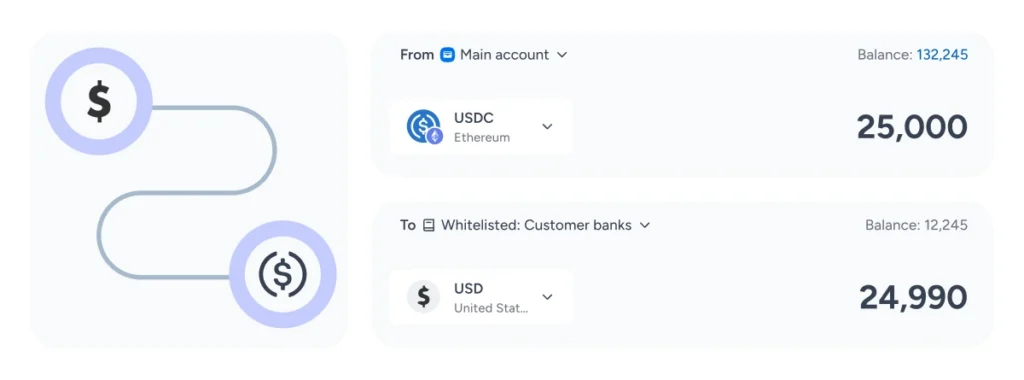
Establish multi-provider redundancy so that if one provider has downtime or unfavorable rates, your operations automatically route to another. This is the same resilience principle you apply to traditional banking relationships, just executed programmatically rather than through manual intervention.
Step 4: Embed Compliance Controls into Transactions
Compliance and transaction monitoring
Every transaction in your stablecoin treasury carries compliance obligations. AML/KYT checks, sanctions screening, Travel Rule data, and wallet verification requirements don’t disappear because funds are moving between your own entities. As you connect to external counterparties in Step 3, those obligations become more complex across jurisdictions.
Configure the following compliance controls at this stage:
- AML/KYT screening on all transactions via integrations with Chainalysis, Elliptic, or equivalent providers. Transactions are screened in real time against risk typologies and flagged for review before settlement.
- Sanctions screening on all counterparty addresses and entities, including OFAC, EU, and UN consolidated lists. Any transaction touching a flagged address is blocked automatically.
- Travel Rule compliance via integrations with Notabene, Sumsub, or GTR. For transactions above the applicable threshold, the required originator and beneficiary data travels with the transaction to meet FATF-aligned requirements across jurisdictions. This is particularly relevant for B2B providers managing cross-border flows in markets with active Travel Rule enforcement.
- Wallet verification on all external addresses before any transfer is initiated. Whitelisted address management ensures funds can only move to pre-approved destinations unless explicitly authorized through your exception workflow.
For PSPs: Configure compliance rules that enforce minimum unstaked reserves in line with your regulatory obligations. The governance layer should make it structurally impossible to inadvertently deploy capital required for regulatory purposes.
For B2B providers: Cross-border flows across multiple corridors mean multiple overlapping jurisdictions. Map your active corridors to their relevant regulatory frameworks now, and configure jurisdiction-specific compliance rules before you begin operational treasury movements in Step 5.
Step 5: Convert Treasury Operations to Stablecoins
With infrastructure and liquidity partners in place, you’re ready to shift your treasury operations from correspondent banking to stablecoin flows.
Hold balances in stablecoin vaults instead of traditional bank accounts. You don’t need to move everything at once. Start with one corridor or one operational flow, validate the economics and operational model, then expand.
Sweep excess liquidity from operating vaults to central treasury on an automated basis: hourly, daily, or on whatever frequency your business requires. When each sweep costs pennies instead of the $15-20 wire transfer fee that forces weekly batching in traditional treasury, you can optimize liquidity positioning far more aggressively.
Rebalance across corridors and regions based on actual demand. If your B2B provider sees a surge in LATAM corridor volume on a Monday morning, replenish that corridor from your central treasury in minutes. Configure corridor-specific rebalancing rules based on anticipated transaction volumes, for example auto-replenish based on prior-day or prior-week patterns, with override capability for unusual spikes.
Reduce prefunding. Because capital moves instantly between vaults, you need less pre-positioned across corridors and settlement accounts. The capital that used to cover the 2-3 day settlement lag can now cycle through multiple round-trips in a single day. This is where the compounding effect of stablecoin treasury becomes most visible: freed capital either goes to work generating yield, or it supports additional transaction volume without raising additional funds.
All internal transfers are onchain, instant, deterministic, and auditable. There’s no ambiguity about whether a transfer was sent, received, or still in transit. Every movement is confirmed in real time.
Test the flow end-to-end before deploying into production, and start realizing capital efficiency gains through continuous, automated treasury management.
As a stablecoin When looking for a company that provides the intersection of blockchain and payments expertise with an enterprise-grade platform, Fireblocks clearly comes out on top.
nabil manji
SVP & GM – Crypto & Web3, WorldPay
Step 6: Deploy Automations and Workflow Controls
Build a treasury operation that runs itself within defined parameters, responds instantly to changing liquidity needs, and provides complete visibility to your finance team.
Automated sweep configurations. Set rules for automated sweeps, defining thresholds and frequencies. For example:
- “Every hour, sweep any amount over $100,000 from regional operating vaults to central treasury”
- “Every day at 6pm UTC, rebalance all corridor vaults to maintain a minimum $50,000 float in each”
- “When a yield vault balance exceeds $500,000, auto-compound staking rewards to the operating vault”
These rules encode your treasury management strategy and execute automatically without human intervention. The same logic you apply to traditional cash management now executes in real time across your entire stablecoin infrastructure.
Rebalancing intelligence. While routine sweeps should be fully automated, larger strategic movements benefit from additional oversight. Configure approval workflows so that moving $1M from US treasury to European operations requires treasury manager approval, while $50K top-ups to a regional vault execute automatically. The approval workflows should match your existing treasury governance.
Automated conversions. Configure rules to convert between stablecoins or between stablecoin and fiat based on threshold triggers or scheduled rules. For example, auto-convert received fiat to stablecoin at optimal rates across your connected providers, or auto-convert stablecoin to local fiat when a corridor vault needs to settle in fiat with a legacy partner.
Operational dashboard. Monitor all positions through a real-time dashboard showing current stablecoin balances across every vault, recent transaction activity, automated sweep history, pending approvals, and any policy violations or unusual patterns. Your treasury team gains visibility into liquidity across your entire network with refresh rates measured in seconds, replacing the end-of-day batch reports and multi-portal spreadsheet exercises that define traditional treasury management.
Step 7: Enable Yield Generation
One of the most significant shifts stablecoins introduce to treasury management is the opportunity to generate yield on capital that has historically earned very little, if anything. Settlement float, prefunded corridor accounts, and reserve buffers are all balance sheet items that can now potentially produce revenue.
Create distinct structures for your funds so you can designate which vaults are eligible for yield generation. Typically, this means reserve capital and excess capital rather than active settlement floats or capital in transit. The separation between operating vaults and yield vaults is critical: you need to know exactly which capital is available for immediate settlement and which is deployed in yield-generating positions.
Access earning opportunities through DeFi lending integrations and choose opportunities that align with your assets and strategies. Institutional-grade lending and borrowing markets are increasingly accessible through platform integrations with leading protocols and strategy providers, enabling you to:
- Browse and select opportunities that align with your objectives and risk profile
- Initiate transactions and supply positions within the guardrails of policies and approval workflows
- Monitor positions and accrued yield in real time
- Withdraw partially or fully at any time, subject to protocol liquidity
Enable native staking on eligible digital assets and configure staking parameters that match your liquidity requirements:
- Set minimum balance thresholds — don’t stake below your operating floor
- Build lockup awareness into your rules — ensure staked funds can be unlocked in time to meet settlement obligations
- Configure auto-compound or automatic yield withdrawal to operating accounts based on your cash management strategy
For PSPs: Regulatory reserve requirements may limit which balances can be staked. Configure policy rules that enforce minimum unstaked reserves in compliance with your regulatory obligations. The governance layer should make it impossible to inadvertently stake capital that’s required for regulatory purposes.
For B2B providers: Corridor prefunding balances that historically sat idle in nostro accounts can now potentially generate yield. Even if that capital still needs to be pre-positioned in a particular region, it’s no longer dead money. The yield on corridor buffers becomes a direct offset to the cost of maintaining those buffers.
The net effect: treasury shifts from a pure cost center to a potential revenue contributor. The yield opportunities won’t replace your core business revenue, but they materially improve the economics of capital management.
Step 8: Reconciliation, Reporting, and ERP Integration
Finance and compliance teams often discover the reconciliation gap three months post-launch. Manual reconciliation, audit-unfriendly blockchain data, and disconnected reporting systems are the silent blockers of scale. Solving reconciliation from day one is what separates a pilot from a production system.
Automated treasury reconciliation in enterprise-grade formats that finance teams already use for traditional assets. Stablecoin treasury operations should produce the same reporting outputs as your existing bank accounts, not blockchain-native formats that require translation. This means MT94x and BAI2 reconciliation reports that integrate directly into your existing finance workflows.
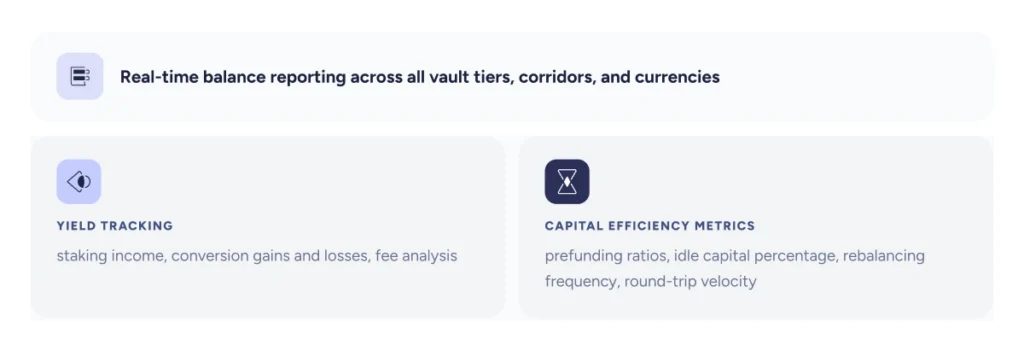
ERP integration. Push treasury data directly into your accounting and financial planning systems. Automated journal entries for internal transfers, conversions, and yield events eliminate the manual matching that consumes treasury operations bandwidth.
For B2B providers managing multi-corridor operations, treasury data flowing into ERP is particularly critical for corridor-level P&L reporting, client billing reconciliation, and the financial visibility that CFOs and boards require.
Audit-ready reporting. Every treasury movement is recorded onchain with a complete, immutable record. This makes audit preparation significantly simpler than traditional correspondent banking, where you’re matching records across multiple institutions with different systems, different timing, and different data formats. Onchain records provide a single source of truth for every movement of capital across your treasury.
What You’ve Built
By following the steps in this blueprint, you’ve optimized your treasury operations to be automated, programmable, and ready for global scale.
Capital that previously sat idle across bank accounts, nostro accounts, and reserve buffers now moves instantly between vaults, generates yield when dormant, and rebalances automatically based on demand — all with full visibility, compliance controls, and audit-ready ERP integration.
Your treasury team shifts from executing manual wire transfers and reconciling batch settlements to monitoring automated flows, optimizing policy rules, and managing exceptions. The infrastructure handles routine operations; your team focuses on strategy and optimization.
Once you’ve done that, you’re ready to build stablecoin pay-in, payout, and merchant settlement flows on top of this infrastructure. The same wallet architecture, policy engine, compliance stack, liquidity connections, and reconciliation layer extend to every use case with zero replatforming required. You build once, and you scale across use cases, geographies, and asset types from the same foundation.
We are leading the next era of money movement by enabling money to move instantly across any channel – fiat or stablecoin. Fireblocks accelerates this vision by giving us the secure, programmable infrastructure to transform global payments at scale.
anthony soohoo
Chairman and CEO, MoneyGram
Summary: Requirements for Stablecoin Treasury Operations
Implementing stablecoin treasury operations for payment companies requires institutional-grade infrastructure that meets the security, compliance, and operational requirements of regulated financial services.
Flexible treasury management system. Structure wallets and stablecoin vaults to mirror your existing business operations. Whether you need separate accounts for regional entities, segregated vaults for different corridors, or hierarchical treasury structures with multiple approval layers, payment companies require a platform that adapts to your organizational structure.
Operational simplicity at scale. As your stablecoin treasury grows from a pilot corridor to company-wide infrastructure, you need a platform that scales without requiring fundamental architectural changes. The same security model, policy engine, and operational workflows that manage thousands of dollars in a pilot should work identically when managing millions in production. You build once and scale confidently.
Automated reconciliation and reporting. Enterprise-grade reconciliation in formats your finance team already works with such as MT94x, BAI2, ERP integrations, and audit-ready reporting. Because all stablecoin transactions are recorded onchain with complete auditability, reconciliation becomes significantly simpler than traditional correspondent banking. This is what keeps your finance and compliance teams from becoming the bottleneck on stablecoin adoption.
Embedded compliance. Compliance built directly into the transaction layer, translating requirements across markets into a unified framework. Every transaction carries the necessary AML/KYT and sanctions checks, beneficiary data, and wallet verifications, with Travel Rule compliance handled through integrations with providers like Notabene, Elliptic, and Chainalysis. Payment companies can expand into new jurisdictions while maintaining a consistent standard of security, transparency, and regulatory readiness.
Security architecture for institutional scale. For payment companies handling customer funds and processing billions in transaction volume, enterprise-grade security is non-negotiable. MPC-based key management eliminates single points of failure. Hot, warm, and cold wallet configurations match your liquidity and security requirements. Multi-layered defense with proactive threat detection protects funds while maintaining the throughput your business demands.
Pre-configured ecosystem connectivity. Immediate access to vetted liquidity providers, on/off-ramp partners, and payment counterparties removes the need to build custom integrations for each relationship. A neutral, provider-agnostic network that connects you to 2,400+ counterparties across 60+ currencies and 100+ countries, with multi-provider access per corridor and no single-provider lock-in, accelerates deployment and reduces ongoing technical maintenance. New corridors or partnerships can be activated in days rather than months of integration work.
Access to institutional DeFi. Native access to onchain lending to potentially earn yield by supplying stablecoin balances to lend-borrow markets and managed strategies. Institutions need a platform with robust security, governance, and policy controls that integrates directly with DeFi lending protocols, while accessing these opportunities within an environment they’re already familiar with.
A complete platform, not a point solution. Treasury optimization is the foundational use case, but it’s not the destination. Payment companies start with one use case but have multi-year roadmaps spanning payouts, pay-ins, merchant settlement, embedded wallets, and new financial products. You need a platform that scales with your ambition across use cases, geographies, and asset types without replatforming as you grow. Start with treasury. Expand to pay-ins, pay-outs, merchant settlement and user accounts. One platform, one integration, multi-year roadmap.
Who’s Already Moving
See how payment companies are using stablecoin treasury infrastructure today:
Worldpay, the world’s largest payment processor, built and launched stablecoin operations in weeks. Full visibility throughout the payment settlement lifecycle was a key driver. Treasury teams can now track capital across the entire flow in real time, replacing the fragmented, multi-portal view that defined traditional operations.
Conduit, a B2B cross-border payments platform serving businesses across Latin America and Africa, chose Fireblocks over building treasury infrastructure in-house. The ability to tap into a network of liquidity providers and trading partners — many of whom were already on the platform — freed 100% more liquidity in one month and enabled new corridor expansion without new vendor integrations.
Triple-A, a global payments processor, uses Fireblocks’ secure wallet infrastructure. They have been able to streamline operational costs and workflows, enter new markets, and enhance regulatory compliance all through a single platform.
By following the steps laid out in this blueprint, you’ve transformed your internal treasury operations and created the technical foundation to extend stablecoin infrastructure to customer-facing payment flows in the next phases of implementation.