


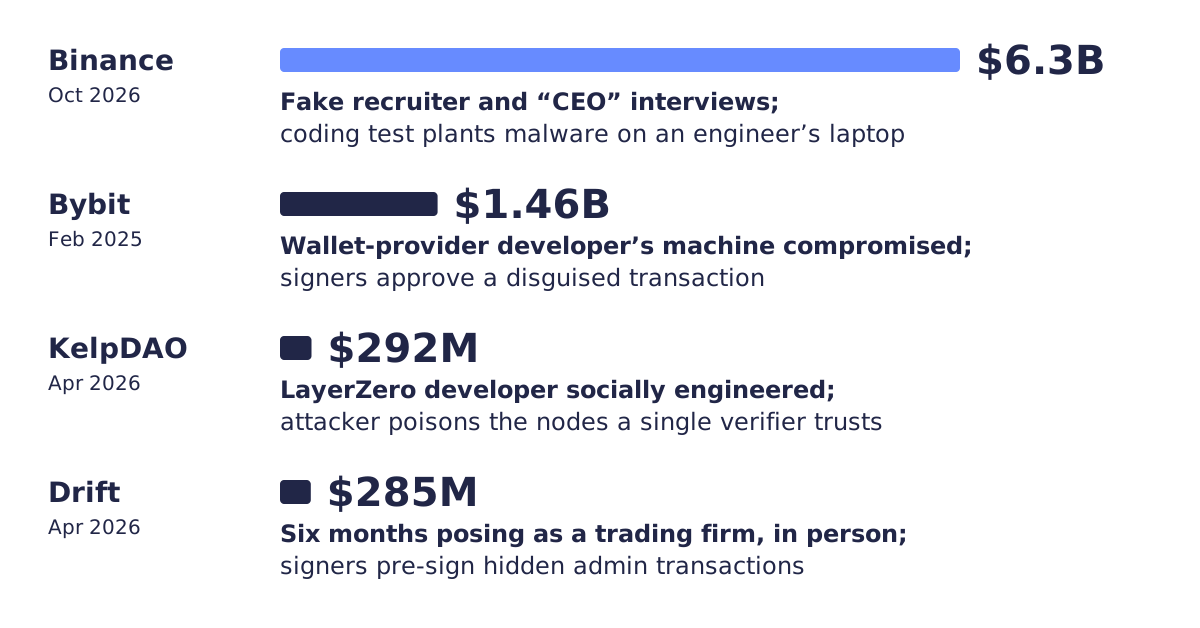
In the Binance hack on October 29, 2026, North Korean attackers moved $6.36B out of Binance wallets on ten blockchains, most of it in roughly 20 minutes. Binance reports that no private key was stolen, yet the attackers obtained valid signatures. They spent five months compromising the engineers behind Binance’s wallet signing service.
Nation-state operations typically start with people and can take that long to play out. Bybit, Drift and KelpDAO, three earlier North Korea-linked thefts that took $2B between them, each began with a human compromise via phishing and social engineering. Any institution that holds or moves assets faces similar entry points and planning. The test is whether an independent control still stops the transfer when any single entry point is compromised.
Four lessons follow.
Lesson 1: Design Your Onchain Security Architecture Against A Nation-State Adversary
In onchain finance, North Korea (DPRK) is the reference adversary. 60% of 2025’s stolen crypto is attributed to North Korean actors, and 2026 is on track for a significant increase. However, North Korea hits smaller targets too: Fireblocks Security Research finds many of its attacks aimed at smaller platforms for single-digit millions or less.
These are long-running operations, not opportunistic attacks. Preparation runs from weeks to months. Binance’s own report calls its case a multi-stage campaign, not a single breach or a simple phishing incident, and the first foothold came in June, five months before the theft. Drift, a decentralized perpetual futures exchange on Solana, lost $285M on April 1, 2026 after attackers spent about six months building trust in person. At Bybit, a centralized exchange that lost $1.46B in February 2025, about two weeks passed between the compromise of a developer at its wallet provider, Safe{Wallet}, and the theft.
What should you assume when defending digital assets against a state-backed attacker? Assume phishing, software vulnerabilities and infrastructure compromise are all possible, and all exploitable at the same time. An employee could open the wrong file. A dependency or node could be compromised. A cloud session could be hijacked. A design that depends on any one of those holding has a single point of failure.
Lesson 2: Attackers Get In Through People
This is how sophisticated actors operate in every industry: they find the weakest link. And it is usually a person. AI acts as a force multiplier, enabling convincing impersonations, deepfakes and new attack tools. Every major DPRK theft since Bybit has involved phishing, social engineering or human error.
Binance’s defenses were working. It caught the June compromise (a tampered Homebrew install of an AI coding tool), replaced the device and rotated credentials. In 2026 it detected and prevented 57 suspected North Korea-linked cases, fraudulent job interviews among them.
Even so, the June catch left the attackers knowing the team: the engineer’s role and his colleagues on the wallet infrastructure team were exposed. With the team mapped, they returned in September with a fake job interview, the technique Binance had caught repeatedly. The 0-day malware it delivered to an engineer’s work computer went undetected by endpoint security. The attacker needed one success, and a defender can’t win every time counting on detection.
How do you mitigate the human element in onchain security? You have a defense-in-depth framework with zero trust, so the compromise of a single component should not by itself enable unauthorized access to funds.
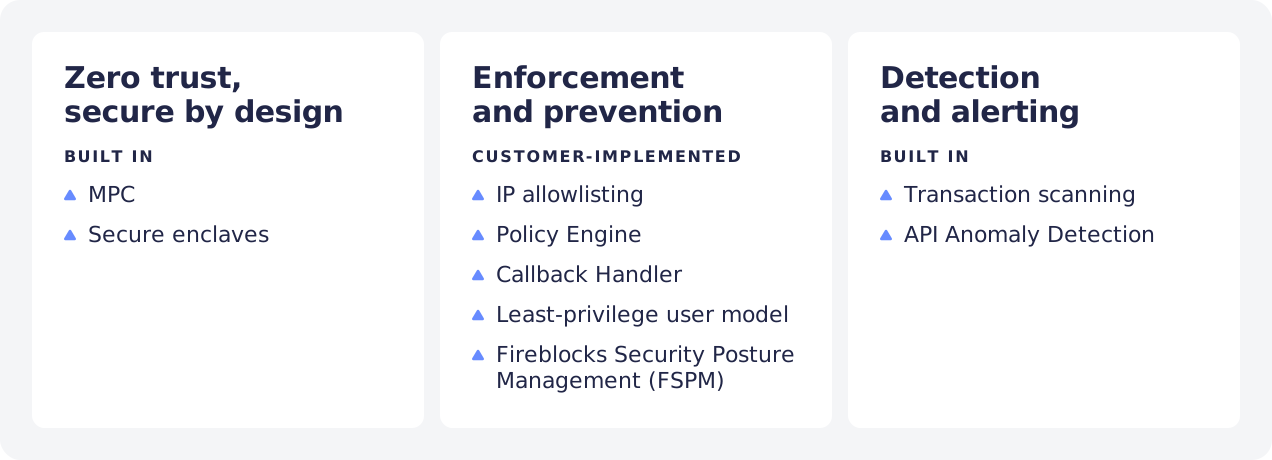
MPC and secure enclaves separate access from authority. Reaching a laptop, a container or an internal tool does not put a whole key, or the power to sign, within reach. No single person, device or credential can move funds on its own. Detection can miss; this layer does not depend on catching the intrusion. This is the first Fireblocks layer: zero trust, secure by design:
Lesson 3: Onchain Access Must Never Equal Authorization
In the Binance example, the core failure was a route to the signer that skipped the checks. Binance says the attacker used access to an internal wallet signing service to initiate transactions outside the normal withdrawal process. Binance also says that route submitted 50 signing transactions to manipulate the account nonce and set up EIP-7702 delegations. The attacker used Ethereum’s EIP-7702 standard to set a new authorization, not to compromise an existing EIP-7702 contract. An authorization is a signed message that assigns a contract’s code to an externally owned account (EOA), so that code runs whenever the wallet is called. This one delegated a primary hot wallet address (Binance 14) to a malicious contract.
Any operation you don’t block is an operation the attacker can use. In the Binance attack, a container deployment token on an engineer’s computer let the attacker deploy a container and launch the attack. The most secure configuration allows only what the business uses, and blocks everything else by default.
How do you enforce least privilege across onchain operations? You write the rules that block every operation your business does not use, and Fireblocks enforces them on every transaction. Apply least privilege to every control: user roles, API permissions, policies and transaction types.
At Fireblocks:
- The Policy Engine sets rules per transaction type, so raw signing and delegations stay blocked unless a workflow needs them.
- The Callback Handler lets your own system approve or reject each transaction, independently of where it came from.
- IP allowlisting and a least-privilege user model limit what a stolen token can reach.
- Fireblocks Security Posture Management (FSPM) checks continuously for configuration drift, so least privilege holds over time.
Lesson 4: Attacks Now Run At Machine Speed, So Detection Must Too
Ten chains were drained in about 20 minutes in the Binance hack. The laundering that followed was automated and ran across thousands of wallets and multiple chains at a scale not seen before. Fireblocks Security Research has seen attackers hand the whole flow to an agentic tool once an API key is stolen, at a speed and volume no team can triage by hand. Assume nation-state attackers have access to the same tools. Once funds reach finality there is rarely a way back.
Fast coordination still worked. Binance suspended withdrawals and worked with partners to freeze affected tokens, and as of November 3 it reports about $2.85B frozen or intercepted, around 45% of the amount affected. Yet as of November 10, about $3.1B was still with the attacker, spread across nearly 20,000 addresses on 14 chains, each a possible route onto any platform that accepts deposits. Freezing is one half of the response. Blocking deposits from those addresses is the other.
How do you respond when an attack moves faster than a team can? Decide the response before the incident: what gets blocked automatically, who gets called, and which partners can freeze funds. Detection is what triggers that plan with the Fireblocks platform:
- Transaction scanning checks each transaction before it is signed.
- API Anomaly Detection gives always-on protection against API key compromise. Intelligence-driven and behavioral detections alert on abnormal user activity.
Defending Onchain Finance Against Nation-State Attackers
Binance showed what a nation-state operation looks like: months of preparation, a person as the way in, access that reached the signing service, and funds gone faster than any team could triage. Each of them can be designed against.
Fireblocks was founded by cybersecurity veterans who spent years defending critical nation-state infrastructure, and our defense-in-depth framework assumes that no single security control is unbreakable. Our Whitepaper walks through every layer: zero-trust architecture, MPC-based distributed wallet infrastructure, multi-device approval, the Policy Engine, a secure operations environment, and transaction scanning and threat detection. Fireblocks Security Posture Management checks that the configuration holds, including with AI-powered attack simulations, and alerts on abnormal activity. Each threat vector the Whitepaper maps faces at least three independent layers, and most face four or more.
You can find more resources covering security within the Fireblocks content hub.