

Digital assets are already part of how value moves through the financial system. Stablecoins, tokenized deposits, and blockchain-based settlement are entering client flows today. At the same time, fintechs and crypto-native firms are capturing payment activity, custody relationships, and liquidity flows that have traditionally sat inside banks.
For banks, this is now an infrastructure decision. Competing on digital rails requires secure, compliant wallet and custody capabilities that integrate with existing risk, governance, and reporting frameworks. Institutions that cannot support these services risk losing wallet share and operational control, even when the underlying financial relationship remains intact.
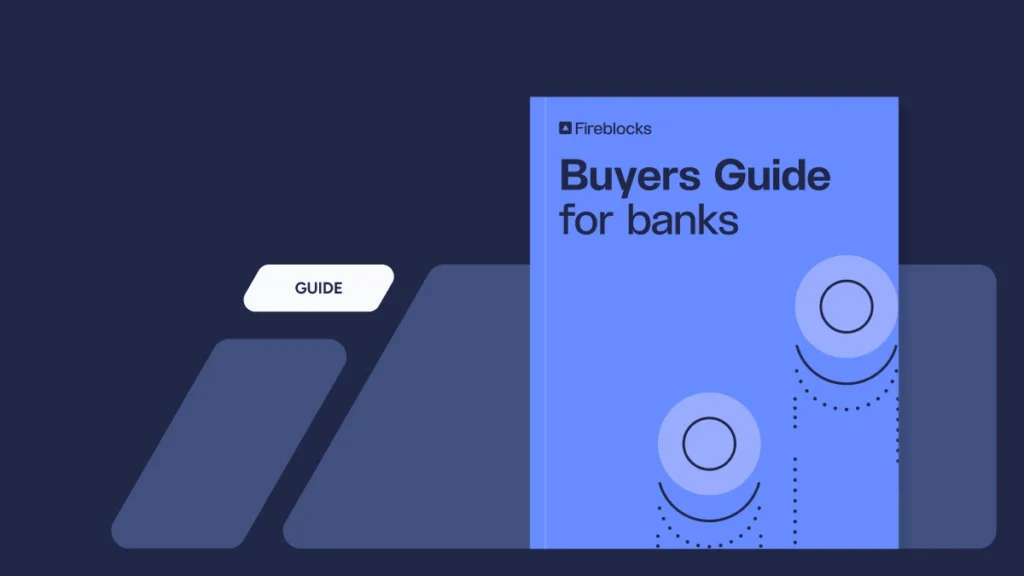
This Buyer’s Guide is for banks that have already decided to enter digital assets and are now evaluating infrastructure partners. It provides a practical framework for assessing digital asset infrastructure in regulated banking environments, with a focus on control, scalability, and long-term relevance.
Where Fireblocks Excels for Banks
Banks do not enter digital assets through a single path. Some begin with custody services. Others start with trading and brokerage, stablecoin payments, or tokenized deposits. The entry point varies by strategy, client demand, and regulatory context.
What does not vary is the infrastructure required to support these services. Each use case depends on the same wallet and custody foundation to enforce security, governance, compliance, and transaction control.
Digital Asset Use Cases for Banks
Banks are entering digital assets through a range of production use cases, depending on client demand, business model, and regulatory context. The most common include:
- Client-facing digital asset custody and asset servicing, supporting safekeeping, collateral management, and staking
- Trading and brokerage services, enabling agency execution, liquidity access, and instant settlement
- Stablecoin banking and payments, including cross-border settlement and internal treasury transfers
- Token lifecycle management, covering the issuance, management, and servicing of tokenized deposits, securities, and real-world assets
The Digital Asset Control Layer
In digital asset environments, control is implemented at the wallet layer. This is where assets are secured, transactions are approved, and policies are enforced. Wallet infrastructure connects blockchains to a bank’s existing risk, digital asset compliance, treasury, and reporting systems.
Custody is not a standalone product or back-office function. It is the control model applied within the wallet infrastructure, defining how authority over assets is exercised, how transaction intent is validated, and how operational and supervisory risks are managed.
Fireblocks for Banks
Fireblocks gives banks the infrastructure foundation to launch and scale digital asset services within regulated environments:
- Institutional wallet infrastructure designed for treasury, institutional, and client-facing use cases, supporting business-controlled and user-controlled models on a single platform
- MPC-CMP custody technology that eliminates single points of failure while preserving transaction-intent integrity and segregation of duties
- Programmable policy engine with role-based access, approval workflows, and transaction limits aligned with internal bank controls and audit requirements
- Built-in support for AML, Travel Rule, transaction monitoring, auditability, and jurisdictional compliance requirements
- Direct connectivity to blockchains, counterparties, exchanges, liquidity providers, and tokenization partners through a single integration layer
- Cloud, hybrid, and on-prem deployment options that allow banks to scale from pilot to production without replatforming
- Integration with existing reconciliation, reporting, risk, and compliance systems rather than operating as a parallel stack
Key Criteria for Institutional-Grade Digital Asset Infrastructure
Selecting a technology partner requires balancing institutional control with speed to market. The following framework reflects common RFP criteria used by banks when evaluating digital asset infrastructure.
| Category | What to Evaluate | Why It Matters | Proof Points & Evidence |
| Security Architecture | MPC-based key management, hardware-backed isolation, transaction-intent integrity, policy enforcement, secure SDLC, penetration testing, cryptographic audits, DR/BCP | Eliminates single points of failure, ensures approved actions execute exactly as intended, and provides auditable evidence of security controls that meet regulatory standards | Third-party penetration test reports, cryptographic audit results, documented DR/BCP plan with test evidence, secure SDLC documentation, SOC 2 Type II and ISO 27001 certifications |
| Wallet Infrastructure | Business-controlled wallet models; end-user controlled (embedded) wallets; segregated vs. omnibus structures; tested key recovery workflows; immutable audit logs; treasury automation | Foundational control layer for all digital asset operations with proven disaster recovery and flexibility to support multiple custody and business models | Account setup demonstrations across dev/staging/production, documented recovery procedures, API and webhook automation demonstrations, exportable audit logs |
| Custody Model & Policy | Treasury self-custody, client direct custody, and qualified custody options; approval workflows and policy engine; role-based governance; alignment with trading, payments, and tokenization use cases; HSM integration via Key Link for institutions with existing key management infrastructure | Defines operational boundaries, determines what the bank controls directly, establishes governance that scales with business growth | Maker-checker workflow demonstration, policy configuration templates, governance matrix documentation, role assignment examples |
| Compliance Controls | Real-time transaction monitoring; sanctions and AML screening (Chainalysis, Elliptic); whitelisting, blacklisting, geofencing; Travel Rule coverage; regulatory reporting and audit trail export | Ensures continuous regulatory compliance, ties all activity to legal entities and users, supports audit and regulatory examination | Integration evidence with Chainalysis, Elliptic, Notabene; transaction monitoring dashboard; sample export formats; regulatory reporting workflow documentation |
| Governance & Operational Oversight | Segregation of duties; role-based access control; maker-checker workflows; onboarding/offboarding procedures; incident detection, escalation, and response; exportable audit trails | Minimizes insider threats and human error, meets regulatory expectations for internal controls, provides complete audit trail for supervisory oversight | Role assignment matrix, onboarding/offboarding workflow documentation, incident response procedures, audit log export samples |
| Architecture Flexibility & Future Proofing | Multi-use-case support on a single foundation; expansion without replatforming; adaptation to DORA, MiCA, GENIUS Act; SaaS, private cloud, on-prem, and hybrid deployment options | Prevents architectural dead ends, ensures the platform remains compliant as regulations evolve, supports deployment models that meet internal control requirements | Modular design documentation, regulatory update policy and process, cloud provider compliance mapping, deployment model options and migration paths |
| Connectivity & Network Access | Public and permissioned blockchain support; regulated counterparty connectivity; direct integrations with exchanges, OTC desks, and liquidity venues; extensibility to tokenization partners and payment networks | Allows banks to move value across chains and partners without fragmented integrations while maintaining appropriate risk controls | Blockchain and network support list, integration documentation, venue and partner onboarding procedures, API coverage documentation, vendor risk management framework |
| Integration & Support | Onboarding and migration support; REST API coverage; 24/7/365 institutional support; professional services and customer success; sandbox and test environment access | Reduces operational risk during deployment, enables faster time to production, ensures ongoing institutional-grade support as the bank scales | Integration checklist and timeline, API documentation and sandbox access, onboarding SLA commitments, support ticket response metrics, professional services scope |
| Scalability & Performance | High-volume transaction processing; treasury workflow automation; 24/7/365 uptime; use case expansion without re-architecture; auto-scaling; latency and throughput SLAs | Ensures reliability as digital asset activity scales across clients, assets, and use cases without compromising operational stability | Performance benchmark results, scalability test documentation, uptime and latency SLA commitments, production incident and resolution statistics |
Why Fireblocks: Core Value, Positioning & Differentiators for Financial Institutions
Fireblocks is the core banking standard for digital assets, enabling banks to operate custody, trading, payments, and tokenization services within regulated financial environments. The platform combines wallet infrastructure, governance controls, network connectivity, and compliance tooling to support digital asset activity across existing banking systems, risk frameworks, and reporting processes.
Core Capabilities
- MPC-Based Custody Technology: Eliminates single points of failure through MPC-CMP distributed key management while preserving transaction-intent integrity and segregation of duties.
- Key Link: Integrate existing HSM-based key management solutions into the Fireblocks platform via zero-knowledge proof verification, enabling full access to Fireblocks’ wallet capabilities, governance controls, and compliance tooling without disrupting current infrastructure.
- Institutional Wallet Infrastructure: Secure Vaults and Accounts designed for treasury, institutional, and client-facing use cases, supporting business-controlled and user-controlled models on a single platform.
- Hot, Warm & Cold Wallets: A single solution for hot, warm, and cold MPC wallets for seamless sweeping between storage environments based on security requirements.
- Policy Engine & Governance Controls: Programmable transaction authorization, role-based access, approval workflows, and limits aligned with internal bank controls and audit requirements.
- Unified API & Orchestration Layer: Automate treasury operations, trading flows, and transaction workflows with purpose-built APIs and webhooks.
- Fireblocks Network: Direct connectivity to 2,500+ institutions, blockchains, counterparties, exchanges, liquidity providers, and tokenization partners through a single integration layer.
- Regulatory-Ready Controls: Built-in support for AML, Travel Rule, transaction monitoring, auditability, and jurisdictional compliance requirements.
- Architecture Flexibility & Future-Proofing: Cloud, hybrid, and on-prem deployment options that allow banks to scale from pilot to production without replatforming.
The Fireblocks Value Proposition
Fireblocks provides the operating foundation banks use to launch and scale digital asset services while maintaining institutional standards. The platform enables banks to:
- Retain control over digital asset operations and customer relationships
- Launch multiple digital asset use cases on a single, shared foundation
- Operate continuously while enforcing bank-grade governance and controls
- Integrate digital asset activity into existing financial and reporting systems
- Expand into new services without repeating architecture or policy decisions
Where Fireblocks Excels in Institutional-Grade Infrastructure
| Feature Category | Fireblocks | Third-Party Custody Models | In-House Build |
| Custody Technology Architecture | ✅ MPC-CMP with transaction-intent integrity | ⚠️ Indirect control, sub-custody model | ⚠️ Complex, unproven at scale |
| Governance & Policy Controls | ✅ Native policy engine with programmable rules | ⚠️ Limited flexibility, vendor-defined | ❌ Custom build required |
| Transaction-Intent Integrity | ✅ Cryptographically enforced | ⚠️ Depends on custody provider | ❌ Must be built from scratch |
| Regulatory Compliance Integration | ✅ Built-in AML, Travel Rule, transaction monitoring | ⚠️ Fragmented, requires multiple vendors | ❌ Each integration built separately |
| Policy Engine Flexibility | ✅ Bank configures rules for all use cases | ⚠️ Constrained by provider’s model | ⚠️ Requires ongoing development resources |
| Multi-Use Case Support | ✅ Custody, trading, payments, tokenization on one platform | ❌ Single use case or requires multiple vendors | ⚠️ Must build separately for each |
| Network & Ecosystem Access | ✅ Direct access to 2,500+ institutions and venues | ❌ Limited to provider’s relationships | ❌ Must build each integration |
| Deployment Flexibility | ✅ SaaS, private cloud, on-prem, hybrid | ❌ Provider-determined deployment only | ⚠️ Full infrastructure responsibility |
| Proven Bank References | ✅ 100+ banks, including BNY, Banking Circle, Revolut | ⚠️ Limited regulated bank adoption | ❌ No external validation |
| Time to Production | Weeks | Months | Years |
Why Leading Financial Institutions Trust Fireblocks
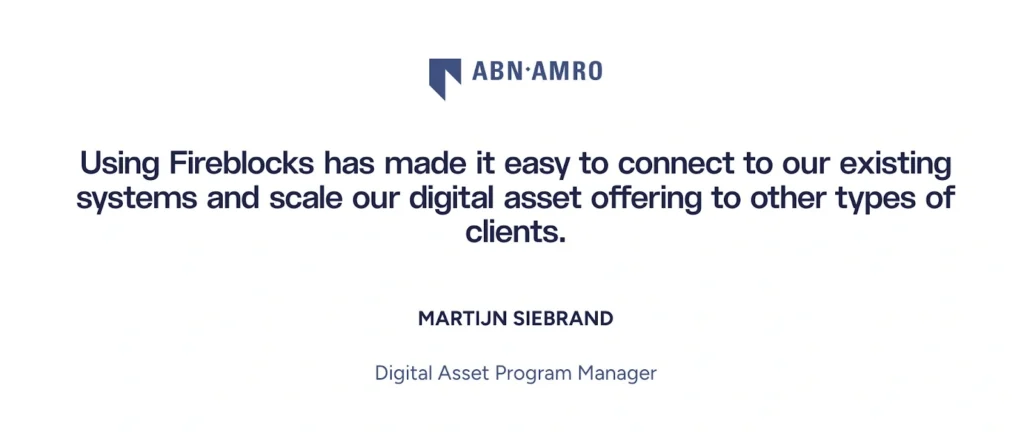
Banks adopt digital asset infrastructure when it meets the same standards as core banking systems: security, control, scalability, and operational resilience. Fireblocks is the world’s most trusted digital asset infrastructure company, serving over 100 banks and 2500+ organizations globally.
Institutions trust Fireblocks to secure more than $16 trillion in digital asset transactions across 200+ blockchains, including BNY, Banking Circle, and Revolut. Fireblocks supports the largest ecosystem of banks, payment providers, stablecoin issuers, exchanges, and custodians operating onchain today.
Banks and financial institutions use Fireblocks to:
- Operate institutional-grade wallet infrastructure under bank-controlled governance models
- Support custody, trading, stablecoin banking, and tokenization services within regulated environments
- Integrate digital asset activity into existing risk, compliance, and reporting frameworks
- Scale from initial deployments to broader digital asset strategies without replatforming
From Evaluation to Implementation: How Institutions Can Engage with Fireblocks
Evaluating digital asset infrastructure is only valuable if it leads to confident execution. Fireblocks supports banks through the evaluation and deployment process with resources designed for regulated financial environments.
Banks working with Fireblocks have access to:
- Structured platform demonstrations tailored to banking use cases, governance models, and internal stakeholder requirements
- Technical documentation and architectural guidance to support IT, security, and risk reviews
- Sandbox and test environments to validate workflows, controls, and integrations before production
- Implementation support aligned with bank operating models, approval processes, and regulatory expectations
Ready to evaluate infrastructure for your bank? Schedule a structured platform demonstration or explore our sandbox environment. Talk to an Expert and subscribe to Banking on Blockchain.