

In the Financial Grid 2026 survey, nearly 150 corporates told us where their digital asset build stands. On the measure that matters most to transaction banks, corporates are ahead.
And corporates have named what they need, who decides it, and what they measure a partner against.
What Corporates Need Is A Digital Asset Service From Their Banks
When asked what would most accelerate their adoption of digital assets over the next 12 to 24 months, corporates named three factors well ahead of the rest.
70% cited reliable on- and off-ramps to fiat currency and liquidity. A corporate treasury holding digital assets still has to fund payroll, settle supplier payments, and meet margin calls in fiat. Without dependable conversion at institutional volume, every digital asset position carries liquidity risk Treasury cannot plan around.
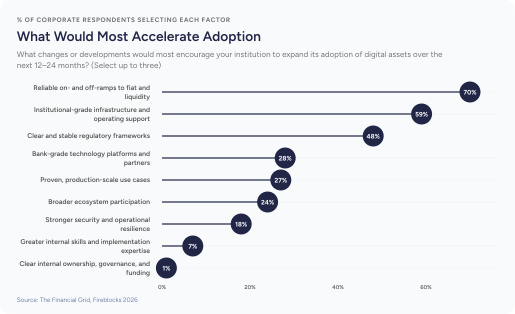
59% cited institutional-grade infrastructure and operating support. Moving digital assets at production volume requires 24/7 monitoring, key management, and operational controls that meet the same bar as core banking infrastructure. Building that internally is a multi-year investment most corporates are not equipped to make on their own balance sheet. Renting it from an institution that has already built it is the faster path to production.
Clear and stable regulatory frameworks came third, cited by 48%. For a corporate treasury moving institutional volumes, an unlicensed provider is exposed capital with no clear point of recourse if something breaks. A licensed, audited institution carries that recourse built in, for fiat and digital assets both.
Fiat access and institutional infrastructure are the direct ask. Regulatory certainty is why that ask has to land with a bank specifically.
The language corporates use to describe what they need is, in itself, a brief for banks.
Budget Is Already Committed On Both Sides
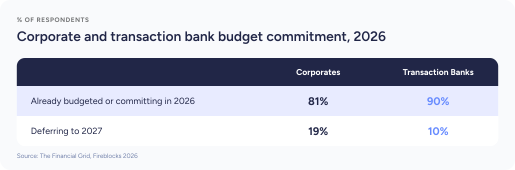
81% of corporates are already funded or committing budget to digital asset infrastructure this year. Transaction banks report a close figure: 90%. Both sides have the budget in place. Neither side is far along in spending it.
Corporates are responding to the same forces pushing their banking partners: the shift to 24/7 settlement infrastructure, cross-border payment rails that work at any hour, and the growing reality that counterparties and clients on the other side of transactions are themselves building digital asset capability.
The payoff is concrete: less capital sitting locked in transit, more round trips on the same capital, and reach into customers and suppliers only reachable on these rails.
The build is self-reinforcing. The more institutions that commit, the higher the cost of not committing.
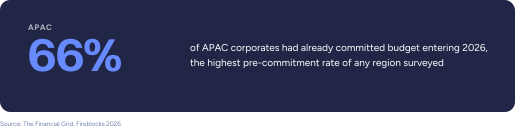
Commitment timing varies by region, though the destination is the same everywhere.
APAC moved earliest, the only region where a majority had a budget in place before the year began. Europe and the UK are moving slowest, with the highest deferral rate of any region.
The regional spread likely reflects different operational starting points: where cross-border payment friction is highest, the corporate build may have started earliest.
Corporates And Banks Are Building The Same System, From Opposite Ends
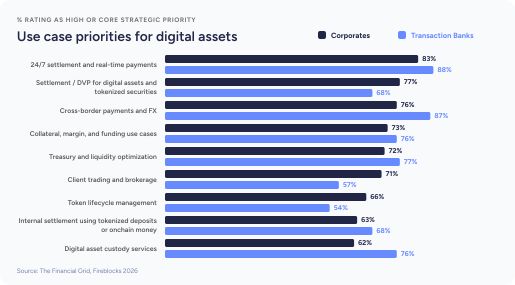
Across nine use cases surveyed, corporate and transaction bank priorities are closely aligned at the top. 24/7 settlement and real-time payments leads for both, and cross-border payments and FX follows closely for both cohorts.
The shape of what corporates want to build matches what their banking partners are building toward. This is what corporates have always needed from their banks: moving money between their own entities, across borders.
What’s changing is the rail they want it done on, faster than correspondent banking allows. A growing number of banks are building tokenized deposits to serve exactly that demand, mobilizing their own liability on infrastructure that runs continuously.
Corporates And Banks Are Building The Same System, From Opposite Ends
Corporates and transaction banks agree on the top use cases. Below them, priorities split.
Corporates rank higher on the use cases that put their own treasury balances to work: settlement and DVP on assets they already hold, and token lifecycle management for tokenized commercial paper and treasury notes they issue themselves. This is capital already on the balance sheet, being put to a new use.
Transaction banks prioritize the infrastructure layer underneath those use cases: custody, payments rails, liquidity. Both are building toward the same system, from different directions, not at cross purposes.
The use cases are set. The build is already in motion.
The survey asked respondents to assess their adoption across two dimensions: as users of digital assets issued by others, and as issuers putting their own digital instruments into circulation. The two tell different stories.
On the user dimension, corporates and transaction banks are converging at almost exactly the same pace. Roughly 1 in 6 of both cohorts is already in production as users. The pipeline behind both is active: nearly a quarter of corporates are in external pilots and a further 30% in internal pilots. Transaction banks are slightly further along: 35% in external pilots, 32% in internal pilots.
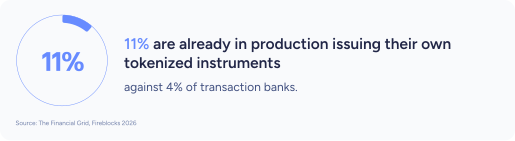
As issuers, corporates are ahead. 11% of corporates are in production, tokenizing their own commercial paper and treasury instruments, versus 4% of transaction banks. For a corporate, issuance is an operational decision: the regulatory perimeter is contained and the business case is direct. For a transaction bank, issuance means putting tokenized deposits or stablecoins onto a balance sheet under regulatory scrutiny.
The determining question is whether the instrument is comfortable on the balance sheet: how it’s treated for capital and accounting purposes, and what it means for credit exposure, liquidity, and legal certainty. None of these are unanswerable, and they are being resolved instrument by instrument and jurisdiction by jurisdiction.
The Checklist Each Bank Has To Clear Is Already Written
Corporates have a clear checklist for evaluating their banking partner. Custody and wallet governance leads, followed by compliance and regulatory alignment, security architecture, and reputation and long-term financial viability.
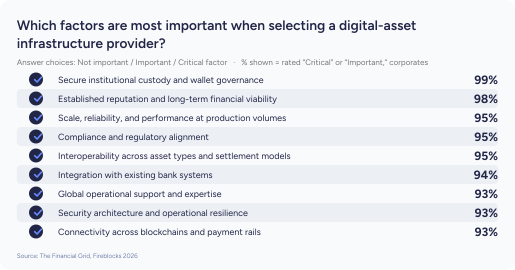
Across every criterion, the combined critical and important rating is between 93% and 99%. The decision-maker in the room is not weighing one capability against another. They are measuring whether their banking partner can hold the full infrastructure stack together as their digital asset build scales.
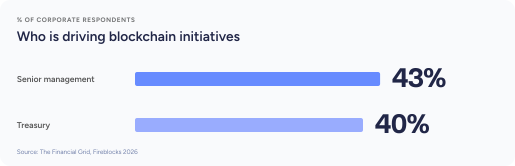
When corporates describe who is driving their blockchain initiatives, the answer sits at the top of the organization. Senior management leads at 43%. Treasury follows at 40%. The economic buyer and the operational owner are already aligned on the same initiatives.
Fiat access, institutional-grade infrastructure, and a licensed and audited counterparty: everything corporates say they need is already built into being a bank. Their senior management and treasury are driving the decision internally. The checklist they are measuring their financial partner against is already set. Corporates have budgeted for their digital asset investments. It’s now up to the banks to be as ready as their clients are.
Fireblocks works with over 100 banks building that infrastructure today, securing more than $16 trillion in digital asset transactions across every major market. The corporates on the other side of that relationship are already funded, already evaluating, and already ahead on their own build. The banks closing that gap are the ones ready to serve them.
Download the Financial Grid Corporates pdf report here.
Read More From The Financial Grid
Read the Flagship Financial Grid 2026 global report for insights into the responses we got from hundreds of financial institutions around the globe about their digital asset adoption.
Additional regional data and insights are available here: